
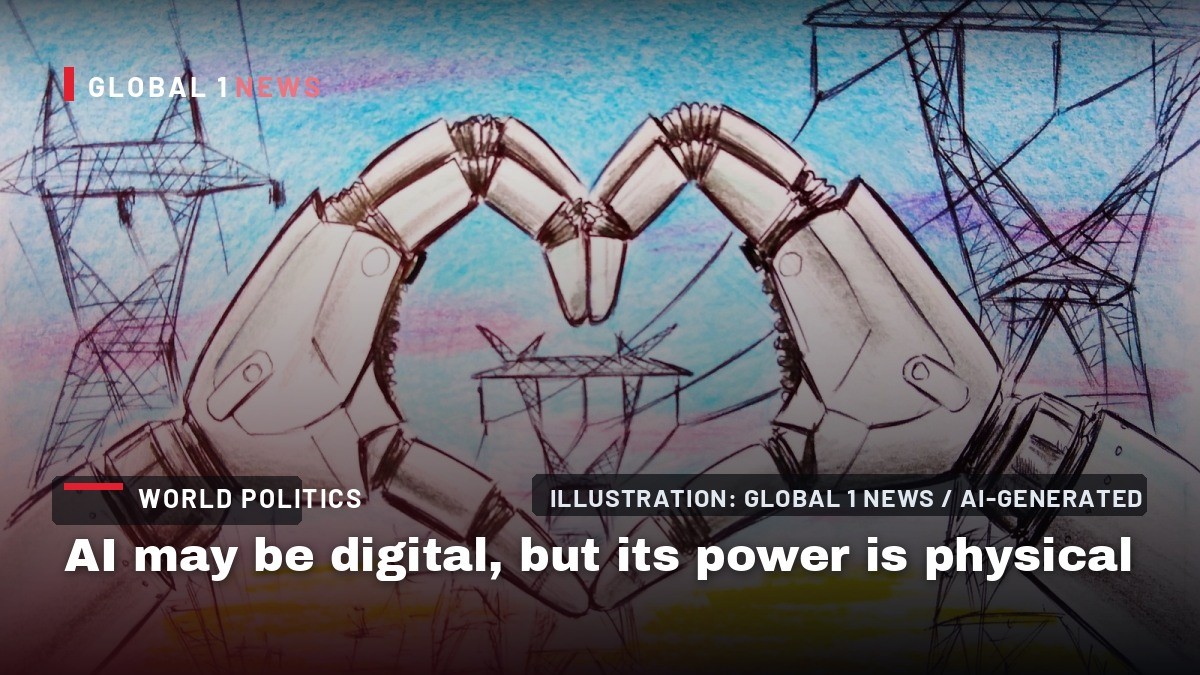
AI may be digital, but its power is physical
As the world grapples with the twin pressures of a rapidly expanding digital economy and an increasingly volatile energy landscape, the physical underpinnings of artificial intelligence have moved from the periphery to the centre of strategic calculations.
As the world grapples with the twin pressures of a rapidly expanding digital economy and an increasingly volatile energy landscape, the physical underpinnings of artificial intelligence have moved from the periphery to the centre of strategic calculations. The International Energy Agency’s latest figures show that data centres alone consumed 415 terawatt‑hours of electricity in 2024 – roughly 1.5 % of global demand – and this load is projected to double by 2030, soon eclipsing the total electricity consumption of Japan. In the United States, the surge in data‑centre power use will account for almost half of the nation’s electricity‑demand growth through the end of the decade, outstripping the combined appetite of all traditional energy‑intensive industries. This convergence of digital ambition and physical constraint reshapes the geography of the AI race, making power‑grid capacity a decisive factor in geopolitical competition.
The Energy Stack Behind AI
The AI ecosystem rests on a layered stack that begins with raw energy sources and culminates in end‑user applications. While public discourse typically highlights chips, models, data, capital and talent, the IEA data makes clear that electricity is the missing link that binds the whole structure. Without reliable power, even the most advanced processors remain inert. The stack can be visualised as follows: primary energy generation, transmission and distribution infrastructure, on‑site power conversion, cooling systems, data‑centre facilities, computing hardware, AI models and finally the services they enable. Each tier is dependent on the robustness of the one below it, meaning that vulnerabilities in the grid translate directly into limits on AI capability.
In practice, the bottleneck manifests as a queue for grid connections. A new data centre can secure land and procure billions of dollars’ worth of processors, yet it cannot perform a single computation until it is linked to the grid. Authorities must assess whether the additional load threatens grid stability, plan upgrades to transmission lines and transformers, and issue the necessary permits. In many jurisdictions, this permitting process moves at a glacial pace, turning the speed of power‑line deployment into the decisive metric for AI expansion, overtaking even the price of electricity itself.
The Illusion of Capacity on Paper
Analyses of U.S. grid‑connection queues reveal a stark disparity between nominal capacity and usable, reliable capacity. More than 1,000 gigawatts of new power‑plant projects are slated for connection before 2030, but a substantial share will either never be completed or will simply replace retiring facilities. Moreover, the intermittent nature of wind and solar generation means that installed capacity does not equate to dependable output. When these adjustments are applied, only about 33 gigawatts of reliable capacity from the one‑thousand‑gigawatt pool can be expected to reach the grid by 2030. Including on‑site generation – where data‑centre operators install their own power plants – raises the total to roughly 82 gigawatts.
This gap between paper‑based abundance and on‑the‑ground scarcity underscores that the real constraint is not ideas or talent, but the physical queue for power. An AI model can be conceived in days, yet the transmission line required to run it may take years, effectively throttling the speed of digital innovation.
Regional Strategies: The United States and China
The United States enjoys a clear advantage in frontier AI models, advanced chip design and deep capital markets, but it suffers from lengthy grid‑connection times that can extend to seven years in some regions. Orders for critical components such as transformers and gas turbines also face multi‑year backlogs, further slowing deployment.
China, by contrast, has turned infrastructure mobilisation into a strategic lever. While the United States accounts for roughly 45 % of global data‑centre capacity, China holds about 25 %. Beijing’s latest five‑year plan earmarks computing infrastructure as a priority, pairing high‑demand eastern regions with renewable generation in the west. The Chinese model seeks to absorb excess renewable output that the grid cannot otherwise dispatch; in the first half of 2026, around 9 % of solar and wind generation could not be integrated, highlighting persistent bottlenecks in pricing, market design and transmission. Nonetheless, the Chinese approach can shave six to sixteen months off the construction timeline for a new AI data centre compared with the United States, thanks to more streamlined permitting and faster grid connections.
The Gulf Model: Energy Abundance Meets Digital Ambition
Gulf states are pursuing a third strategic model that leverages abundant hydrocarbon wealth and emerging nuclear capacity to fund computing infrastructure directly. The United Arab Emirates, for example, has already commissioned 5.6 gigawatts of capacity through its first civilian nuclear programme and aims to scale data‑centre capacity to the gigawatt level. By converting surplus energy into digital assets, these states hope to translate traditional geopolitical influence into a new form of technological leverage.
However, the Gulf model faces its own physical challenges. Extreme ambient temperatures drive cooling demands to exceed 40 % of total data‑centre electricity consumption, eroding the advantage of cheap energy. Moreover, access to advanced semiconductor technology remains uncertain under the United States’ chip‑diffusion restrictions, prompting the UAE to diversify through overseas data‑centre partnerships as a hedge against supply‑chain vulnerabilities.
Europe’s Quest for Digital Sovereignty Amid Energy Volatility
Europe’s fourth model centres on achieving digital sovereignty through domestic computing capacity, cloud autonomy and indigenous chip production. The continent’s energy layer, however, has undergone the most dramatic disruption in recent years. Since the war in Ukraine, liquefied natural gas (LNG) has largely supplanted Russian pipeline gas, shifting Europe’s reliance from a single pipeline to the volatility of a global spot market and, increasingly, to U.S. LNG exports.
This transition has amplified exposure to price swings and supply uncertainty, complicating the continent’s ambition to secure stable electricity for data centres. While Europe is investing heavily in renewable generation, the same integration challenges that affect China – namely, the inability to fully absorb intermittent solar and wind output – persist, limiting the reliability of the power supply needed for AI workloads.
Implications for Geopolitical Power and Technological Sovereignty
The emerging reality is that AI’s strategic value is inseparable from the physical infrastructure that powers it. Nations that can align energy policy, grid investment and digital strategy will command a decisive edge in the AI race. The United States, despite its leadership in chips and capital, must confront protracted grid‑connection queues if it wishes to maintain its dominance. China’s coordinated renewable‑to‑compute approach offers speed but still wrestles with integration bottlenecks. Gulf states can convert energy wealth into digital influence, yet cooling costs and chip access remain limiting factors. Europe’s drive for digital autonomy is hampered by a volatile energy import mix and the lingering challenge of integrating renewable generation.
In a world where the next breakthrough in AI could hinge on the availability of a reliable megawatt, the physical dimension of power infrastructure becomes a strategic asset on par with silicon and data. Policymakers across the Middle East, Europe and the United States will need to weigh the trade‑offs between accelerating grid upgrades, diversifying energy sources and safeguarding supply chains for critical hardware. The balance they strike will shape not only the pace of AI development but also the broader contours of geopolitical power in the coming decade.
This article was produced with AI-assisted research and editorial support. Reporting is based on the source material cited below. Sources: Daily Sabah Middle East; dailysabah.com; Global1.News (18 September 2026).
By Malik Hassan, Staff Writer
What's Your Reaction?
 Like
0
Like
0
 Dislike
0
Dislike
0
 Love
0
Love
0
 Funny
0
Funny
0
 Wow
0
Wow
0
 Sad
0
Sad
0
 Angry
0
Angry
0

Middle East Correspondent at Global1.News. Based in Beirut, covering politics, conflict, energy, and society across the Middle East. Brings context and depth to a region often reduced to headlines.












Comments (0)