
African Stars Shine at 2026 Met Gala as Costume Art Theme Takes Center Stage
The 2026 Met Gala transformed New York's Metropolitan Museum of Art into a living gallery of wearable art on Monday night, as celebrities and fashion's elite embraced the "Costume Art" theme with looks that blurred the line between clothing and canvas.
The 2026 Met Gala transformed New York's Metropolitan Museum of Art into a living gallery of wearable art on Monday night, as celebrities and fashion's elite embraced the "Costume Art" theme with looks that blurred the line between clothing and canvas. Beyoncé's triumphant return after a decade away, alongside a powerful contingent of African music stars and designers, made this year's edition a landmark moment for the continent's growing influence on the world's most famous red carpet.
Stars Turn Fashion into Art at 2026 Met Gala as African Talent Shines on Global Stage
New York City — The Metropolitan Museum of Art's grand steps became a runway of living sculpture on May 4, 2026, as the annual Costume Institute Benefit unfolded under the theme "Costume Art" with a dress code of "Fashion is Art." Hosted by co-chairs Beyoncé, Nicole Kidman, Venus Williams, and Anna Wintour, the evening treated the dressed body as a canvas — and perhaps no group embraced that concept more vividly than the African stars and designers who made their presence felt from the red carpet to the after-parties.
Beyoncé's Bejeweled Homecoming
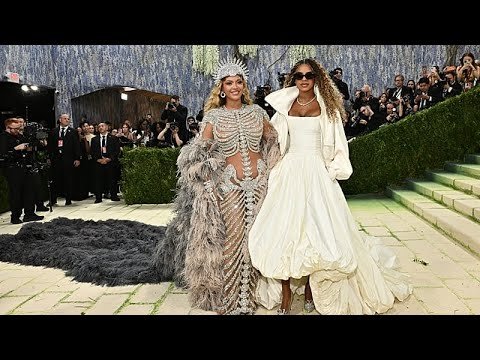
Beyoncé's return to the Met Gala after nearly a decade was the evening's defining moment. The global icon arrived on the arm of her daughter Blue Ivy Carter, marking a generational mother-daughter moment that captivated fashion observers worldwide. Beyoncé wore a custom bejeweled skeletal couture gown by Olivier Rousteing — the designer of Ethiopian heritage who previously made history as the first Black creative director of a major Parisian house at Balmain.
The gown, inspired by 16th-century bejeweled relics of holy catacomb saints, featured a crystal-dripped skeleton motif that sparkled under the flashbulbs. An ombré feather train cascaded behind her, adding movement and drama to a look that the Washington Post would later crown as belonging to the "Queen of the Met Gala." Blue Ivy complemented her mother in a custom white Balenciaga puff dress, holding her own on one of fashion's most intimidating red carpets.
Beyoncé accessorized with a Chopard necklace from the "Garden of Kalahari" collection — a deliberate choice that spotlighted Botswana's diamond heritage and Southern African gemstones. The jewelry house's Kalahari collection, named after the vast desert spanning Botswana, South Africa, and Namibia, brought African natural resources into the conversation of luxury and craftsmanship.
For a star who commands the biggest stages on the planet, this Met Gala return carried particular significance. Beyoncé had not attended fashion's biggest night since 2014, and her absence had been noted in industry circles year after year. Her return as a co-chair alongside Nicole Kidman, Venus Williams, and Anna Wintour signaled not just a personal milestone but a recognition of the cultural weight the Met Gala now carries as a global pop culture event.
The Washington Post, Vanity Fair, and Vogue all led their coverage with Beyoncé's look, cementing it as the defining image of the 2026 Met Gala. For African audiences watching from Dakar to Johannesburg, the presence of a Black woman at the helm of fashion's biggest night, adorned in diamonds from the Kalahari and dressed by a designer of Ethiopian heritage, sent a powerful message about the continent's place at the center of global luxury.

African Music Stars Take the Red Carpet
While Beyoncé commanded the spotlight, an unprecedented contingent of African music stars ensured the continent's cultural footprint was felt across the entire red carpet. South Africa's Tyla, Nigeria's Tems, Ayra Starr, Asake, Rema, and Omah Lay all walked the Met steps, representing a critical mass of African pop talent that had never before been assembled at fashion's biggest night.
Tyla, the South African singer who has become a global phenomenon with her amapiano-infused pop, wore a custom Valentino look that blended high fashion with African sensibility. Her appearance generated significant buzz on social media, with Vogue naming her among the best-dressed African celebrities of the night. The moment represented a breakthrough for South African pop culture on the global fashion stage — a path paved by her chart-topping success and distinctive sense of style.
Ayra Starr brought Nigerian heritage to the red carpet with Yoruba-inspired body paint integrated into her ensemble. The singer, known for her bold fashion choices and genre-defying music, used the Met Gala as a canvas for cultural storytelling. Her look was widely praised for its innovative fusion of traditional elements with contemporary haute couture, embodying the "Fashion is Art" theme through a distinctly African lens.
Tems, Asake, Rema, and Omah Lay completed the Nigerian contingent, each bringing their own interpretation of the evening's theme. The sheer density of African representation led Pulse Nigeria to declare the event the "African Met Gala" — a tongue-in-cheek recognition that the continent's music stars had collectively claimed the red carpet as their own. For a night celebrating costume and art, the presence of so many African artists elevated the conversation beyond Western fashion into a genuinely global celebration.
The visible unity of these artists — spanning South Africa and Nigeria, Afrobeats and amapiano, established stars and rising talents — told a story about African pop culture's growing confidence. These were not token appearances. They were a declaration that African music and fashion belong at fashion's most exclusive table.
African Designers Making Their Mark
Beyond the music stars walking the carpet, African designers and models made their own powerful statements. Toyin Lawani, the Nigerian designer behind Tiannah's Place Empire, unveiled a dramatic sculptural outfit tailored to the "Costume Art" theme. The avant-garde creation, described by Nigerian fashion commentators as quintessentially bold and creative, demonstrated that African design can hold its own against the biggest European luxury houses on fashion's grandest stage.
Perhaps the most significant breakthrough of the night belonged to Laduma Ngxokolo's MaXhosa by Laduma. The South African brand, known for its vibrant Xhosa-inspired geometric knitwear and indigenous patterns, achieved its first Met Gala moment — a milestone for African heritage fashion on the international circuit. South African media erupted with pride, celebrating MaXhosa's appearance as a validation of the country's rich textile traditions and contemporary design innovation.
South Sudanese model Anok Yai delivered one of the most talked-about looks of the evening. Walking the carpet in a dramatic Balenciaga gown described as evoking "Black Madonna" energy, Yai combined a black hooded silhouette with gold tear-like accents and bronze tones that commanded attention. As one of the most successful African models on the international runway, her Met Gala appearance reinforced the growing visibility of African beauty standards in global fashion.
These moments did not happen in isolation. They built on years of groundwork by African designers like Kenneth Ize, whose bold aso-oke textiles have gained international recognition, and Thebe Magugu, the South African LVMH Prize winner who blends cultural narratives with contemporary luxury. Cameroonian designer Imane Ayissi has been showing at Paris Haute Couture Week, while Senegal's Tongoro — founded by Sarah Diouf and previously worn by Beyoncé — continues to champion African craftsmanship. The 2026 Met Gala was a culmination of this momentum, proof that the conversation about African fashion has moved beyond potential to presence.
The Costume Art Theme in Full Display
The "Costume Art" theme — with its accompanying "Fashion is Art" dress code — invited attendees to treat their bodies as living canvases, and the red carpet delivered accordingly. Robert Wun emerged as the most-dressed designer of the evening, with seven attendees wearing his creations including Naomi Osaka and BLACKPINK's Lisa. The Hong Kong-based designer's sculptural approach aligned perfectly with the theme's emphasis on the body as an artistic medium.
Christian Dior Couture created notable looks for BLACKPINK's Jisoo and Sabrina Carpenter, with one of Carpenter's gowns reportedly incorporating vintage film strips into its construction — a literal interpretation of art meeting fashion. Saint Laurent dressed Rosé, Hailey Bieber, and Madonna, while Prada and Schiaparelli rounded out the top tier of luxury houses dominating the carpet.
The range of artistic interpretation was extraordinary. Some attendees embraced maximalist floral and romantic silhouettes, while others pushed into avant-garde territory with skeletal structures, sculptural headpieces, and architectural forms. The evening's aesthetic ranged from museum-worthy elegance to deliberately provocative statements, all united by the understanding that fashion, at its highest level, is a form of artistic expression.
Jeff Bezos and Lauren Sánchez Bezos served as lead sponsors and honorary co-chairs — a presence that generated some controversy and debate about the commercialization of the event. Yet the artistic ambition of the red carpet remained the dominant story, with the "Costume Art" exhibition at the Costume Institute providing the intellectual foundation for an evening that celebrated fashion as a serious art form on par with painting, sculpture, and performance.
What African Fashion's Met Gala Moment Means
The 2026 Met Gala signals a genuine shift in how global fashion perceives Africa. For years, African designers have been relegated to the margins of the international fashion conversation — celebrated during Africa-focused events but absent from the mainstream calendar. The red carpet at the Met Gala changed that equation. When Tyla, Ayra Starr, and Anok Yai walk the same steps as Nicole Kidman and Madonna, the message is clear: African talent has arrived at fashion's center stage.
This visibility translates into real economic opportunity. The global luxury fashion market is valued at hundreds of billions of dollars, and African designers have historically captured only a fraction of that spend. Events like the Met Gala — covered by Vogue, Vanity Fair, the Washington Post, and every major fashion publication — introduce African brands to buyers, editors, and consumers who may never have encountered them. The ripple effects extend from Lagos Fashion Week to Dakar's growing fashion scene, from Johannesburg runways to Accra's design studios.
Senegal, with its rich textile traditions and emerging fashion industry, stands to benefit from this momentum. Dakar Fashion Week has been gaining international attention, and Senegalese designers like those behind Tongoro are proving that African craftsmanship can compete at the highest level. The 2026 Met Gala's celebration of artistic expression through fashion validates what African designers have been doing for generations — transforming heritage textiles, traditional techniques, and cultural narratives into contemporary wearable art.
The presence of Olivier Rousteing — the French designer of Ethiopian heritage — at the center of the evening's most iconic look adds another layer to the story. The African diaspora's influence on global fashion has been profound, from Rousteing's tenure at Balmain to the countless African and Afro-descended designers shaping trends worldwide. The Met Gala brought this full circle, celebrating African creativity in all its forms — from the continent itself to its global diaspora.
The Road Ahead for African Fashion
The 2026 Met Gala is not an endpoint but a milestone in a longer journey. African designers are increasingly visible at the highest levels of fashion — Kenneth Ize showing at Paris Fashion Week, Thebe Magugu winning the LVMH Prize, Imane Ayissi presenting at Paris Haute Couture Week, and South Africa's MaXhosa now claiming its Met Gala moment. The infrastructure for African luxury fashion is being built, piece by piece, designer by designer.
What made this Met Gala different was not just the presence of African talent but the confidence with which it presented itself. The African music stars who walked the carpet were not guests at someone else's party — they were stars in their own right, commanding attention and setting trends. The designers whose work appeared on the red carpet were not curiosities but serious creative forces. The models who owned the spotlight were not exceptions but representatives of a continent rich with beauty and talent.
For young African creatives watching from Lagos, Dakar, Nairobi, and Johannesburg, the message is unmistakable: the global stage is accessible. The path from a design studio in Abidjan to the Met Gala red carpet exists, and it is being walked. The challenge now is to build the infrastructure — the manufacturing capacity, the retail networks, the investment capital — that can sustain this momentum and turn visibility into lasting economic transformation.
What to Watch For
As the fashion world catches its breath after the 2026 Met Gala, several developments bear watching. African fashion weeks — Lagos, Dakar, Johannesburg, Accra — will likely see increased international attendance as buyers and editors seek to discover the next generation of talent. The major luxury conglomerates may accelerate their efforts to identify and acquire African design talent, following the pattern established in other emerging fashion markets.
The "Costume Art" exhibition at the Costume Institute will run through the summer, drawing visitors from around the world. The Met Gala's fundraising for the institute exceeded expectations, ensuring that fashion as art will continue to receive scholarly and curatorial attention. For African designers, the exhibition's emphasis on the dressed body as a canvas validates the artistic sophistication of textile traditions that have existed on the continent for centuries.
Perhaps the most important legacy of the 2026 Met Gala is the message it sends to young Africans with dreams of fashion. The red carpet at the Metropolitan Museum of Art has never been more African. The co-chair was Beyoncé. The most iconic look was created by a designer of Ethiopian heritage. The brightest emerging stars came from South Africa and Nigeria. The diamonds on the most photographed necklace came from the Kalahari. This is not a moment of inclusion but of arrival — and the fashion world will not soon forget it.
The road ahead is long, and the economic transformation of African fashion will require sustained investment, infrastructure development, and institutional support. But on a Monday night in May, on the steps of one of the world's greatest museums, African fashion showed the world what it can do. The message was received.
By Amara Diop, Staff Writer
This article was produced with AI-assisted research and editorial support. Reporting is based on sources cited in the article.
What's Your Reaction?
 Like
0
Like
0
 Dislike
0
Dislike
0
 Love
0
Love
0
 Funny
0
Funny
0
 Wow
0
Wow
0
 Sad
0
Sad
0
 Angry
0
Angry
0

West Africa/Sahel Correspondent at Global1.News. Dakar-based journalist covering politics, security, climate, and development across Francophone and Anglophone West Africa. Tells the stories of a region undergoing profound transformation.














Comments (0)