
74% of Americans Back Israel's Right to Exist, but Young Voters Are Split
In a recent i24NEWS English report examining what new US voters think about Israel's right to exist, a fresh Harvard CAPS/Harris poll finds 74% of Americans still back Israel as the homeland of the Jewish people — but among voters aged 18 to 24 that consensus collapses to roughly half, a generational divide with major implications for the US-Israel alliance.
In a recent i24NEWS English report examining what new US voters think about Israel's right to exist, fresh polling data has landed in Jerusalem with a stark warning for Israeli policymakers: the generation that will soon inherit the American electorate is fundamentally divided over the Jewish state's legitimacy, and the gap is no longer a fringe phenomenon but a measurable political reality.
74% of Americans Back Israel's Right to Exist, but Young Voters Are Split
Jerusalem - September 2026 - The numbers from the latest Harvard CAPS/Harris Poll, fielded August 28-30 among 2,100 registered US voters with a margin of error of plus or minus 2.1 percentage points, offer a portrait of an American public that remains broadly pro-Israel but is fracturing along generational lines in ways that Israeli officials in the Prime Minister's Office and the Foreign Ministry in Jerusalem are watching with increasing concern. The poll, released in the first week of September, found that 74% of Americans agree Israel "has a right to exist as the homeland of the Jewish people." Yet among voters aged 18 to 24, that consensus collapses to roughly half agreeing and half disagreeing—a statistical chasm that has profound implications for the future of US-Israel relations as this cohort becomes the dominant voting bloc in American democracy.
The Generational Divide: A Statistical Warning from the Harvard CAPS/Harris Data
The August Harvard CAPS/Harris Poll, conducted by the Harvard Center for American Political Studies in partnership with the Harris Poll, reveals that the overall pro-Israel majority masks a deeply troubling trend for Israeli public diplomacy. When asked which side they support in the Israel-Hamas conflict, 70% of all voters said they support Israel more, with only 30% siding with Hamas. Republicans showed overwhelming support at 84%-16%, independents backed Israel 68%-32%, and Democrats, while still pro-Israel, registered a narrower 57%-43% split. But the generational breakdown tells a different story entirely: among voters aged 18-24, 54% said they support Hamas more, with only 46% supporting Israel. This inversion among young Americans is not an anomaly but a pattern that has been building for years, and it directly contradicts the assumption that American support for Israel is a permanent, bipartisan fixture of the political landscape.
For Israeli officials accustomed to relying on strong bipartisan backing in Washington, these numbers represent a strategic challenge. The data suggests that as older, more pro-Israel generations age out of the electorate, they are being replaced by younger voters whose primary exposure to the Israeli-Palestinian conflict comes not from traditional news outlets but from social media platforms like TikTok, Instagram, Reddit, and X—platforms where anti-Israel narratives often go unchallenged. The Harvard CAPS/Harris findings align with the Yale Youth Poll, an undergraduate-led research group that surveyed 3,429 registered US voters with an oversampling of those under 35. That poll found that 15% of voters under 30 said Israel should not exist at all, and fewer than three in ten under-30s said Israel should exist as a Jewish state, compared to 64% of voters aged 65 and older. The contrast could not be starker, and it underscores the urgency of the messaging challenge facing Israeli advocacy organizations and their American Jewish partners.
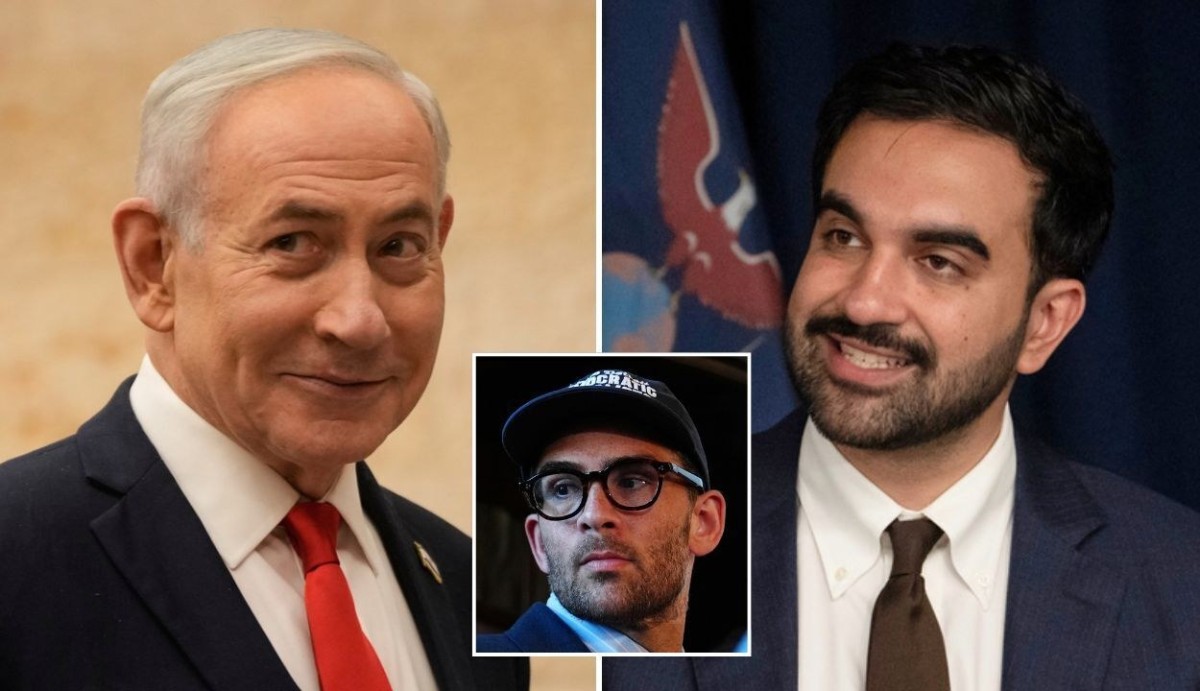
Hasan Piker and Candace Owens: The Unlikely Faces of America's Israel Debate
The Harvard CAPS/Harris Poll also probed American attitudes toward two controversial political figures who have become lightning rods in the Israel discourse, and the results reveal a public that is largely repelled by extreme rhetoric even as that rhetoric finds purchase among young audiences. Respondents were asked whether the Democratic Party should "embrace or reject people like Hasan Piker who have said things like America deserved 9/11." The results were decisive: 77% overall said reject, including 79% of Republicans, 72% of Democrats, and 80% of independents. Only 23% said embrace. Piker, a left-wing Twitch streamer with a massive young audience, has become increasingly involved in progressive Democratic politics and has a documented history of inflammatory statements about Israel. As reported by The Algemeiner, Piker has accused Israel of "genocide" against Palestinians, called Orthodox Jews "inbred," compared Israel to Nazi Germany, and praised Hamas and Hezbollah as "resistance" forces. Sen. Jon Ossoff (D-GA) previously called Piker's rhetoric "reckless and dangerous," though Piker has denied antisemitism, arguing he was warning about rising antisemitism and that political leaders deliberately conflate criticism of Israel with anti-Jewish hatred.
On the Republican side, the poll asked whether the GOP should "embrace or reject people like Candace Owens who have said things like the Jews are behind everything." The response was similarly lopsided: 75% overall said reject, with 73% of Republicans, 76% of Democrats, and 76% of independents agreeing. Owens, a conservative commentator and podcaster, has faced criticism from lawmakers and Jewish organizations over statements and conspiracy theories concerning Jews and Israel. The fact that majorities across the political spectrum reject both figures suggests that the American public, at least in the aggregate, retains a basic discomfort with overt antisemitism and extreme anti-Israel rhetoric. Yet the persistence of these voices in the digital ecosystem, particularly among young consumers of political content, means that Israeli public diplomacy cannot afford to ignore the platforms where these narratives thrive.
What the Poll Numbers Mean for Israeli Policymakers in Jerusalem
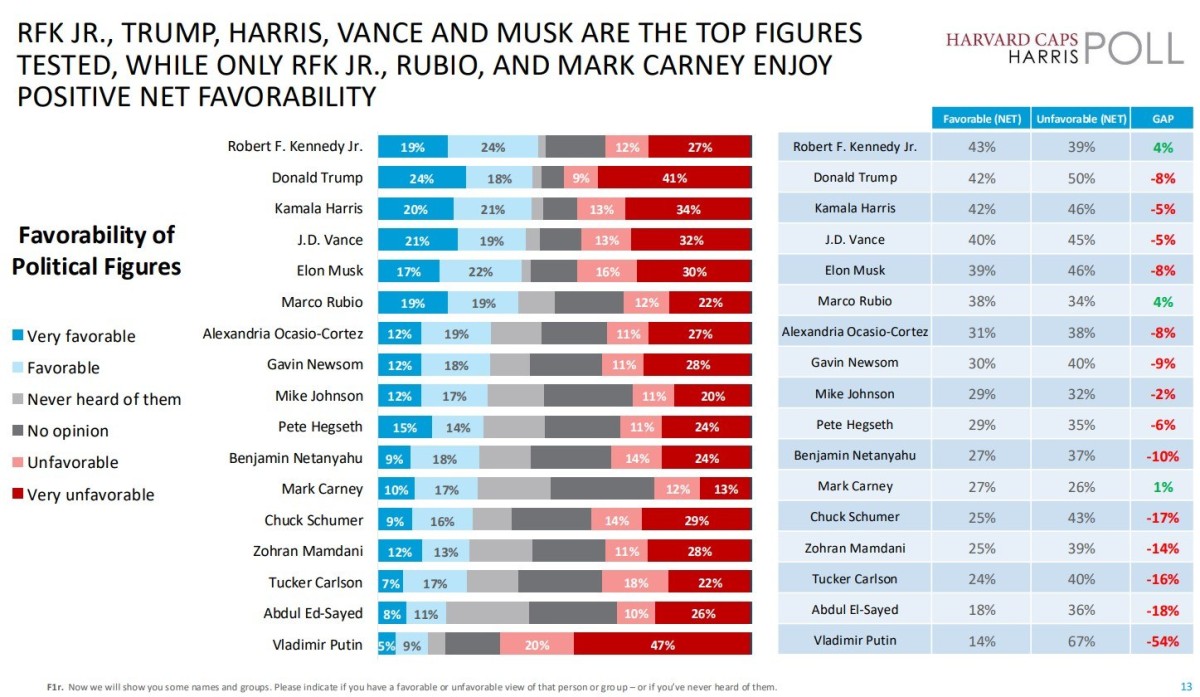
For the Israeli Foreign Ministry and the Prime Minister's Office, the Harvard CAPS/Harris data arrives at a delicate moment. The United States is roughly eight weeks from the November 2026 midterm elections, and the political landscape in Washington is already febrile. The same poll found that former Democratic presidential candidate Robert F. Kennedy Jr. holds the highest net favorability among tested figures at plus four percent, while Israeli Prime Minister Benjamin Netanyahu sits underwater at negative ten percent, with 27% favorable and 37% unfavorable. New York City Mayor Zohran Mamdani registered at negative fourteen percent, and Russian President Vladimir Putin was deeply unpopular at negative fifty-four percent. President Donald Trump's approval rating stood at 44%, up from 42% in July, while Democrats led the generic congressional ballot 51%-49%. These numbers suggest that Israel remains a polarizing issue in American politics, and Netanyahu's personal unpopularity among certain segments of the electorate could complicate efforts to build consensus around Israeli policy positions.
The poll's findings on US-Iran dynamics add another layer of complexity. Forty-three percent of voters believe the United States is winning the US-Iran conflict, while only 13% believe Iran is winning. A robust 72% say the US should use force, sanctions, and blockades against Iran if it does not give up control of the Strait of Hormuz. For Israeli defense officials, these numbers provide some reassurance that the American public retains a hawkish posture toward Tehran, which aligns with Jerusalem's own assessments of the Iranian threat. However, the generational divide on Israel itself suggests that this hardline consensus on Iran may not translate into sustained support for Israeli security needs if younger voters continue to drift away from the pro-Israel consensus.
The Blue Square Alliance Survey: Corroborating Evidence of a Troubling Trend
The Harvard CAPS/Harris findings are not isolated. The Blue Square Alliance Against Hate survey, conducted by SSRS and Research Narrative and fielded from March through April 2026 among 7,050 US adults, found that only 52% of Gen Z respondents aged 18 to 29 said Israel has a right to exist. Even more alarming for Jewish communities and pro-Israel advocates, the survey found that 29% of respondents aged 18 to 44 viewed Jews as a "threat to the unity of American society," compared to just 13% of those over 60. These numbers, which have circulated among Jewish American organizations and pro-Israel advocacy groups in recent months, paint a picture of a younger generation that is not merely skeptical of Israeli policies but is increasingly receptive to antisemitic tropes that have historically been confined to the fringes of American society.
Pro-Israel advocacy groups and Jewish organizations have warned for years about eroding support for Israel among young Americans and about antisemitism spreading through social media. The Yale Youth Poll, which found that around two-thirds of under-30 voters favored reducing or ending US military aid to Israel, with a plurality of 46% favoring a total cutoff, suggests that the policy implications of this generational shift could be profound. If these attitudes persist as Gen Z and younger millennials become the dominant voting bloc, the annual debates over US military assistance to Israel—currently a cornerstone of the bilateral relationship—could become significantly more contentious. Israeli diplomats in Washington and at the United Nations are already grappling with how to address these trends, and the data from these polls is likely to feature prominently in internal strategy discussions ahead of the midterms and beyond.
Regional Context: What This Means for Israel's Public Diplomacy and the Future Alliance
The generational divide in American public opinion toward Israel is not occurring in a vacuum. Three-quarters of voters in the Harvard CAPS/Harris Poll agree that there are terrorist groups on Israel's borders, a finding that aligns with Israeli security assessments of threats from Hamas in Gaza, Hezbollah in Lebanon, and Iranian-backed militias in Syria. However, a plurality of voters under 44 and a plurality of Democrats say the groups on Israel's borders are "fighting just to have more rights in their territory" rather than seeking to destroy Israel or expand territory. This framing, which Israeli officials reject as a fundamental misreading of the terrorist groups' intentions, reflects the success of narratives that portray Israeli security measures as disproportionate responses to legitimate grievances. For Israeli public diplomacy, the challenge is not merely to rebut these claims but to do so in a way that resonates with younger audiences who are skeptical of traditional institutional messaging.
The implications for the US-Israel relationship are significant. As Gen Z becomes the dominant generation of American voters, Israeli policymakers will need to recalibrate their approach to American public opinion. The days of relying solely on bipartisan congressional support and the influence of established Jewish American organizations may be waning. The rise of figures like Piker on the left and Owens on the right, both of whom command substantial young audiences, suggests that the battle for hearts and minds is increasingly being fought on digital platforms where Israeli voices are often underrepresented or drowned out. Israeli advocacy efforts will need to adapt to this new reality, engaging with influencers, content creators, and grassroots movements in ways that go beyond traditional lobbying and public relations campaigns.
Looking Ahead: The Midterms and the Long-Term Trajectory of US-Israel Relations
With the November 2026 midterm elections approximately eight weeks away, the Harvard CAPS/Harris Poll data provides a snapshot of an American electorate that is deeply divided along generational lines on Israel. The overall numbers—74% supporting Israel's right to exist, 70% backing Israel over Hamas—remain reassuring for Israeli officials. But the under-25 cohort, where a majority supports Hamas and only half affirm Israel's right to exist, represents a warning that cannot be ignored. The Yale Youth Poll's finding that fewer than three in ten under-30s support Israel's existence as a Jewish state, and the Blue Square Alliance's data showing that only 52% of Gen Z affirms Israel's right to exist, collectively suggest that the erosion of support is not a temporary phenomenon but a structural shift in American public opinion.
For Israeli leaders, the path forward requires a dual strategy: maintaining the strong bilateral relationship with the current American administration and Congress while investing in long-term public diplomacy aimed at younger Americans. This means engaging with the platforms where young voters consume news, countering antisemitic narratives wherever they appear, and making the case for Israel in terms that resonate with a generation that is more skeptical of traditional authority and more attuned to questions of human rights and social justice. The Harvard CAPS/Harris Poll's finding that 72% of voters support using force, sanctions, and blockades against Iran if it does not relinquish control of the Strait of Hormuz suggests that there is still common ground on regional security issues. But the generational gap on Israel itself is a challenge that will require sustained attention from Israeli policymakers, American Jewish leaders, and pro-Israel advocates in the years ahead.
The data from the Harvard CAPS/Harris Poll, the Yale Youth Poll, and the Blue Square Alliance Against Hate survey collectively paint a picture of an American public that remains broadly supportive of Israel but is increasingly divided by age. As the United States heads into the midterms, and as the 2028 presidential election looms on the horizon, Israeli officials would be wise to treat these numbers not as a passing concern but as a strategic imperative. The alliance between the United States and Israel has weathered many storms over the decades, but the generational shift in American public opinion represents a challenge of a different magnitude—one that will require creativity, persistence, and a willingness to engage with audiences that are often hostile to Israeli perspectives. The question is no longer whether this shift is occurring, but how Israel and its supporters will respond to it.
This article was produced with AI-assisted research and editorial support. Sources: Harvard CAPS/Harris Poll, The Times of Israel, The Algemeiner, World Israel News, Yale Youth Poll, i24NEWS.
By Hannah Berg, Staff Writer
What's Your Reaction?
 Like
0
Like
0
 Dislike
0
Dislike
0
 Love
0
Love
0
 Funny
0
Funny
0
 Wow
0
Wow
0
 Sad
0
Sad
0
 Angry
0
Angry
0

Israel Correspondent at Global1.News. Based in Tel Aviv, covering Israeli politics, security, technology, and society. Provides balanced, deeply-sourced reporting on one of the most closely-watched regions in the world.















Comments (0)