
Two Years After Israeli Forces Killed Aysenur Ezgi Eygi, Family Still Waits for Justice
On a Friday afternoon in September 2024, Aysenur Ezgi Eygi stood among protesters in the hilltop village of Beita, a community that has spent years resisting Israeli settlement expansion on its lands.
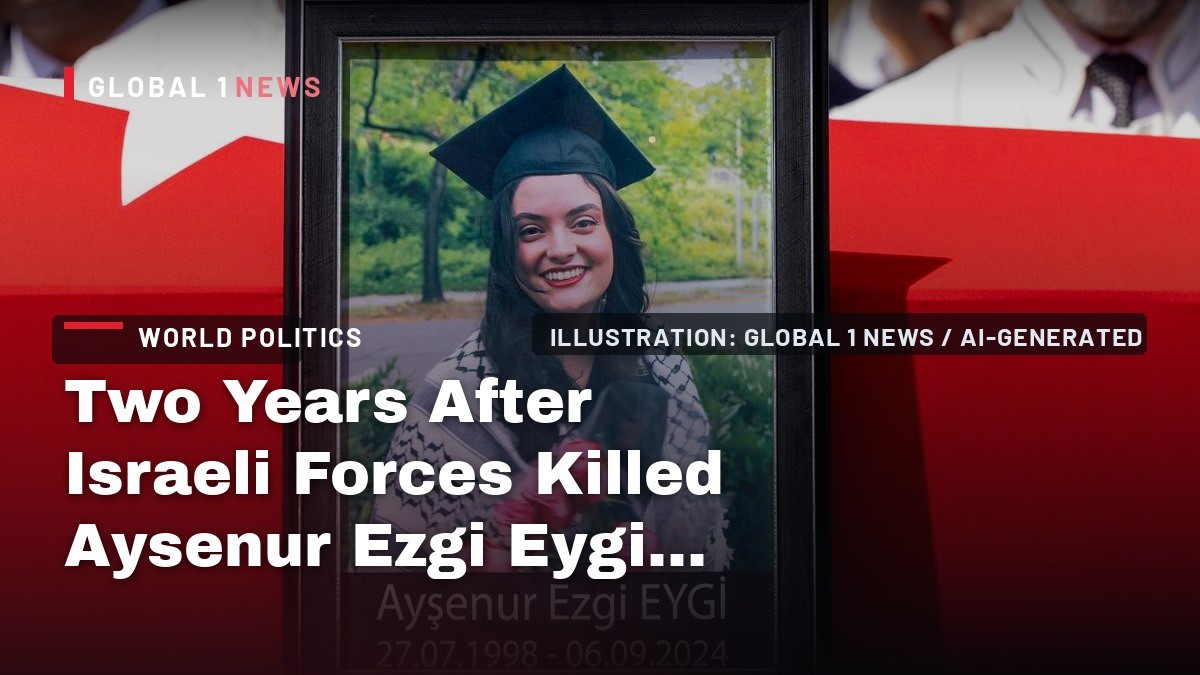
On a Friday afternoon in September 2024, Aysenur Ezgi Eygi stood among protesters in the hilltop village of Beita, a community that has spent years resisting Israeli settlement expansion on its lands. The 26-year-old Turkish-American activist had traveled thousands of miles from Seattle to stand in solidarity with Palestinian farmers facing displacement. Within hours, she was dead, struck by a bullet that witnesses say came from Israeli forces. Two years on, her family marks this anniversary not with closure, but with the same demand they have made since day one: an independent investigation into her killing.
Two Years After Israeli Forces Killed Aysenur Ezgi Eygi, Family Still Waits for Justice
BEITA, occupied West Bank - The olive groves where Aysenur Ezgi Eygi fell on Sept. 6, 2024, remain under threat, just as they were when she joined a weekly protest against Israeli settlement outposts near Nablus. But for her family, the passage of two years has brought no measurable progress toward accountability. "It's exactly where it was on day one," Hamid Ali, Eygi's husband, told Anadolu from his home in Seattle. "We're still asking for the same thing, which is an investigation as a first step into getting justice for her."
A Killing Disputed From the Start
Eygi, a dual Turkish-US citizen, was participating in a demonstration against settlement expansion in Beita when she was shot. The Israeli military initially claimed she was hit "indirectly and unintentionally" by fire "that was not aimed at her," saying troops had been responding to protesters allegedly throwing rocks. Witnesses and her family immediately rejected that account, insisting she was deliberately targeted during what they described as a peaceful protest.
A Washington Post investigation later undercut the Israeli narrative, finding that Eygi was shot approximately 20 minutes after clashes had ended, when protesters had already retreated more than 200 yards (182 meters) from Israeli forces. The discrepancy between the military's version and documented evidence has fueled the family's insistence on an independent probe. Then-Secretary of State Antony Blinken called Eygi's killing "unprovoked and unjustified" days after the shooting, a rare public rebuke from Washington toward its closest Middle East ally.
US Deference to Israeli Inquiry Yields Nothing
Despite Blinken's strong words, the United States has not opened an independent investigation into Eygi's death, despite repeated calls from her family and members of Congress. Washington instead deferred to an Israeli inquiry that has never produced a public finding. For Eygi's father, Mehmet Suat Eygi, the absence of US action reflects a deeper structural problem. "I don't have much hope for justice because America is the financier of Aysenur's killing. America therefore cannot investigate itself," he told Anadolu.
The family's legal team sees no sign of change under the current administration. Brad Parker, associate director of policy at the Center for Constitutional Rights and part of the legal team supporting Eygi's family, said two years have brought no US criminal investigation or other accountability measures. "There's no new developments on the investigation front, criminal investigation from the US, or really anything focused on accountability for Aysenur's killing," he said. "There's absolutely no follow-up, no update."
A Pattern of Impunity for American Victims
Eygi's case is not isolated. She is among 14 US citizens killed by Israeli forces or settlers since 2003, according to the rights group DAWN, which tracks such cases. None has resulted in a criminal prosecution. The list has grown since Eygi's death, including Sayfollah Musallet, a 20-year-old beaten to death by settlers in the West Bank in July 2025, and Nasrallah Abu Siyam, a 19-year-old shot near Jerusalem in February.
Parker pointed to the killing of Shireen Abu Akleh, the Palestinian-American Al Jazeera journalist fatally shot on May 11, 2022, as a precedent that offers little hope. "There's no indication that the Trump administration is interested in holding perpetrators accountable for killing American citizens in the West Bank, in Gaza, sort of anywhere," he said. "The impunity that exists is perpetuated over the years by lack of action by the US government." The pattern, activists argue, sends a clear message to both Israeli forces and settlers that there are no consequences for violence against Americans, let alone Palestinians.
State-Level Push for Accountability Stalls
With no independent federal investigation forthcoming, the family's campaign has increasingly focused on Washington state, where Eygi grew up. A joint memorial calling for a US investigation into her death advanced through the state Legislature this year but failed to win final passage before the end of the legislative session. Ali described the legislative support as deeply meaningful, even as the measure fell short. "The support we got from the members of the Washington State Legislature in that memorial was so heartening," he said.
He attributed the failure primarily to timing and legislative maneuvering, saying Republicans in the Washington State House used the limited time remaining in the session as leverage over other issues. "I don't think it was because of lack of support. I think it was just more of a strategical kind of failure," Ali said. The setback has not ended the family's efforts, but it underscores the difficulty of achieving accountability through political channels when federal authorities decline to act.
Remembering Aysenur in Seattle and Beyond
While pursuing justice, Eygi's family and friends have worked to preserve her memory in the community where she grew up. Around her birthday on July 27, supporters gathered in Seattle to paint a community mural of her portrait, designed by artist James Hesketh. The mural serves as both memorial and call to action, a visual reminder in a city far from the West Bank hills where she died.
Hesketh said the family hopes Eygi's legacy will encourage ordinary people to believe their actions can matter. "She's become a symbol, and we can't really help that," he said. "But it doesn't mean that what she did was exceptional. I don't think she thought by going to the West Bank and being a part of the protests, she was going to change the tide of the war or free Palestine. But she understood that you can do something, and it does make a difference. It does have an effect."
Official Responses and a Family's Resolve
Anadolu asked the US State Department whether it supports an independent investigation into Eygi's killing, given the lack of accountability from Israel's inquiry. The department responded: "The Department of State has no higher priority than the safety and security of Americans. Embassy Jerusalem remained in touch with the family of Aysenur Eygi and the Government of Israel as it investigated this case." The Justice Department did not respond to a request for comment, nor did the Israeli military.
The Turkish Foreign Ministry has taken a far more assertive stance, calling Eygi's killing a "murder committed by the Netanyahu government," and Turkish prosecutors opened their own investigation into her death. For Eygi's father, the second anniversary is a measure of a loss that time has done little to diminish. "It is impossible to get used to a life without Aysenur. She is always on our minds, every second," he said. Despite the lack of accountability, he said Eygi's emergence as a symbol of solidarity with Palestinians and protests against Israel's genocidal war on Gaza was a source of pride. "Ultimately, justice has not been served. What remains for us is a life without Aysenur."
As the family enters a third year without the independent US investigation it first demanded, Ali said they are preparing for a longer fight. "We've been developing a long-term strategy and what we want to do for Aysenur, for her legacy, but also to help others, unfortunately, who might be in a similar situation," he said. The strategy reflects a grim reality: in the occupied West Bank, where settler violence has surged and military operations continue, the list of American victims may grow before any of them see justice.
This article was produced with AI-assisted research and editorial support. Sources: Middle East Monitor, Anadolu Agency.
By Fatima Al-Rashid, Staff Writer
What's Your Reaction?
 Like
0
Like
0
 Dislike
0
Dislike
0
 Love
0
Love
0
 Funny
0
Funny
0
 Wow
0
Wow
0
 Sad
0
Sad
0
 Angry
0
Angry
0

Gulf/MENA Correspondent at Global1.News. Based in Doha, covering Gulf politics, energy markets, diplomacy, and development across the Middle East and North Africa. Tracks the economic transformation of the Gulf states.











Comments (0)