
3I/ATLAS Leaves the Solar System With Three Answers and Two Puzzles
Webb and ALMA data on interstellar comet 3I/ATLAS reveal dust-rich micron-scale ice, glassy silicates and extreme deuterium as the visitor leaves the solar system, and SETI heard nothing.
Folks, astronomers spent sixteen months arguing about a rock from another star system, and this week they started agreeing with each other. What they agree on is stranger than anything the tabloids invented, and it is all sitting in a fortnight's worth of papers.
3I/ATLAS Leaves the Solar System With Three Answers and Two Puzzles
San Antonio, Texas — The interstellar comet 3I/ATLAS is past Saturn now, moving away at more than 60 kilometres per second, and it is never coming back. What it left behind is a run of papers published within days of each other that collectively redrew the picture of the third object humanity has ever confirmed came from another star system.
The Comet That Is Already Leaving
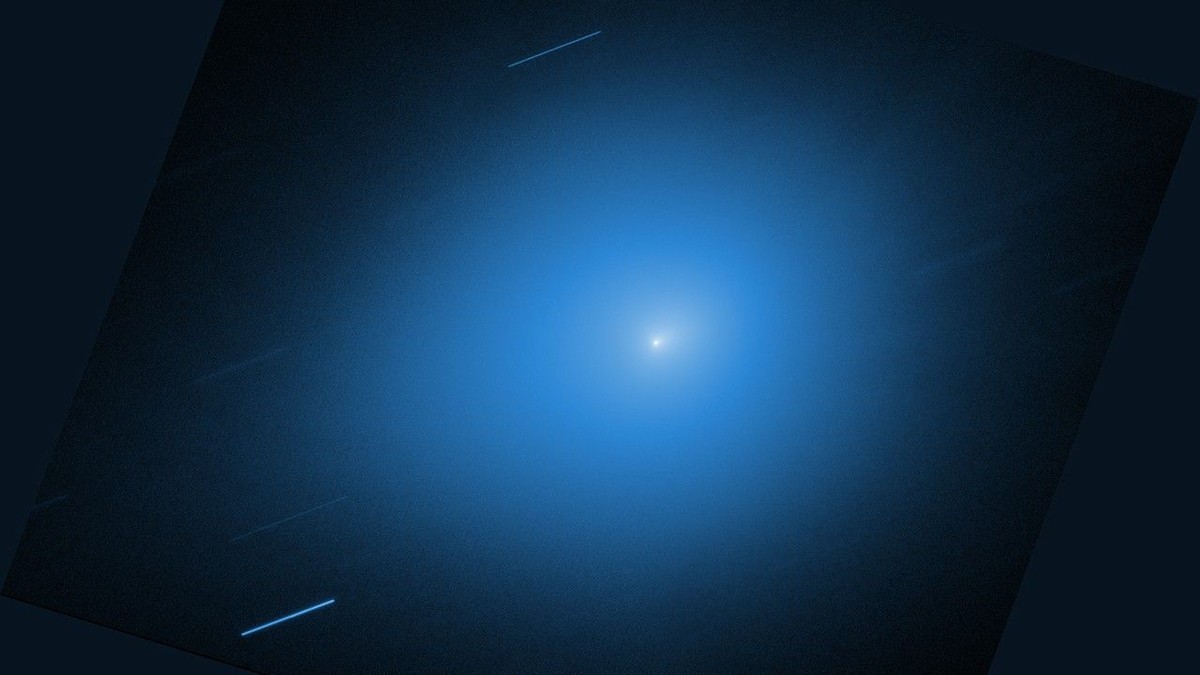
The ATLAS survey telescope at Río Hurtado in Chile reported the object to the Minor Planet Center on 1 July 2025, and the orbit gave it away almost immediately: it was not falling around our Sun at all, it was passing through. Astronomers catalogued it as 3I/ATLAS, the third interstellar object ever confirmed, behind 1I/'Oumuamua in 2017 and 2I/Borisov in 2019. It swung closest to the Sun on 29 October 2025 at about 1.35 astronomical units, roughly 126 million miles out, and it was behind the Sun from Earth's point of view for the most active stretch of the encounter.
That geometry mattered. NASA threw almost everything it had at the visitor anyway, from the Hubble and James Webb space telescopes to instruments at Mars and on the Europa Clipper probe as it cruised out towards Jupiter. The comet is now receding between the orbits of Saturn and Uranus, and it will stay within reach of large ground telescopes until roughly May 2027. From September 2027 to the end of 2028 only the largest space telescopes will be able to observe it, and after that it will be too faint for even Webb.
Two Fingerprints Missing, and the Answer Was Dust
Water ice writes three signatures in infrared light: a deep absorption dip near 3 microns and weaker ones near 1.5 and 2.0 microns. Almost every icy comet from our own backyard shows all three. 3I/ATLAS showed the strong one and barely a trace of the others.
"That combination was a puzzle," said Dr. Silvia Protopapa of the Southwest Research Institute, lead author of a paper published in The Astrophysical Journal Letters. "The strong 3-micron band points to water ice in the coma. But the weak or absent shorter-wavelength bands suggest the ice is not in the form we usually see in solar system comets."
Webb's Near-Infrared Spectrograph observed the comet three times between August 2025 and April 2026, bracketing the Sun pass. Modelling the spectra eventually produced a blunt answer: the grains are about a micron across, roughly the same size as the ice in our own comets, but they are thick with dust rather than the relatively pure ice most comets are thought to carry.
When Compared to Ours, It Stopped Looking Strange
The bigger surprise came when the team laid those spectra beside Webb observations of trans-Neptunian objects — the frozen worlds beyond Neptune that preserve some of the solar system's oldest material. The 3-micron band in 3I/ATLAS matched several groups of them, especially the ones whose own spectra also carry carbon dioxide ice and organic compounds — though the resemblance lies in the water-ice band, not the carbon dioxide.
"At first glance, 3I/ATLAS looks different from the icy comets we know," Protopapa said. "But when we placed it alongside distant icy worlds in our own solar system, it no longer looked out of place. This suggests that the icy building blocks of planets, here and around other stars, may share ice in the form of tiny, micron-scale grains, ranging from relatively pure ice to ice mixed with dust, with 3I/ATLAS toward the dusty end."
If that holds, the physical form of water ice is set early, in the planet-forming disc, and partly survives in everything that condenses out of it — a common rulebook for two different star systems. What nobody can yet say is whether the grains changed because the Sun heated them differently at each pass, or because the comet's surface eroded and exposed new material. The team says both are possible.
A Second Webb Instrument, More Dust, No Crystals
A second team posted mid-infrared spectroscopy from Webb's MIRI instrument. The comet stood 2.21 astronomical units from the Sun when the data were taken. The spectrum carries a prominent emission feature at 10 microns with a broad, smooth shape unlike those typically seen in comets of our solar system, fitted with thermal emission from amorphous carbon, amorphous olivine and amorphous pyroxene grains.
The models strongly favour a pyroxene-dominated, amorphous silicate make-up. Among the representative fits tested, the best-fitting solution requires no crystalline material whatsoever, and the authors cap the crystalline fraction at 5.3 per cent. They also report a feature near 6.83 microns consistent with aliphatic carbon-hydrogen material.
That matters more than it sounds. Crystalline silicate forms when material is cooked — heated and then cooled slowly enough for atoms to line up in order. An overwhelmingly glassy, disordered silicate means this object was barely warmed before it was ejected from its home system, so what we measured is closer to the original condition than almost anything we can sample locally.
The Isotopes That Date It to the Cosmic Noon
If the mineralogy says cold, the isotopes say cold, old and strange in a way nothing in our solar system matches. Radio observations with the Atacama Large Millimeter/submillimeter Array in Chile found the comet's water laced with deuterium at a ratio roughly 30 times higher than solar system comets and about 40 times higher than Earth's oceans, findings published in Nature Astronomy. Processes that lift deuterium that high generally need temperatures below about 30 Kelvin, or minus 406 Fahrenheit.
A Nature paper the same year went further. Its measurements put the deuterium-to-hydrogen ratio at 0.98 per cent — more than an order of magnitude above known comets — and carbon isotope ratios of 141 to 191 for carbon dioxide and 123 to 172 for carbon monoxide — outside the range found in solar system bodies, nearby interstellar clouds and protoplanetary discs alike. Working backward through models of galactic chemical evolution, the team concluded 3I/ATLAS could have formed as long ago as 12 billion years, in a relatively metal-poor environment, following a period of intense, early star formation.
How Much the Sun Took Off It
A comet that has been frozen for most of the universe's history does not arrive unchanged. Tessa Frincke and Darryl Seligman of Michigan State University took published measurements of escaping gas before and after perihelion and modelled how much skin the Sun stripped away. Their estimate, accepted by Monthly Notices of the Royal Astronomical Society, is a surface layer about 1.7 to 5.2 metres thick removed by solar heating alone — five and a half to seventeen feet. Allow for plausible amounts of dust and some estimates pass ten metres, or 33 feet.
Total gas loss comes out at roughly 18 to 58 billion kilograms, mostly water, carbon dioxide and carbon monoxide. With equal masses of dust and gas the modelled erosion runs 3.4 to 10.5 metres; with four times as much dust as gas it reaches 8.6 to 26.7 metres. The arithmetic rests on assumptions the authors state openly, and how much dust leaves per unit of gas can change along the pass.
The Carbon That Changed Its Mind
There is one more result worth sitting with, because it is the sort of thing that only shows up when you watch an object for long enough. A team led by the Physical Research Laboratory in Ahmedabad used Indian telescopes, including the 2-metre Himalayan Chandra Telescope, to monitor the comet's post-perihelion evolution. Their spectra show the usual molecular emissions of CN, diatomic and triatomic carbon, the standard kit of a solar system comet.
What changed is the ratio. Before perihelion the comet was carbon-depleted. After it, the composition had shifted to carbon-typical. The most economical explanation is that outgassing near the Sun stripped away processed surface material and exposed fresh material from below. Their photometry, published in Monthly Notices, also yields colours redder than the average comet and matching the "ultrared" class of objects, plus a nuclear radius between 0.45 and 0.65 kilometres derived from the way the comet's own venting nudged its path.
The Radio Search That Came Back Empty
Now the part that got the most attention and deserves the least: the aliens. Astronomers at the SETI Institute pointed the Allen Telescope Array at 3I/ATLAS across one to nine gigahertz for more than seven hours. The pipeline logged 73,974,799 narrowband hits, filtered them down to 211 candidates, and inspected every one. All of them traced back to transmitters on Earth or to our own satellites.
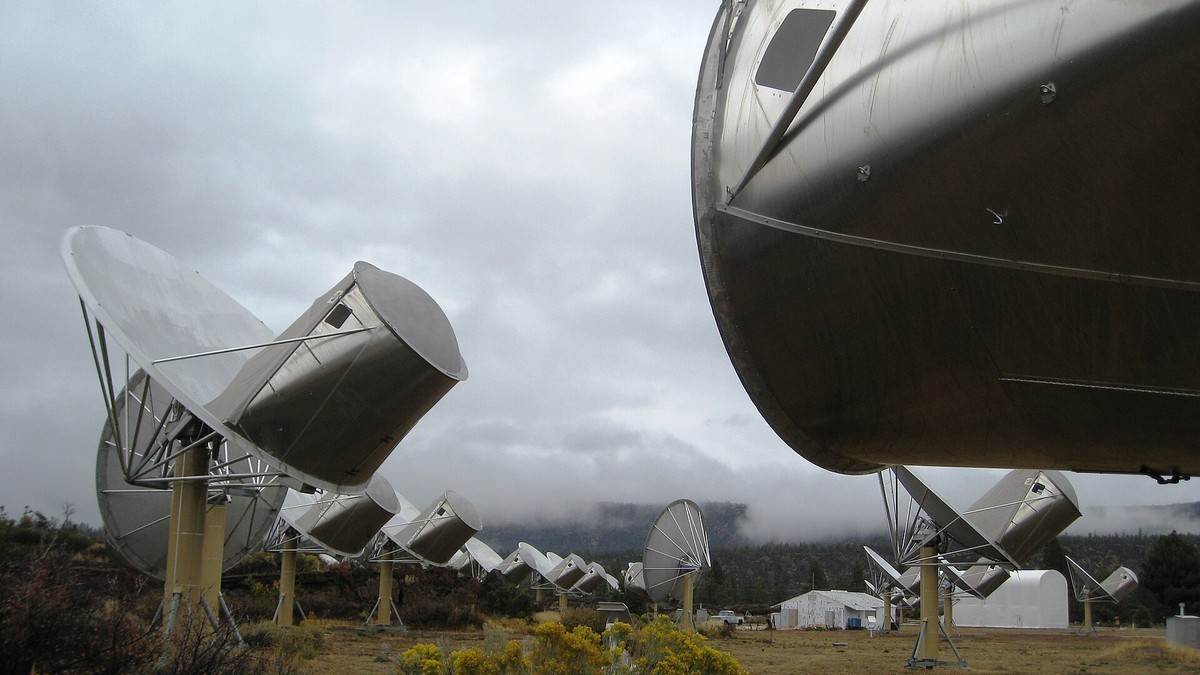
The null result, published in The Astronomical Journal, still buys something concrete. It sets an upper limit of 10 to 110 watts on the power of any radio transmitter on or near the object across the frequencies and drift rates covered — roughly the output of a household appliance. "The results from 3I/ATLAS show how realistic it is to detect a signal with the technology we have today," said Valeria Garcia Lopez of Furman University, a co-author. For anyone still forwarding a video claiming this rock is a mothership, that is the answer, and it is the same answer every instrument has given.
The Arguments Still Open
Not everything is settled, and the disagreement is instructive. The Michigan State model assumes a nucleus 1.3 kilometres in radius; the Indian team's non-gravitational-force measurement puts the radius at 0.45 to 0.65 kilometres, while Hubble's first images put the nucleus at under 5.6 kilometres across. Those numbers are not compatible yet, and the erosion depths scale with them.
Then there is chemistry. ALMA measured methanol-to-hydrogen-cyanide ratios of about 70 and 120 on two dates in late 2025. Methanol appears to come from both the nucleus and from ice particles in the coma, while hydrogen cyanide comes mainly from the nucleus alone. That distinction changes how much of the chemistry we read is the comet and how much is the cloud around it. "Observing 3I/ATLAS is like taking a fingerprint from another solar system," said Dr. Nathan Roth of American University, who led that work. A fingerprint, not a full address.
Why the Next One Matters More
Here is the part I would put in front of every lawmaker who funds a telescope. We have now had three confirmed interstellar visitors in nine years, from three different stars, and every one of them turned up unannounced. 1I/'Oumuamua turned up in a survey built to find asteroids that might hit us, and 2I/Borisov was found by an amateur astronomer at his own telescope. Everything trained on 3I/ATLAS afterwards — Webb, Hubble, a spacecraft on its way to Jupiter, a radio array listening for a signal — was built for a different job entirely. And even with all of it, we nearly missed the comet's most active phase because it was hiding behind the Sun.
The Vera Rubin Observatory, with the largest camera ever built, could find dozens of interstellar objects in the coming decade, astronomers predict. Every one will run the same test: is ice in other planetary systems formed the way ours was? The answer so far, from a comet older than the Sun, is cautiously yes — with more dust stirred in than anyone predicted.
So look up while the dark holds, and be a little less credulous online. The universe does not need invented spaceships to be astonishing. A glassy, frozen, dust-choked fragment of somebody else's solar system, made before our Sun existed and passing through our sky on a path it will never repeat, is more than enough.
By Jessica Ali, Staff Writer
This article was produced with AI-assisted research and editorial support. Sources: Southwest Research Institute, The Astrophysical Journal Letters, arXiv:2610.37540, Monthly Notices of the Royal Astronomical Society, Nature, Nature Astronomy, The Astronomical Journal, SETI Institute, ALMA, NASA, ESA, Physical Research Laboratory. Cover: Global 1 News editorial image. Photographs: NASA, ESA, STScI, D. Jewitt (UCLA) and M.-T. Hui (Shanghai Astronomical Observatory) via the Hubble Space Telescope; brewbooks via Wikimedia Commons, CC BY-SA 2.0 (Allen Telescope Array).
What's Your Reaction?
 Like
0
 Dislike
0
 Love
0
 Funny
0
 Wow
0
 Sad
0
 Angry
0

Editor-in-Chief at Global1.News. Atlanta-based journalist who cuts through the BS and tells it like it is. Lead anchor, host, and the voice you hear when the spin stops and the truth starts.















Comments (0)