
Amit Shah lauds Chandigarh Police, says it set benchmarks for police forces across country
On November 1, 2026, Union Home Minister Amit Shah addressed the 60th Raising Day of the Chandigarh Police, a ceremony that also saw the presentation of the President’s Colour to the force.
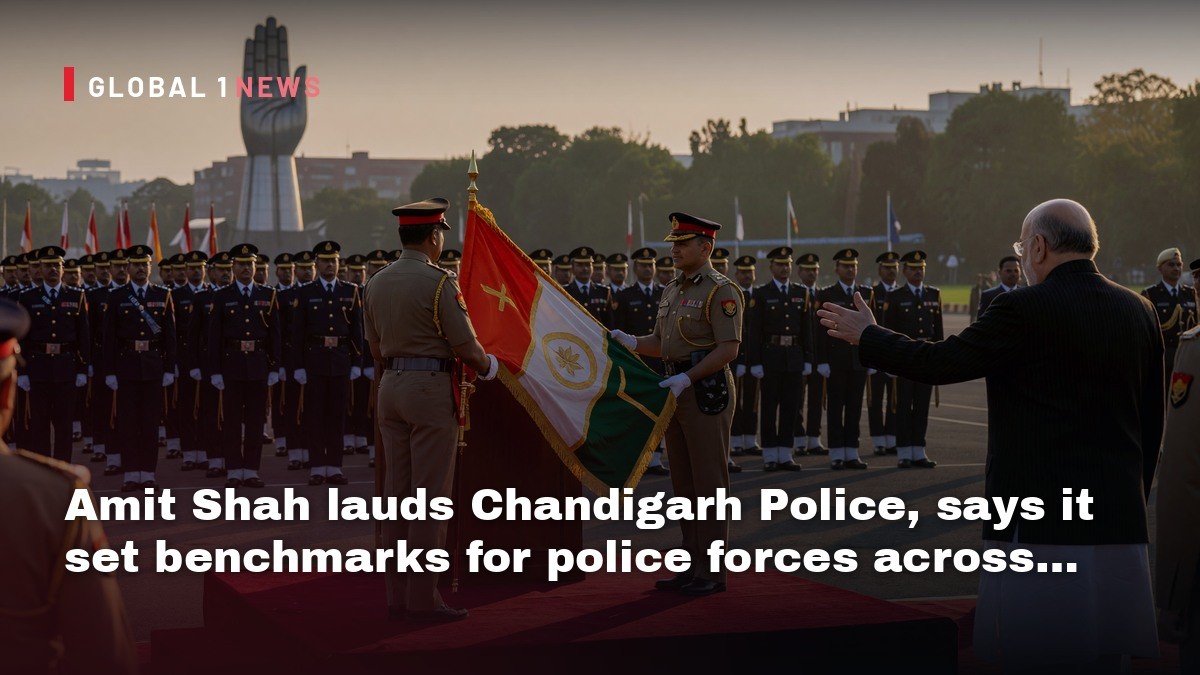
On November 1, 2026, Union Home Minister Amit Shah addressed the 60th Raising Day of the Chandigarh Police, a ceremony that also saw the presentation of the President’s Colour to the force. While the event was largely ceremonial, Shah’s remarks offered a window into the broader policy narrative the government is weaving around policing, technology, and public health. By foregrounding the addition of 141 new vehicles and the force’s standing in response‑time rankings, the minister signalled a strategic push to position Chandigarh as a benchmark for modern, drug‑free policing across India.
Celebrating Six Decades of Policing in a Planned City
Chandigarh, conceived as a modernist capital after independence, marked its 60th year of dedicated police service on Sunday. Shah highlighted the city’s role as “the heart of the northern region” and framed its policing record as a “golden chapter” in the nation’s law‑enforcement history. This rhetorical framing aligns with the long‑standing perception of Chandigarh as a showcase of urban planning, and now, as a showcase of policing excellence.
The minister’s reference to the city’s contribution to national security underscores a policy perspective that views regional police forces not merely as local enforcers but as integral components of a coordinated security architecture. By celebrating the force’s longevity, the government reinforces the narrative that sustained institutional development yields measurable outcomes—a point that will resonate with policymakers in other states seeking similar trajectories.
The President’s Colour: Symbolism and Institutional Pride
Presenting the President’s Colour is a ceremonial honour that, according to Shah, “serves as a tribute to six decades of service, dedication, and commitment.” While the colour itself carries no operational weight, its bestowal is a potent symbol of state recognition. In the Indian policing context, such symbols often translate into morale boosts and can be leveraged to attract talent, especially in a sector where recruitment and retention remain challenges.
Shah’s emphasis on the colour also dovetails with the broader governmental agenda of valorising public service. By linking the honour to “the ultimate sacrifice” of martyrs, the minister reinforces a culture of duty that aligns with the Indian Armed Forces’ ethos, thereby encouraging a cross‑institutional identity that could facilitate joint operations and intelligence sharing in the future.
Vehicle Augmentation and the Quest for Faster Response
The most concrete policy announcement of the day was the addition of 141 new vehicles to the Chandigarh Police fleet. Shah asserted that this infusion would “significantly strengthen the response time, patrolling, mobility, technology, and modern policing.” The figure of 141, while modest in absolute terms, represents a substantial percentage increase for a force that already ranks second nationally in response time.
From a logistical standpoint, expanding the fleet directly addresses the perennial challenge of urban traffic congestion, a factor that has historically hampered police response in Indian metros. By increasing mobility, the force can reduce the average time taken to reach incident sites, thereby improving public confidence. Moreover, newer vehicles are likely to be equipped with integrated communication suites, GPS tracking, and possibly on‑board analytics, aligning with the ministry’s push for technology‑enabled policing.
From Second to First: The Ambitious Ranking Target
Shah’s confidence that Chandigarh will ascend to the top national position in response time “by next year” reflects an aggressive benchmarking strategy. The claim rests on the assumption that the new vehicles will translate directly into faster dispatches, an inference that warrants scrutiny. While vehicle numbers are a critical input, response efficiency also depends on dispatch protocols, traffic management, and real‑time data integration.
If the force achieves this target, it could set a precedent for other states to adopt similar fleet‑expansion models. However, the sustainability of such rankings will depend on systemic reforms—such as the integration of AI‑driven call‑centres, predictive policing tools, and inter‑agency coordination platforms—that go beyond mere hardware upgrades.
Drug‑Free Policing: A Public Health Lens
In a notable pivot, Shah linked the police’s operational excellence to the broader national goal of a “drug‑free” India, stating his confidence that “if any unit in the country becomes drug‑free first, it will Chandigarh.” This statement places the police force at the intersection of law enforcement and public health, echoing the government’s recent emphasis on treating substance abuse as a health issue rather than solely a criminal one.
By positioning Chandigarh as a potential model for drug‑free policing, the ministry signals an intent to integrate health‑oriented interventions—such as community outreach, rehabilitation referrals, and data‑driven hotspot mapping—into routine police work. This approach aligns with the National Drug Dependence Treatment Centre’s recommendations for multi‑sectoral collaboration, suggesting that future resource allocations may include training police officers in basic counseling and referral mechanisms.
Technology, Mobility, and the Future of Modern Policing
The minister’s remarks on “technology” and “modern policing” hint at an evolving operational doctrine. While the source material does not detail specific tech upgrades, the mention of a larger fleet implies that newer vehicles will be outfitted with contemporary communication and surveillance tools. In the Indian context, many state police forces are adopting body‑worn cameras, drone‑assisted surveillance, and integrated command‑control centres.
Should Chandigarh adopt a holistic tech stack—including real‑time crime analytics, automated dispatch, and interoperable data platforms—it could become a testbed for nationwide policing reforms. The city’s status as a planned urban centre, with relatively organized road networks, offers a conducive environment for piloting such innovations before scaling them to more congested metros.
Implications for Policy, Training, and Inter‑State Collaboration
Shah’s speech, while celebratory, carries substantive policy implications. The addition of 141 vehicles and the ambition to lead in response time will likely necessitate expanded training programmes for drivers, mechanics, and dispatch personnel. Moreover, achieving a drug‑free status will require coordination with health ministries, NGOs, and community groups, prompting the development of joint operational protocols.
Finally, Chandigarh’s ascent as a benchmark could catalyse inter‑state knowledge‑sharing mechanisms. The Ministry of Home Affairs may institutionalise regular forums where high‑performing forces present best practices, thereby fostering a competitive yet collaborative environment. Such forums could accelerate the diffusion of successful models—be it rapid response logistics, community policing, or drug‑free initiatives—across the nation’s diverse policing landscape.
This article was produced with AI-assisted research and editorial support. Reporting is based on the source material cited below. Sources: The Hindu; thehindu.com; Global1.News (01 November 2026).
By Dr. Raj Patel, Staff Writer
What's Your Reaction?
 Like
0
 Dislike
0
 Love
0
 Funny
0
 Wow
0
 Sad
0
 Angry
0

India/South Asia Correspondent at Global1.News. Analytical voice with a background in science and health journalism. Based in New Delhi, covering Indian politics, education, healthcare, technology, and policy. Breaks down complex data into clear, actionable reporting.














Comments (0)