
Will the World Ever Take Action on Myanmar?
At the 63rd session of the United Nations Human Rights Council (HRC) in Geneva, the stark reality of the crisis in Myanmar was laid bare for diplomats, NGOs and observers alike.
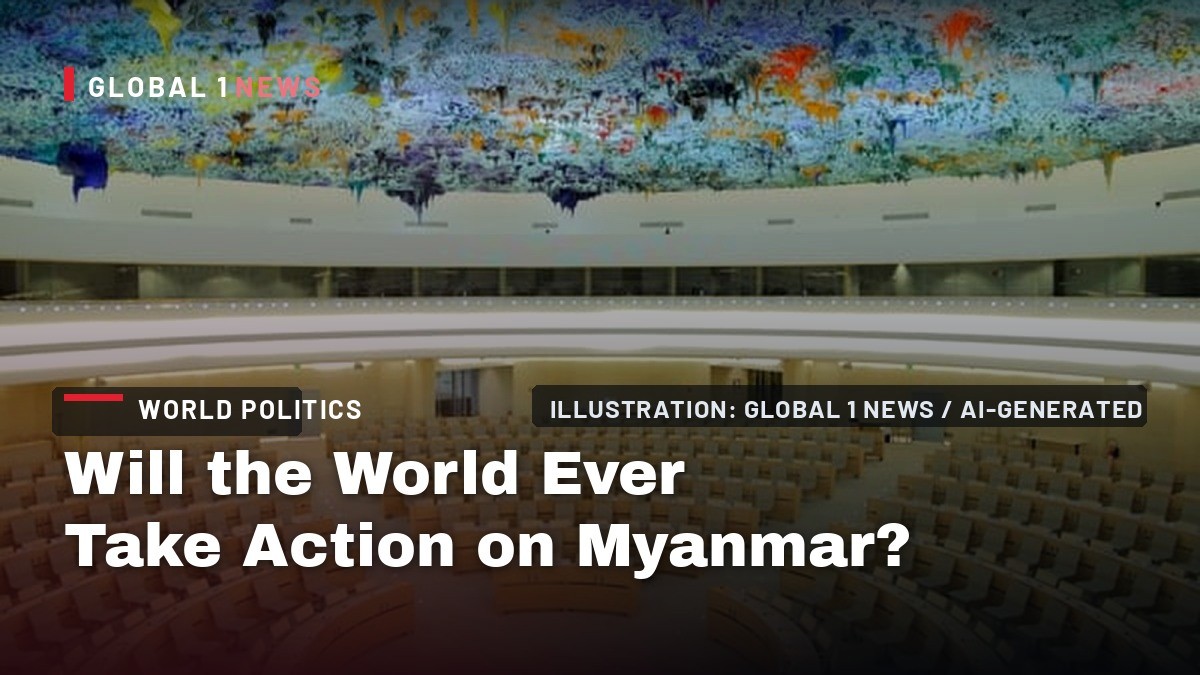
At the 63rd session of the United Nations Human Rights Council (HRC) in Geneva, the stark reality of the crisis in Myanmar was laid bare for diplomats, NGOs and observers alike. The United Nations High Commissioner for Human Rights, Volker Türk, described a “deepening crisis” marked by systematic airstrikes, forced conscription, arbitrary detention, sexual violence, displacement and the weaponisation of humanitarian assistance. He called on member states to refer the situation to the International Criminal Court (ICC) via the Security Council and to halt transfers of arms, ammunition, jet fuel and dual‑use items that could facilitate further violations of international law. The testimony of the Independent Investigative Mechanism for Myanmar, led by Nicholas Koumjian, reinforced the urgency: serious international crimes are being committed with increasing frequency and intensity, and evidence is being collected for future accountability. Yet, despite the abundance of documentation, the council’s deliberations revealed a fragmented international response, raising the question that now dominates policy circles: what will governments do with the evidence that already exists?
Evidence and Documentation: A Growing Archive
The Human Rights Council session highlighted that the evidentiary base on Myanmar’s atrocities is now extensive. Fortify Rights, an advocacy organization, has documented aerial attacks on civilians in Kachin and Karenni states, tracing the chain of command behind these operations. The Independent Investigative Mechanism for Myanmar continues to collect and preserve evidence, preparing for eventual prosecutions. Human rights defenders within Myanmar and abroad are also contributing: survivors are interviewed, violations are recorded, and findings are shared with the Office of the High Commissioner for Human Rights. This expanding archive, however, has not yet been matched by a commensurate machinery of political action.
While documentation is indispensable, the source material underscores a critical gap: the transition from evidence to accountability remains incomplete. The International Criminal Court issued an arrest warrant for senior military leader Min Aung Hlaing in November 2024, and the International Court of Justice conducted merits hearings in The Gambia’s genocide case against Myanmar in January 2026. National jurisdictions in Argentina, Germany, Indonesia, the Philippines, Timor‑Leste and Turkiye have also pursued universal‑jurisdiction cases. Yet no international tribunal is presently prosecuting the full spectrum of crimes committed since the 2021 coup, leaving the accountability process fragmented.
Diplomatic Positions at HRC63
Of the 39 governments and entities that addressed the council, fewer than half—just 14—explicitly raised issues of accountability, justice or impunity. Twenty speakers expressed broad support for stronger action, but the remaining participants were divided. Eight countries, including Indonesia, Malaysia, Thailand, India and Vietnam, advocated a cautious approach, emphasizing regional engagement, dialogue and a “Myanmar‑owned or Myanmar‑led” process. Five governments—Laos, Belarus, Russia, China and Venezuela—actively shielded the junta, invoking sovereignty, non‑interference and engagement with Myanmar’s authorities while opposing international pressure.
This distribution reflects the complex diplomatic landscape surrounding Myanmar. The question of who legitimately represents the country at the United Nations remains unresolved, complicating consensus on sanctions, arms embargoes and diplomatic recognition. Moreover, divergent relationships with the military junta, the National Unity Government (NUG), ethnic resistance groups and the Association of Southeast Asian Nations (ASEAN) further fragment potential collective action.
Sanctions and Arms Controls: Limited but Symbolic Measures
Some governments have already employed the limited tools at their disposal. Canada maintains an arms embargo and a prohibition on aviation fuel, while continuing targeted sanctions against military officials and entities linked to the junta. The United Kingdom and the European Union have similarly imposed sanctions on aviation‑fuel suppliers and other actors connected to the military. These measures, though symbolically important, represent only a narrow slice of the broader sanctions regime that could be mobilised.
The source material suggests that such actions are insufficient on their own. While they signal condemnation and restrict certain logistical capacities of the junta, they do not address the underlying structures that enable the military’s continued operations, nor do they provide a comprehensive framework for reparations or victim‑centered justice.
ASEAN’s Role and the Prospect of a Myanmar‑Led Process
Regional actors repeatedly invoked the notion of a “Myanmar‑owned or Myanmar‑led” process. ASEAN, as the primary regional organisation, has historically favoured quiet diplomacy and consensus‑building, often prioritising stability over direct confrontation. Nevertheless, the source material stresses that a Myanmar‑led or ASEAN‑led initiative must not become a pretext for postponing accountability or for sidelining civilian protection.
Humanitarian assistance, as the authors of the source note, remains essential, yet it should not be decoupled from demands for justice. The risk is that a purely diplomatic track, absent robust accountability mechanisms, could legitimize the junta’s rule and undermine the rights of victims. Thus, any ASEAN‑facilitated dialogue must be coupled with clear benchmarks for civilian protection, transparent monitoring and a commitment to eventual judicial processes.
International Legal Pathways: From Universal Jurisdiction to Global Courts
The pursuit of universal‑jurisdiction cases across multiple jurisdictions illustrates a growing strategy to circumvent the deadlock at the UN Security Council. Prosecutors in Argentina, Germany, Indonesia, the Philippines, Timor‑Leste and Turkiye have opened investigations into Myanmar’s crimes, signalling that national courts can serve as complementary venues for accountability when international mechanisms stall.
Nevertheless, these cases are inherently piecemeal. They target specific individuals or entities and lack the comprehensive scope of a tribunal that could address the full range of atrocities—from mass killings to forced displacement and the weaponisation of aid. The International Criminal Court’s arrest warrant for Min Aung Hlaing remains a landmark, yet the ICC’s jurisdictional limitations and the need for Security Council referral mean that broader prosecutions remain out of reach. The source material’s observation that “no international court is currently prosecuting the full range of those crimes” underscores the necessity of a coordinated, multilateral approach that bridges national prosecutions, ICC actions and potential ad‑hoc tribunals.
Policy Recommendations: Bridging Evidence and Action
Drawing on the insights from the Geneva session, a clear set of policy steps emerges. First, governments should translate the existing evidentiary base into concrete political commitments, such as expanding arms embargoes to cover additional dual‑use items and tightening fuel restrictions. Second, the international community must pursue a dual track: sustaining targeted sanctions while simultaneously supporting universal‑jurisdiction prosecutions and encouraging the ICC to broaden its mandate in Myanmar.
Third, ASEAN should be encouraged to adopt a hybrid approach that couples diplomatic engagement with explicit accountability benchmarks, perhaps through a regional monitoring mechanism that reports to the UN Human Rights Council. Fourth, donor states and multilateral institutions should increase funding for documentation initiatives—ensuring that the Independent Investigative Mechanism for Myanmar can preserve evidence for future trials.
Finally, the global community must confront the political calculus that renders Myanmar a low‑priority issue for many states. As the source material notes, “Myanmar is simply not a sufficiently high political priority for many governments to generate sustained action.” Elevating the crisis on foreign‑policy agendas, integrating it into broader Indo‑Pacific security strategies and linking it to human‑rights conditionalities in trade and aid could generate the sustained pressure needed to move from documentation to decisive accountability.
Looking Forward: The Imperative of Timely Action
The evidence of atrocities in Myanmar is now robust, the mechanisms for documentation are well‑established, and a constellation of legal avenues is already in motion. What remains missing is a coordinated, high‑level political will to harness these tools into a comprehensive accountability framework. The 63rd Human Rights Council highlighted both the depth of the crisis and the fragmentation of the response. As scholars and journalists who track Korean diplomatic engagement in the region, we note that South Korea’s own foreign‑policy apparatus—through the Ministry of Foreign Affairs, the Ministry of Unification and think‑tanks such as the Asan Institute and the Korea Development Institute—has been monitoring ASEAN dynamics and could play a constructive role in shaping a multilateral response.
In the coming months, the international community will face a decisive test: will the amassed evidence be transformed into concrete action that curtails the junta’s capacity for violence and delivers justice to victims? The answer will shape not only the future of Myanmar but also the credibility of global human‑rights governance in an era where evidence alone no longer suffices without political resolve.
This article was produced with AI-assisted research and editorial support. Reporting is based on the source material cited below. Sources: The Diplomat; thediplomat.com; Global1.News (25 September 2026).
By Prof. David Park, Staff Writer
What's Your Reaction?
 Like
0
Like
0
 Dislike
0
Dislike
0
 Love
0
Love
0
 Funny
0
Funny
0
 Wow
0
Wow
0
 Sad
0
Sad
0
 Angry
0
Angry
0

East Asia/Technology Correspondent at Global1.News. Seoul-based voice covering Korean politics, technology, business, and culture. Analyzes how technology and geopolitics intersect across East Asia.











Comments (0)