
Why the Mecca Agreement Might Fail
The Mecca Joint Defense Agreement, signed on August 7, 2026 by Turkey, Saudi Arabia and Pakistan, was presented as a historic step toward collective security among three of the Muslim world’s most influential states.
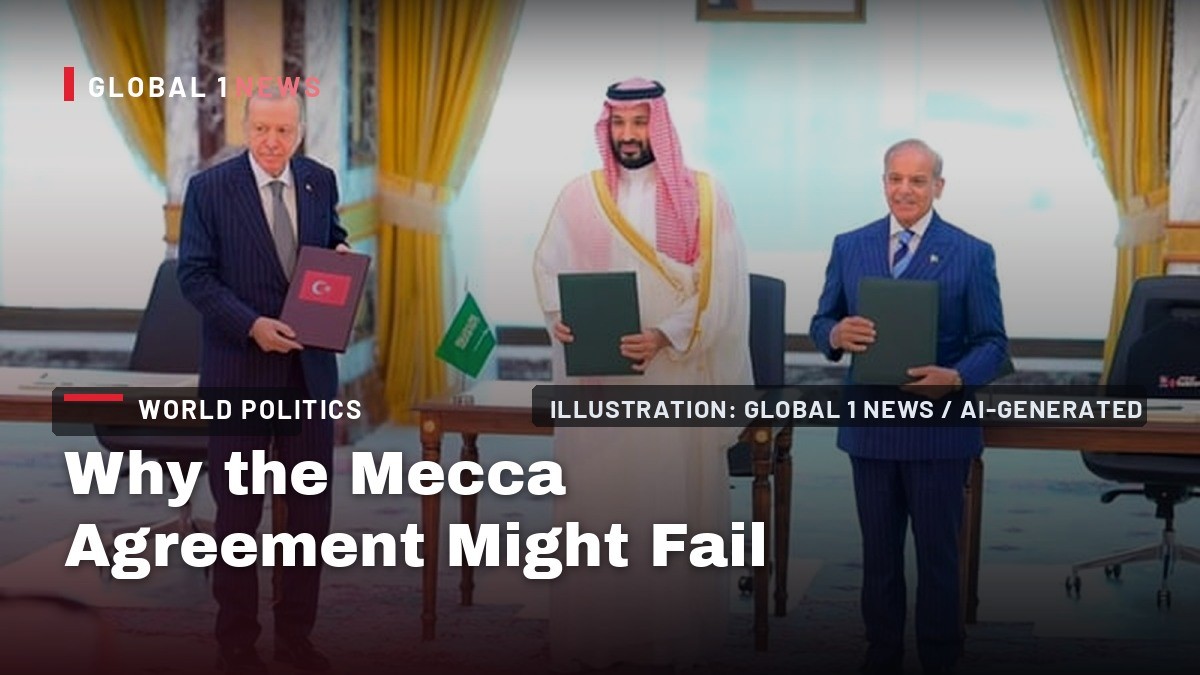
The Mecca Joint Defense Agreement, signed on August 7, 2026 by Turkey, Saudi Arabia and Pakistan, was presented as a historic step toward collective security among three of the Muslim world’s most influential states. Yet, from the moment the treaty was announced, analysts have warned that its vague wording and the divergent ambitions of its signatories could undermine its effectiveness when a crisis actually arises. By examining the political motives, historical rivalries and recent diplomatic incidents that shape each country’s security calculus, we can see why the accord may struggle to function as a true “attack‑against‑one‑is‑attack‑against‑all” pact.
Origins and Structure of the Mecca Accord
The agreement emerged from a series of high‑level meetings in August 2026. President Recep Tayyip Erdoğan, Crown Prince Mohammed bin Salman and Prime Minister Shehbaz Sharif signed the document in Mecca, linking it to the earlier Saudi‑Pakistani Strategic Mutual Defense Agreement of September 2025. A follow‑up gathering on August 31 in Istanbul brought together foreign ministers, defence ministers and military chiefs, who announced the creation of a secretariat based in Saudi Arabia and initially led by a Pakistani secretary‑general. The secretariat is intended to coordinate cooperation in military technology and production, but the public record does not detail the mechanisms for joint command, cost‑sharing or decision‑making.
According to a statement from Pakistan’s Foreign Ministry, the three states agreed that an armed attack on any one would be considered an attack on all. However, the treaty’s text has not been released, and officials have not clarified which forces would be deployed, under whose authority, or within what timeframe. This lack of operational detail is the first sign that the accord may face serious implementation challenges.
Competing Visions of Islamic Leadership
All three signatories claim a leadership role in the Muslim world, but each bases that claim on a different historical and ideological foundation. Turkey under Erdoğan invokes its Ottoman legacy, a narrative reinforced by symbolic actions such as the 2020 reconversion of Hagia Sophia into a mosque. Erdoğan has repeatedly framed Turkey as a rightful shaper of the Muslim world’s future, citing the authority once exercised by the Ottoman Empire.
Saudi Arabia’s claim rests on its custodianship of the holy cities of Mecca and Medina and its long‑standing role in Islamic diplomacy. Crown Prince Mohammed bin Salman seeks to preserve this religious legitimacy while simultaneously turning the kingdom into a hub for investment, technology and regional diplomacy. This dual focus creates a tension: Saudi Arabia must balance religious leadership with pragmatic statecraft, and any alliance that appears to elevate a rival’s influence could be seen as a threat to its own status.
Pakistan’s leadership narrative is rooted in its military strength and nuclear capability. Historical statements by leaders such as Zulfikar Ali Bhutto and, more recently, Field Marshal Asim Munir, portray Pakistan’s defence assets as a protective shield for the entire Islamic civilization, even invoking the “Haramain” (the holy sites) as a religious duty. This self‑image gives Islamabad a sense of moral authority that it has used to justify independent diplomatic moves, sometimes at odds with Saudi or Turkish preferences.
Historical Frictions and Recent Diplomatic Snags
The three countries have a record of actions that run counter to one another’s regional objectives. During Saudi Arabia’s 2017 blockade of Qatar, Turkey deployed troops and food supplies to Doha, directly opposing Riyadh’s pressure campaign. Pakistan, meanwhile, declined Saudi requests for troops, aircraft and warships for the Yemen intervention in 2015, voting in parliament to remain neutral. These episodes illustrate that even when formal agreements exist, each state retains the prerogative to refuse participation in a partner’s military ventures.
More recent incidents underscore the fragility of the alliance. In September 2026, Saudi Arabia shut down its East‑West oil pipeline as a precaution after drone attacks it attributed to Iraq‑based actors. Simultaneously, Houthi forces captured the strategic ports of Mokha and Perim, threatening the Bab el‑Mandeb gateway. Despite the Mecca accord and the earlier “NATO‑like” defence pact signed in September 2025, neither Pakistan nor Turkey intervened to defend Saudi interests against these threats, citing concerns about being drawn into a broader conflict.
Decision‑Making Ambiguities
The Mecca agreement’s most glaring weakness lies in its failure to define who decides when a collective response is warranted. Collective defence pacts traditionally require a clear chain of command and a consensus‑building process for authorising military action. In the absence of such mechanisms, each member can interpret the treaty’s wording to suit its own strategic calculus, potentially leading to paralysis or unilateral action.
Financial contributions and authority are also left undefined. If one member bears a larger share of the cost, it may expect greater influence over operational decisions. Conversely, a member that contributes less may resist being drawn into costly engagements. The secretariat in Saudi Arabia, while a symbolic coordination hub, does not currently have a mandate to adjudicate disputes or allocate resources, further complicating joint decision‑making.
Strategic Divergences and Threat Perceptions
Each country identifies different primary security concerns, shaping what it perceives as a “common threat.” Turkey’s strategic focus includes its eastern border, the Syrian conflict and broader NATO commitments. Saudi Arabia is chiefly concerned with Iranian influence, the security of its oil infrastructure and the stability of the Red Sea corridor. Pakistan’s security calculus centres on its rivalry with India, the situation in Afghanistan and the protection of its nuclear assets.
These divergent threat matrices mean that a crisis involving, for example, Iranian‑backed militias in the Red Sea may compel Saudi Arabia to seek immediate military assistance, while Turkey and Pakistan could deem the situation insufficiently aligned with their own priorities to justify deployment. Without a shared definition of “common threat,” the pact’s collective defence clause may remain largely rhetorical.
Economic and Political Costs of Commitment
Beyond military considerations, the Mecca agreement implicates significant economic and political trade‑offs. Turkey’s pursuit of a broader geopolitical role involves substantial defence spending and a desire to project power beyond its borders. Saudi Arabia’s Vision 2030 agenda seeks to diversify the economy away from oil, requiring stable regional conditions for foreign investment. Pakistan, grappling with a fragile economy, depends on foreign aid and trade partnerships, making it cautious about costly overseas deployments.
When a conflict escalates, each state must weigh the economic sacrifice required to support its partners. The lack of pre‑agreed cost‑sharing formulas could lead to disputes over burden‑sharing, especially if one member feels it is shouldering a disproportionate share of the financial or political fallout.
Prospects for the Accord’s Viability
Given the structural ambiguities, competing leadership ambitions and recent instances of non‑cooperation, the Mecca Joint Defence Agreement faces a steep uphill battle to become an operative security framework. Its symbolic value—signalling a united front among three major Muslim powers—remains significant, particularly for domestic audiences that favour strong alliances. However, the practical implementation of collective defence will likely be tested in the coming months as regional tensions around the Red Sea, the Iran‑Saudi rivalry and the broader Indo‑Pacific security environment intensify.
If the secretariat can evolve into a decision‑making body with clear rules on command authority, cost allocation and threat assessment, the pact may yet find a functional niche. Absent such reforms, the agreement risks becoming a diplomatic headline rather than a reliable security guarantee, leaving each member to pursue its own strategic path while publicly professing solidarity.
This article was produced with AI-assisted research and editorial support. Reporting is based on the source material cited below. Sources: The Diplomat; thediplomat.com; Global1.News (08 October 2026).
By Kenji Tanaka, Staff Writer
What's Your Reaction?
 Like
0
Like
0
 Dislike
0
Dislike
0
 Love
0
Love
0
 Funny
0
Funny
0
 Wow
0
Wow
0
 Sad
0
Sad
0
 Angry
0
Angry
0

Japan Correspondent at Global1.News. Tokyo-based voice covering Japanese politics, technology, economy, and culture. Tracks the intersection of tradition and innovation in one of the world's most dynamic societies.











Comments (0)