
Russian Security Council Calls for Rapid Deployment of Starlink Rival Satellites
The Security Council of the Russian Federation convened an expert meeting on 6 November 2026, issuing a stark warning that the United States‑backed Starlink constellation could be wielded as a tool for destabilising sovereign states.
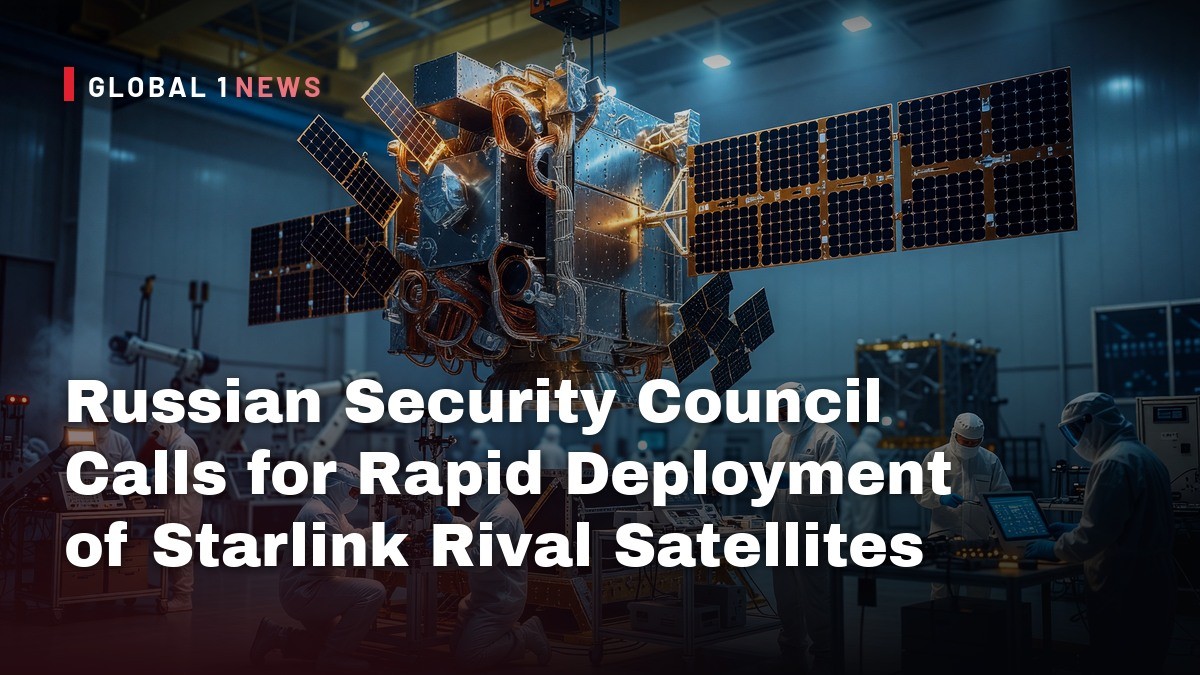
The Security Council of the Russian Federation convened an expert meeting on 6 November 2026, issuing a stark warning that the United States‑backed Starlink constellation could be wielded as a tool for destabilising sovereign states. In its statement, the council called for an accelerated rollout of Russia’s own low‑Earth‑orbit (LEO) communications system, Rassvet, arguing that the nation must achieve “rapid scaling of mass production of communications satellites and terminal equipment” to counter the perceived threat.
Security Council’s Assessment of Western Satellite Networks
The council’s communiqué framed the proliferation of Western LEO constellations as a direct challenge to information security. It highlighted “the main risks and threats posed by the use of Western space‑based communications systems over the territory of sovereign states to destabilise the socio‑political situation.” The statement singled out Starlink and OneWeb as the most widely used services, implying that their reach could be leveraged to influence public opinion and disrupt internal stability.
By attributing the risk to “Western” systems, the council aligned its narrative with a broader Kremlin discourse that portrays foreign technology as a vector for external interference. This framing serves to justify a policy push for indigenous alternatives, reinforcing the narrative that national security depends on technological sovereignty.
Rassvet’s Current Capabilities and the Scale Gap
According to Digital Development Minister Maksut Shadayev, Russia has launched “just over 30 satellites” as part of the Rassvet network. By contrast, the council’s statement noted that Starlink operates “more than 10,000 active satellites.” The disparity in scale is presented as a strategic vulnerability that must be addressed urgently.
While the exact number of Rassvet satellites remains modest, the council’s call for “rapid scaling” suggests an intention to close the quantitative gap. The emphasis on “mass production” of both satellites and terminal equipment indicates a shift from a pilot programme to a full‑fledged industrial effort, likely involving state‑owned enterprises and possibly new public‑private partnerships.
Military Implications of Satellite Communications
The council’s concerns are rooted in recent battlefield experience. The statement referenced Ukraine’s use of the “military version of the satellite internet network” for drone operations and battlefield communications. This underscores the tactical advantage conferred by resilient, high‑bandwidth satellite links in modern warfare, where conventional ground‑based communications are vulnerable to disruption.
By positioning Rassvet as a countermeasure, the council signals that future Russian military operations will increasingly rely on domestically controlled satellite assets. This move aims to reduce dependence on foreign constellations that could be denied or compromised in a conflict scenario, thereby enhancing operational security for Russian forces.
Political Rhetoric and the Kremlin’s Strategic Narrative
President Vladimir Putin’s recent praise of Elon Musk as a “real genius” for developing Starlink illustrates a nuanced stance: admiration for technological innovation alongside suspicion of its geopolitical use. Deputy Chairman Dmitry Medvedev’s criticism of Musk for “allowing Ukraine to use Starlink” reinforces the council’s narrative that Western‑origin technology can be weaponised against Russian interests.
This duality reflects a broader Kremlin strategy that acknowledges the utility of advanced communications while simultaneously framing them as instruments of foreign influence. By publicly condemning Musk’s platform, Russian officials aim to rally domestic support for a sovereign alternative and to delegitimize any foreign‑sourced communication channels operating within Russian territory.
Legal Pressures on Independent Media
The article includes a statement from The Moscow Times noting its designation as an “undesirable” organization by Russia’s Prosecutor General’s Office, following an earlier “foreign agent” label. This legal pressure illustrates the tightening environment for independent journalism, which the outlet frames as a direct attempt to silence dissenting voices.
While the media notice is peripheral to the council’s technical agenda, it provides context for the broader information environment in which the Rassvet push is occurring. The crackdown on independent reporting serves to consolidate the state’s control over the narrative surrounding satellite communications and national security.
Economic and Industrial Challenges Ahead
Scaling up satellite production will require substantial investment in manufacturing capacity, supply chain development, and workforce training. The council’s call for “mass production” implies a shift from a research‑and‑development focus to large‑scale industrialisation, potentially involving state‑owned enterprises such as Roscosmos and private sector partners.
Given the current modest fleet of “just over 30” Rassvet satellites, the gap to the “more than 10,000” Starlink constellation is considerable. Achieving a comparable constellation would demand not only launch capacity but also the development of ground infrastructure, user terminals, and service platforms. The economic burden of such a programme will likely be borne by the federal budget, reflecting the strategic priority placed on communications sovereignty.
Geopolitical Outlook and Future Trajectories
The council’s warning that Western satellite networks could destabilise “countries throughout the world” signals an intention to position Russia as a champion of sovereign communications infrastructure. By advancing Rassvet, Russia may seek to export its technology to allied states, offering an alternative to Western‑controlled constellations and thereby extending its geopolitical influence.
In the short term, the emphasis on rapid deployment suggests an acceleration of launch schedules and terminal production. Over the longer horizon, the development of a robust domestic LEO network could become a cornerstone of Russia’s broader strategy to assert technological independence, reduce vulnerability to external sanctions, and project power in the information domain.
This article was produced with AI-assisted research and editorial support. Reporting is based on the source material cited below. Sources: The Moscow Times; themoscowtimes.com; Global1.News (07 November 2026).
By Irina Volkov, Staff Writer
What's Your Reaction?
 Like
0
 Dislike
0
 Love
0
 Funny
0
 Wow
0
 Sad
0
 Angry
0
Russia/Eastern Europe Correspondent at Global1.News. Covering Russian politics, energy, security, and the shifting dynamics of the post-Soviet space. Provides clear-eyed analysis on one of the world's most opaque regions.















Comments (0)