
US-Venezuela Oil Deal Reshapes Latin American Chessboard, Posing New Challenges for Beijing
The announcement of a sweeping United States-Venezuela oil agreement, hailed by President Donald Trump as a “historic transaction” that would place more than 65 billion barrels of proven reserves under American control, marks a seismic shift in hemispheric geopolitics.
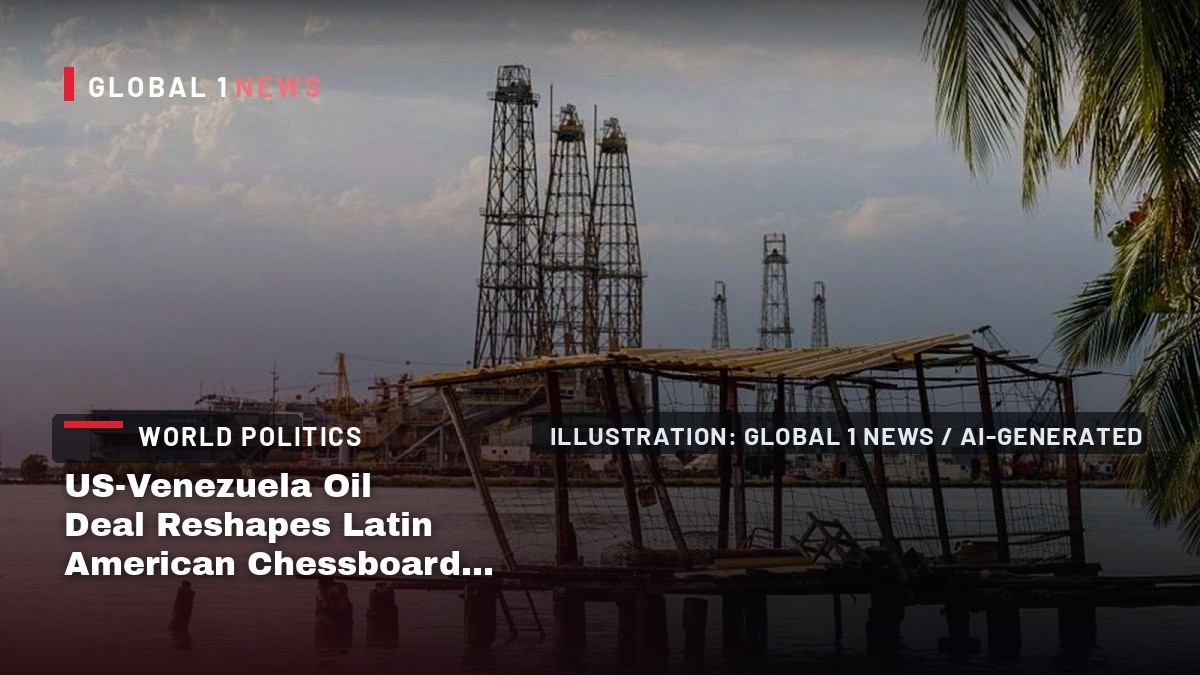
US-Venezuela Oil Deal Reshapes Latin American Chessboard, Posing New Challenges for Beijing
The announcement of a sweeping United States-Venezuela oil agreement, hailed by President Donald Trump as a “historic transaction” that would place more than 65 billion barrels of proven reserves under American control, marks a seismic shift in hemispheric geopolitics. For Beijing, which has spent nearly two decades cultivating Caracas as a cornerstone of its Latin American strategy, the deal represents more than a commercial rearrangement; it is a direct strategic challenge to China’s energy security architecture and its diplomatic foothold in the Western Hemisphere. As Washington moves to consolidate its influence over the world’s largest proven oil reserves, Chinese policymakers are now confronted with the prospect of a significantly altered balance of power in a region long considered America’s backyard.
A Strategic Recalibration in the Western Hemisphere
The agreement, announced on 29 August 2026, follows the dramatic arrest of Venezuela’s former President Nicolas Maduro in January, a military operation authorised by Trump that fundamentally altered the political landscape of the South American nation. The deal, negotiated by Secretary of State Marco Rubio and Defence Secretary Pete Hegseth with Venezuela’s interim president, Delcy Rodriguez, is framed by Washington as a dual victory: a boon for American energy independence and a humanitarian lifeline for the Venezuelan people. Rubio has touted the arrangement as bringing nearly $100 billion in private investment to rebuild Venezuela’s shattered economy, while Trump has emphasised that the transaction comes “at no cost to the American Taxpayer.” Yet for observers of great-power competition, the deal’s strategic dimensions are unmistakable. Axios has reported that the agreement is central to Trump’s so-called “Donroe Doctrine,” a hemispheric policy explicitly designed to counter Chinese influence. This framing elevates the oil deal beyond a mere commercial transaction into a geopolitical instrument aimed at rolling back Beijing’s two-decade-long penetration of Latin American markets and political institutions. The timing is particularly pointed: Washington has simultaneously tightened sanctions pressure on Iran, China’s largest supplier of crude oil, suggesting a coordinated effort to constrain Beijing’s energy options on multiple fronts simultaneously.China’s Oil-for-Loans Model Under Duress
The most immediate concern for Beijing is the fate of its substantial financial exposure in Venezuela. Since 2007, China has extended an estimated $50-63 billion in loans through policy banks, primarily the China Development Bank, under a distinctive “oil-for-loans” cooperation model. This arrangement, which collateralised Chinese infrastructure and energy financing against PDVSA oil sales to China National United Oil Corporation (ChinaOil), a subsidiary of CNPC, was designed to secure a stable crude supply for China’s growing economy while providing Venezuela with much-needed capital. The model was hailed in Beijing as a template for South-South cooperation, a practical demonstration of how Chinese finance could bypass Western-dominated financial institutions. However, the model has been under strain for years. Venezuela’s economic collapse, hyperinflation, and the precipitous decline in oil production from its peak in the late 1990s have left the country unable to service its debt obligations fully. Venezuelan debt, much of it owed to Chinese policy banks, remains one of the world’s most complex unresolved sovereign defaults. PDVSA has at times been forced to slash sales to other partners, including India, to meet its oil-for-loan obligations to China and Russia. The new US deal, which reportedly could involve a 100-year lease of Venezuelan oil reserves with the White House allocating oilfields to hand-picked corporations, threatens to upend this arrangement entirely. If Washington gains effective control over Venezuelan oil production and export revenues, Chinese creditors may find themselves at the back of a very long queue for repayment.Beijing’s Diplomatic Response and Strategic Calculus
China’s foreign ministry has already condemned the US moves on Venezuelan oil exports, signalling deep unease with Washington’s unilateral approach. The Chinese government has consistently adhered to a policy of non-interference in the internal affairs of sovereign states, and the arrest of Maduro, followed by the assertion of American control over Venezuelan oil assets, represents a direct violation of the principles Beijing has long championed. For Chinese diplomats, the Venezuela case is a troubling precedent: if the United States can seize control of a nation’s natural resources through military action and subsequent bilateral agreements, what does this mean for other resource-rich nations in the developing world that have aligned themselves with Beijing? The strategic calculus for China extends beyond the immediate financial exposure. Venezuela has been a critical node in China’s broader Latin American strategy, serving as a gateway for Chinese investment, trade, and political influence in a region historically dominated by the United States. The loss of Venezuela as a reliable partner would be a significant setback, but it would not be catastrophic. China has diversified its Latin American portfolio across Brazil, Argentina, Chile, and Peru, and its trade with the region has grown exponentially over the past two decades. Nevertheless, the symbolic and strategic importance of Venezuela, as the country with the world’s largest proven oil reserves at an estimated 303 billion barrels, cannot be overstated.Implications for Global Oil Markets and OPEC
The deal’s implications extend far beyond the bilateral US-Venezuela relationship. Bloomberg has reported that Venezuela is considering whether to quit OPEC as it deepens ties with Washington, a move that would deliver a significant blow to the cartel it helped create six decades ago. OPEC’s cohesion has already been tested by production disputes and the rise of US shale oil, and the loss of Venezuela, even as a diminished producer, would further erode the organisation’s ability to manage global oil prices. For China, the world’s largest crude importer, a more fragmented OPEC could mean greater price volatility and a more uncertain supply environment. The deal also has implications for the broader Global South. Many developing nations have watched the Venezuela situation with alarm, seeing it as a case study in the risks of resource nationalism and over-reliance on a single great power. China has positioned itself as a champion of the developing world, offering an alternative to Western-dominated economic models. The US move in Venezuela, framed by Washington as a humanitarian intervention but perceived by many in the Global South as resource appropriation, could paradoxically strengthen Beijing’s diplomatic position among nations wary of American power. Chinese state media have already begun framing the deal as a case of “neo-colonialism,” a narrative that resonates in regions with historical memories of Western resource extraction.The Unresolved Question of Terms and Implementation
Despite the triumphalist rhetoric from Washington, the deal’s terms remain opaque. Trump has called it the “biggest oil deal in history,” but details have not been released, and the costs and implementation timeline are unclear. The involvement of “private business” partners, as mentioned by Trump, raises questions about the structure of the arrangement and the potential for conflicts of interest. Reports suggesting a 100-year lease of Venezuelan oil reserves would represent an unprecedented transfer of sovereign resources, and it remains uncertain whether such an arrangement could withstand legal challenges or political transitions in either country. For Beijing, the uncertainty is itself a concern. Chinese policymakers must now assess a range of scenarios, from a best-case outcome where the deal collapses under its own contradictions to a worst-case scenario where American control over Venezuelan oil is consolidated and extended. In preparing for these contingencies, China is likely to accelerate its efforts to secure alternative oil supplies, deepen its relationships with other Latin American producers, and strengthen its strategic petroleum reserves. The Venezuela episode serves as a stark reminder of the vulnerabilities inherent in relying on long-distance supply chains for critical resources.Broader US-China Competition and the Energy Dimension
The Venezuela deal must be understood within the broader context of US-China great-power competition, which has intensified across multiple domains: technology, trade, military posture, and now energy. Washington’s simultaneous pressure on Iran, China’s largest oil supplier, and its move to control Venezuelan reserves suggest a coordinated strategy to constrain Beijing’s energy security. The United States, once a major importer of oil, has become a net exporter, and it now wields energy as a strategic weapon in its competition with China. For China, energy security has always been a paramount concern, driving its investments in Africa, the Middle East, and Latin America. The oil-for-loans model in Venezuela was a creative solution to the challenge of securing supply in a world where Western companies controlled most of the global oil infrastructure. If Washington succeeds in displacing Chinese influence in Venezuela, Beijing will need to reassess its approach to energy diplomacy across the developing world. The lesson may be that financial instruments alone are insufficient to secure strategic resources; political and, if necessary, military backing may be required to protect Chinese interests abroad.Strategic Implications for Beijing’s Latin America Policy
Looking ahead, the Venezuela deal is likely to accelerate a strategic recalibration in Beijing’s approach to Latin America. China has already been shifting its focus from large-scale infrastructure projects under the Belt and Road Initiative to smaller, more commercially viable investments, and the Venezuela experience may reinforce this trend. Chinese state banks, burned by their exposure to Venezuelan debt, are likely to demand more stringent conditions for future lending, including stronger political risk assessments and clearer repayment guarantees. At the same time, Beijing is unlikely to abandon the region. Latin America remains a vital source of agricultural commodities, minerals, and energy for China, and its growing middle class represents a significant market for Chinese goods. The challenge for Beijing will be to maintain and expand its influence in the region without exposing itself to the kind of political risk that Venezuela now represents. This may involve deepening relationships with more politically stable nations, such as Brazil and Mexico, while adopting a more cautious approach to countries with volatile political situations.Conclusion: A New Chapter in Hemispheric Geopolitics
The US-Venezuela oil deal, if implemented as announced, would represent a fundamental reordering of energy geopolitics in the Western Hemisphere. For China, it is a strategic setback that exposes the limits of its financial diplomacy and the vulnerabilities of its energy supply chain. Yet it is also a catalyst for strategic adaptation. Beijing has demonstrated resilience in the face of adversity throughout its rise, and the Venezuela episode is likely to spur a more sophisticated, diversified approach to Latin America and to energy security more broadly. The coming months will be critical. The deal’s terms, once revealed, will determine whether Washington has truly secured control over Venezuelan oil or whether the announcement is more bluster than substance. For Beijing, the watchword is caution: the Chinese government will be monitoring developments closely, preparing contingency plans, and seeking to protect its substantial investments in Venezuela through diplomatic channels and, where possible, legal means. The Venezuela case is far from closed, and its final chapter will have profound implications for the balance of power in the Americas and beyond.By Prof. Marcus Chen, Staff Writer
This article was produced with AI-assisted research and editorial support. Sources: BBC News, Reuters, Bloomberg, The Guardian, Al Jazeera.
What's Your Reaction?
 Like
0
Like
0
 Dislike
0
Dislike
0
 Love
0
Love
0
 Funny
0
Funny
0
 Wow
0
Wow
0
 Sad
0
Sad
0
 Angry
0
Angry
0

Marcus Chen
World Politics Analyst at Global1.News. Based in Beijing, covering US-China relations, global trade, and geopolitical strategy. Brings deep analytical perspective to the power dynamics shaping international affairs.











Comments (0)