
Under Siege in the South Hebron Hills: A Week of Unchecked Settler Violence
Israeli settlers attacked Palestinian herders in Al-Tuwani, Masafer Yatta, near Hebron on August 7, injuring one man, part of a week of coordinated settler attacks across the occupied West Bank. UN monitors recorded 3,033 settler attacks between January 2025 and June 2026, and OCHA says 18 Palestinians have been killed by settlers in 2026, surpassing the 2025 total.
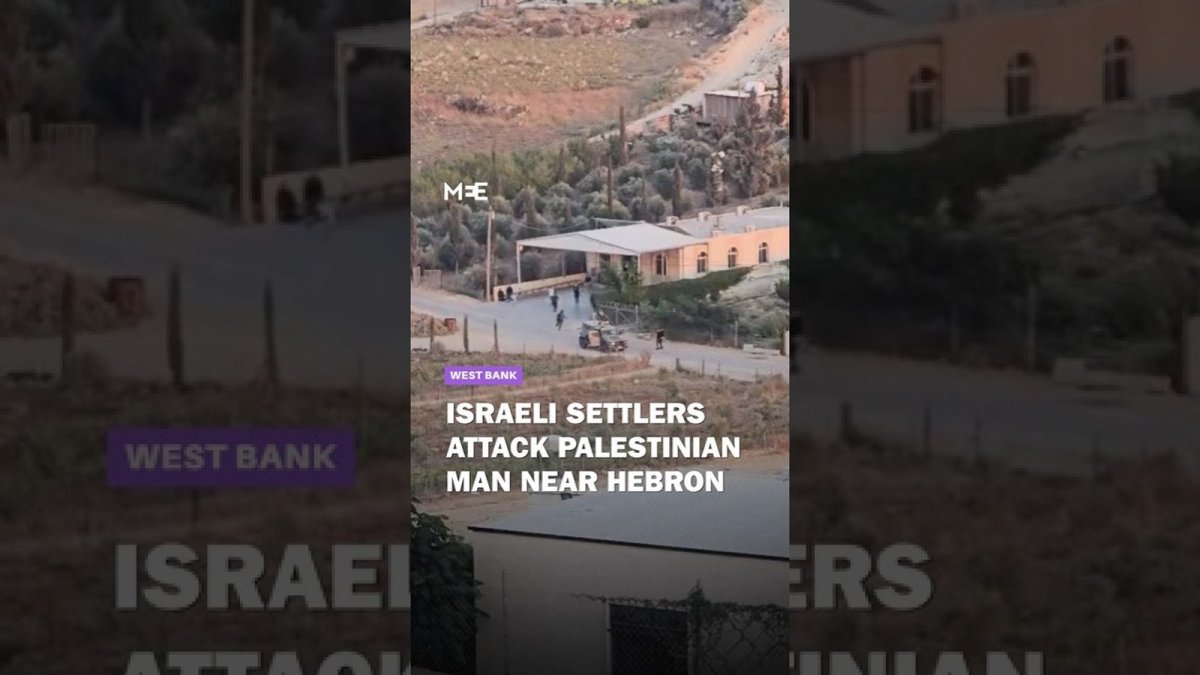
In a recent Middle East Eye report, the spotlight fell on an attack by Israeli settlers on a Palestinian man near Hebron, underscoring a terrifying new reality in the occupied West Bank. Published on August 8, the report focuses on the assault in the village of Al-Tuwani, part of the Masafer Yatta region, where illegal colonial settlers, accompanied by attack dogs, injured a local herder. The incident is not isolated; it is the latest in a week of coordinated, violent attacks that have left Palestinian communities across the West Bank under siege, raising urgent questions about law enforcement, accountability, and the international community's response.
Under Siege in the South Hebron Hills: A Week of Unchecked Settler Violence
Hebron, occupied West Bank – August 10, 2026 — The terror that unfolded in Al-Tuwani on Friday, August 7, was swift and brutal. According to Fo'ad Amour, a local rights activist who spoke to the Palestinian WAFA news agency, a group of illegal colonial settlers, accompanied by attack dogs, stormed the village and assaulted herders, injuring one man in his abdomen and hand. The injured man was rushed to a nearby hospital for medical treatment, his condition a grim symbol of the vulnerability that defines daily life in this arid, isolated region.

A Community Under Constant Threat
Al-Tuwani is one of approximately 19 Bedouin hamlets that make up the Masafer Yatta region, a sprawling area in the southern occupied West Bank that has become a flashpoint for settler violence. For the families here, livestock herding is not merely a tradition but the very lifeline of their economy. The attack on Friday was a direct assault on that livelihood, a calculated act of intimidation designed to force residents from their ancestral land. Amour described the chaos as families scrambled to protect their animals and children from the raiders. The attack left the community shaken and on edge, wary of the next incursion.
The violence, however, was not confined to a single day. The week preceding the Middle East Eye report saw a dramatic escalation across the West Bank, painting a picture of a coordinated campaign of displacement and terror. On Tuesday, August 4, settlers attacked and injured two Palestinian farmers with sharp tools as they worked their land in Umm Safa, northwest of Ramallah, according to WAFA via IMEMC. The farmers, whose families have cultivated those terraced hillsides for generations, were targeted simply for being present on their own property.
Coordinated Night Raids and Arson
The most brazen attacks occurred on August 5 and 6. On Wednesday, at least nine Palestinians were injured in two separate settler attacks. In Beit Furik, east of Nablus, three Palestinians were beaten by settlers who entered the village under the protection of Israeli soldiers, WAFA reported. The presence of military escorts for the attackers highlights a deeply troubling dynamic: the line between the Israeli army and the settler movement has become dangerously blurred. In a separate incident on the same day, armed settlers attacked residents of Khirbet al-Tuba in Masafer Yatta, setting fire to several homes. The Palestinian Red Crescent reported that six people, including three women, suffered bruises and were taken to hospital, while several other residents, including women and children, were treated for smoke inhalation.
The violence reached its zenith on the night of August 6, when a large group of Israeli settlers carried out a coordinated attack on the village of Tuba in the South Hebron Hills, according to Haaretz reporting. The attackers arrived in vehicles, stormed Palestinian homes, assaulted residents, and set fire to buildings, trees, and bales of hay. They systematically destroyed solar panels—a critical resource in a region with limited infrastructure—and damaged at least six structures before retreating toward the nearby Havat Ma'on settler outpost. At least six Palestinians were injured, including four children: a mother, three girls aged between five and eight, a ten-year-old boy, and a 22-year-old man.
Voices from the Rubble
Radwan Abu Jundi, a Tuba resident, described the horror of that night to Haaretz with chilling clarity. "If any of us had stayed outside, they would have killed us," he said. His wife suffered injuries to her head and body, and his daughter required medical treatment. The family's home, like many others, was left damaged and uninhabitable. The psychological toll is immeasurable, and families who lived through the night now describe a constant, gnawing fear that the masked men will return. The community, already living under the constant threat of forced displacement due to a decades-long legal battle over the Israeli military's designation of the area as a "firing zone," now faces a new, more immediate terror.
The Israeli army's response to the Tuba attack has been met with widespread skepticism. The military said the attackers had fled before soldiers reached the village, and while police collected evidence, Israeli authorities announced no immediate arrests. The army claimed it "strongly condemns these types of events, including harming residents like women and children," but its response did not explain how such a large, organised group travelled to the village, carried out an extended arson attack, and escaped without interception. For residents, this is a familiar pattern: a statement of condemnation, a promise of investigation, and a return to business as usual—with the settlers emboldened and the community left to rebuild.
A Surge in Violence: The Data Tells a Grim Story
The recent attacks are not an anomaly but part of a staggering upward trend. According to a UN OCHA humanitarian situation report from July 23, 2026, fatalities linked to settler attacks in 2026 have already surpassed the total recorded during all of 2025—18 Palestinians killed as of July 20, compared with 17 throughout the entire previous year. The Palestinian Authority says at least 20 Palestinians have been killed by settlers since the start of the year, citing UN figures and its own monitoring.
The frequency of attacks is equally alarming. Between January 1, 2025, and June 30, 2026, UN monitors recorded 3,033 Israeli settler attacks across the occupied West Bank. The monthly rate of attacks in 2026 averaged 190 per month—a 24 percent increase over the already record-high monthly average recorded in 2025. These are not random acts of violence; they are systematic, often coordinated, and frequently carried out with impunity. The data reveals a clear pattern: settlers are emboldened, the army is either unwilling or unable to stop them, and Palestinian communities are paying the price.
The Erosion of Law and Order
The situation has prompted even mainstream Israeli analysts to sound the alarm. Veteran Ynet military analyst Ron Ben-Yishai wrote a stark assessment, arguing that Jewish extremists had effectively become "the sovereign" in the occupied West Bank. He stated that "the IDF has lost control of the extremists among the settlers and has become a security company for their whims and illegal actions." This is a damning indictment from a figure who has long been a fixture of the Israeli security establishment. When the military is reduced to a "security company" for settlers, the rule of law has collapsed entirely, and the protection of Palestinian civilians becomes a distant afterthought.
The attacks are not limited to the South Hebron Hills. Earlier in July, the village of Al-Tuwani was the site of another shocking incident. On July 19, settlers set fire to the Al-Taqwa Mosque and sprayed Hebrew graffiti on its walls, an AFP journalist saw the scorched entrance. Several Palestinians were injured in the attack. In a separate incident that same evening, a group of armed colonists carrying clubs and batons attacked Palestinians in their homes in the Khallat Ghneimat area of Surif, northwest of Hebron. Surif Mayor Hazem Ghneimat told WAFA that an elderly man sustained head injuries from being beaten with clubs, and several other Palestinians sustained minor injuries. In yet another incident, colonists released a herd of cattle onto farmland planted with fruit trees in the Khallat al-Homs area, south of Yatta, damaging trees and crops belonging to farmer Samir Obeid.
International Law and the Failure of Accountability
Under international humanitarian law, the occupied West Bank is subject to the Fourth Geneva Convention, which prohibits the transfer of an occupying power's civilian population into the territory it occupies. Israeli settlements are therefore illegal under international law, a position consistently reaffirmed by UN resolutions and the International Court of Justice. The settler attacks are not merely criminal acts; they are a mechanism of forcible transfer, designed to create a hostile environment that pushes Palestinian communities off their land. The systematic destruction of homes, mosques, and livelihoods, coupled with the physical violence, constitutes a grave breach of the laws of war.
Yet accountability remains virtually nonexistent. Israeli authorities rarely arrest settlers for attacks on Palestinians, and when they do, convictions are exceedingly rare. The army's response to the Tuba attack—condemning the violence while failing to prevent it or arrest the perpetrators—is emblematic of a system that prioritizes the protection of settlers over the rights of Palestinians. The international community, for its part, has offered little more than statements of concern. Sanctions against violent settlers, such as those imposed by the United States and European Union in previous years, have had a limited deterrent effect. The lack of meaningful consequences has created a vacuum in which violence thrives.
Analysis and Implications
The escalation in settler violence must be understood within a broader political context. The current Israeli government includes far-right parties whose leaders have openly called for the annexation of the West Bank and have been vocal supporters of the settler movement. These political figures have provided ideological cover and, in some cases, material support for settler violence. The army, meanwhile, is caught between its legal obligations to protect all civilians and the political pressure from a government that views the settlers as a key constituency. The result is a paralysis that has effectively ceded control of large parts of the West Bank to armed extremist groups.
For the Palestinian communities of Masafer Yatta, the implications are existential. The region has been under a decades-long legal battle over the Israeli military's designation of the area as a "firing zone," a designation that would allow for the forced displacement of its residents. The settler attacks serve a dual purpose: they terrorize the population into leaving, and they create a reality on the ground that makes the "firing zone" designation a self-fulfilling prophecy. If the international community fails to act, the slow-motion ethnic cleansing of the South Hebron Hills will continue, one attack at a time.
The week of violence in early August 2026 will not be remembered as a turning point unless the world decides to make it one. The images from the Middle East Eye report—of a man bleeding in the dust, of homes reduced to ash, of children trembling in fear—are a moral indictment. The question is whether the international community, which has repeatedly declared that "never again" must be the watchword of human rights, will find the will to apply that principle to the occupied Palestinian territory. For the families of Al-Tuwani, Tuba, and Beit Furik, the answer cannot come soon enough. They are running out of time, and they are running out of hope.
By Fatima Al-Rashid, Staff Writer
This article was produced with AI-assisted research and editorial support. Reporting is based on sources cited in the article.
What's Your Reaction?
 Like
0
Like
0
 Dislike
0
Dislike
0
 Love
0
Love
0
 Funny
0
Funny
0
 Wow
0
Wow
0
 Sad
0
Sad
0
 Angry
0
Angry
0
Gulf/MENA Correspondent at Global1.News. Based in Doha, covering Gulf politics, energy markets, diplomacy, and development across the Middle East and North Africa. Tracks the economic transformation of the Gulf states.











Comments (0)