
Türkiye and Greece Trade Marine Parks in the Aegean as Environmentalism Meets Geopolitics
Türkiye and Greece Trade Marine Parks in the Aegean as Environmentalism Meets Geopolitics The decades-old maritime rivalry between Türkiye and Greece has entered a new phase, with both NATO allies now deploying environmental protection as a strategic instrumen
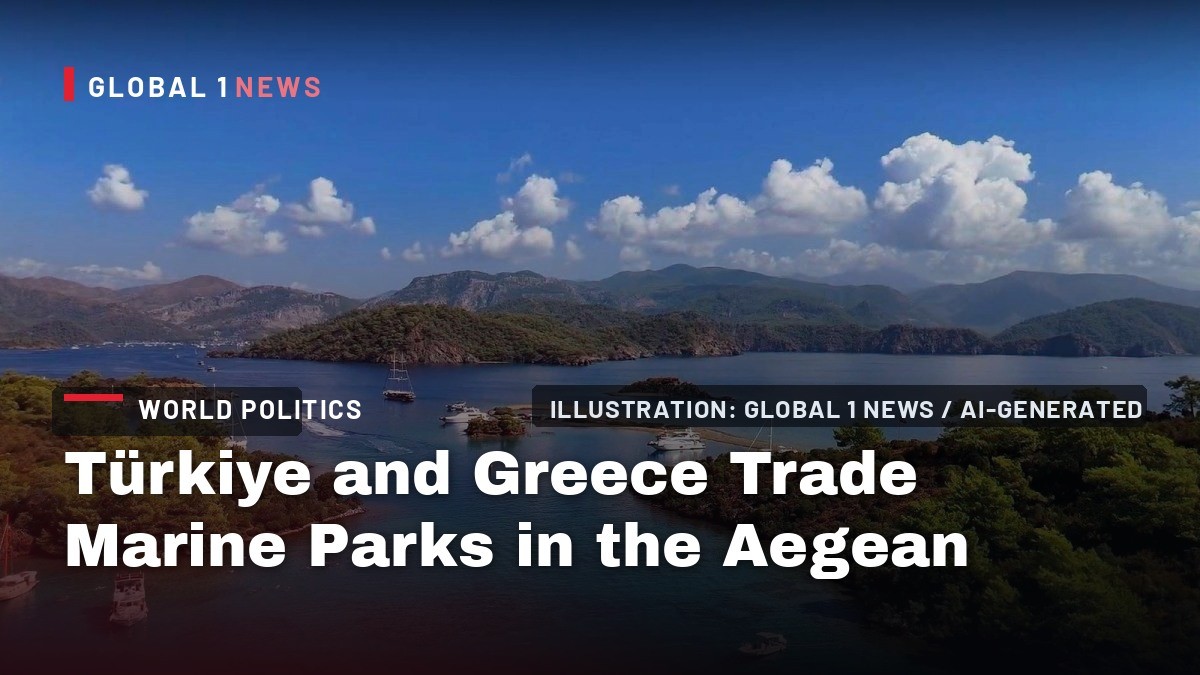
The decades-old maritime rivalry between Türkiye and Greece has entered a new phase, with both NATO allies now deploying environmental protection as a strategic instrument in the Aegean Sea. What began as an ecological initiative by Athens in July 2025 has evolved into a reciprocal designation of marine parks by Ankara, transforming conservation into a contemporary front of a deeper sovereignty dispute.
Türkiye and Greece Trade Marine Parks in the Aegean as Environmentalism Meets Geopolitics
Beirut, Lebanon – August 28, 2026 — The designation of "marine parks" in the Aegean Sea has become the latest arena for the long-standing contest between Türkiye and Greece over maritime jurisdiction. While both governments frame their initiatives in the language of biodiversity and ecosystem protection, the strategic undertones are unmistakable, reflecting unresolved disputes over continental shelf limits, territorial waters, exclusive economic zones (EEZs), and the legal status of islands and islets whose sovereignty was never formally transferred to Greece by treaty.
From Milos to Gökçeada: The Spark and the Response
The current cycle of tension began on July 21, 2025, when Greece announced the establishment of a marine park spanning a large maritime area between the islands of Milos (Değirmenlik) and Levitha (Koçbaba). Athens justified the move on environmental grounds, citing the need to protect ecosystems, ban bottom trawling, and safeguard wildlife. For Ankara, however, the initiative was never purely ecological. The Turkish Ministry of Foreign Affairs argued that the park represented a strategic maneuver to expand Greece's sphere of influence in the Aegean and Eastern Mediterranean, creating faits accomplis on islands, islets, and rocks whose sovereignty was not transferred to Greece by treaty, while indirectly lending support to the claims embodied in the "Seville Map."
Greece's continued pursuit of what Ankara views as unilateral policies prompted a "challenge and response" strategy. Rather than limiting itself to diplomatic protests, Türkiye designated its own national marine parks through a presidential decision dated August 16, 2026 — one in the Northern Aegean and another along the Fethiye-Kaş corridor. The North Aegean Marine National Park covers 1,742.14 square kilometres within the provincial waters of Çanakkale and Tekirdağ, centered on the Turkish island of Gökçeada (Imbros), extending toward the maritime area between the Greek islands of Samothrace and Lemnos.
Ankara's Position: Environmental Protection as a Shield, Not a Sword
Türkiye maintains that it does not oppose environmental protection in principle and has expressed readiness to cooperate with Greece on ecological matters in the Aegean. The fundamental objection, according to the Turkish Ministry of Foreign Affairs, is the instrumentalization of environmental protection for unilateral measures. Ankara has emphasized that unilateral actions should be avoided in semi-enclosed seas such as the Aegean and Mediterranean, and that cooperation among coastal states should be prioritized.
The Turkish government has stated that Greece's marine parks would have no legal effect with respect to islands, islets, and rocks whose sovereignty was not transferred to Greece, while warning that such initiatives could have restrictive implications for freedom of navigation, access to the high seas, and the activities of Turkish fishing vessels. This position is rooted in Türkiye's longstanding sensitivity, dating back to the 1930s, toward what it has regarded as unilateral faits accomplis in the Aegean.
The newly designated Turkish parks establish an environmental, administrative, and political protection mechanism within the framework of the "Blue Homeland" doctrine. Although they do not constitute a direct declaration of an EEZ, the environmental protection and monitoring powers associated with them provide a form of "environmental law-enforcement" capacity. This framework enables Türkiye to monitor unauthorized activities and regulate the use of maritime areas, while also contributing to the protection of freedom of navigation, navigational safety, and the activities of Turkish fishermen.
Athens' Rebuttal: "Illegal" Parks and No Faits Accomplis
Greece has categorically rejected Türkiye's counter-designation. The Greek Foreign Ministry branded the Turkish marine parks "illegal," asserting that they create "no fait accompli." Athens argued that the parks "extend beyond Turkish territorial waters" and cannot create legal consequences for Greece or establish new rights in disputed maritime areas. Greek officials have consistently maintained that their own marine parks are purely environmental measures, compliant with international law and the EU's biodiversity strategy.
Athens' primary concern, according to regional analysts, is that Türkiye may establish a continuous pattern of state practice in the region. Greece is worried about Turkish naval forces conducting environmental enforcement activities, restrictions being imposed on Greek fishing vessels, continuous surveillance through unmanned aerial vehicles (UAVs), and the status of the "grey zones" — whose sovereignty was not transferred to Greece — being brought back onto the international agenda. The Greek government has also pointed to the strategic location of the Fethiye-Kaş park, which is delineated around the island of Meis (Kastellorizo), rendering Greece's maximalist claim to a 40,000 km² continental shelf based on the island, as well as the approach reflected in the Seville Map, effectively meaningless in terms of its practical implications on the ground.
The Strategic Calculus: What Each Side Wants
For Türkiye, the marine park initiative represents a shift from a previously reactive posture — relying solely on diplomatic notes — to a proactive approach grounded in concrete measures on the ground. Ankara is seeking to reinforce this initiative through its "Marine Spatial Planning Map," registered with the Intergovernmental Oceanographic Commission (IOC) of UNESCO, and the proposed "Blue Homeland Law" (Maritime Jurisdiction Areas Law), which is expected to be brought before the Grand National Assembly of Türkiye. Through these measures, Ankara aims to strengthen the legal and scientific foundations of its rights and interests in the Aegean and Eastern Mediterranean.
The Fethiye-Kaş National Marine Park also carries strategic significance in terms of energy security, owing to its wind and current energy potential, as well as the gas-hydrate resources in the area. This connects directly to the broader Eastern Mediterranean energy landscape, where gas fields, gas hydrates, and renewable energy potential have become focal points of competition. The marine parks, in this context, serve as instruments for asserting presence and jurisdiction in areas rich in energy resources.
For Greece, the marine parks serve a dual purpose: advancing its environmental credentials within the EU while reinforcing its maritime claims in the Aegean. Athens has long sought to extend its territorial waters from 6 to 12 nautical miles — a move Türkiye has declared a casus belli — and the marine parks can be seen as a step toward consolidating control over maritime areas without formally extending territorial waters. The Northern Aegean park, from Türkiye's perspective, covers maritime passages between Samothrace and Lemnos, providing a counterweight to Greece's strategy of restricting the Aegean through its islands.
NATO Implications and Regional Dynamics
The dispute places NATO in a delicate position. Both Türkiye and Greece are alliance members, and their friction over the Aegean has historically complicated NATO's southeastern flank. The marine parks dispute adds a new layer of complexity, as environmental enforcement activities by naval forces could lead to incidents at sea, potentially escalating into broader confrontations. NATO's internal cohesion is further strained by the fact that the EU — of which Greece is a member and Türkiye is a candidate — has generally sided with Athens on maritime issues, complicating EU-Türkiye relations.
The dispute also fits into a wider pattern of maritime contestation in the Eastern Mediterranean. The Türkiye-Libya Memorandum of Understanding on maritime boundaries, the Egypt-Greece EEZ deal, and the Israel-Lebanon maritime border agreement all reflect a region where maritime jurisdiction is being actively contested and redefined. The marine parks dispute is the latest manifestation of this trend, with environmental protection serving as a new language for asserting sovereignty.
Great power competition adds another dimension. The United States has historically sought to balance its relationships with both NATO allies, while Russia has shown interest in exploiting divisions within the alliance. The EU's role is particularly significant, as it has both a strategic interest in Eastern Mediterranean energy security and a political commitment to supporting Greece. The marine parks dispute, by adding a new layer of complexity to an already fraught relationship, provides opportunities for external actors to influence regional dynamics.
Diplomatic Advantage and the Path Forward
Analysts suggest that the marine park initiative has given Türkiye a clear diplomatic and psychological advantage. By employing the same environmental instrument, Türkiye has exposed what it regards as Greece's expansionist geopolitical strategy pursued under the guise of "environmental protection," thereby depriving Athens of this diplomatic leverage. Moreover, Türkiye has demonstrated that it can act proactively through concrete measures on the ground, moving beyond its previously reactive position. Supporting this process with the scientifically based Marine Spatial Planning Map, registered with the IOC of UNESCO, has provided Türkiye's claims with a stronger legal and scientific foundation and strengthened its position in potential diplomatic negotiations.
Yet the risks of escalation remain significant. Both countries present their marine parks as biodiversity measures, but the strategic undertone is clear to all observers. The overlapping coordinates of the parks — particularly in the Northern Aegean and around Meis (Kastellorizo) — create the potential for incidents at sea, as enforcement activities by one side could be perceived as provocations by the other.
Given that the maritime areas of the two countries are directly interconnected, Athens would be better served, both in terms of regional stability and its own long-term interests, by developing regular consultation and joint maritime governance mechanisms with Ankara rather than pursuing unilateral initiatives. Similarly, Ankara's challenge-and-response strategy, while effective in signaling resolve, carries the risk of entrenching positions and making future compromise more difficult.
The marine parks dispute is unlikely to be resolved in the near term. It is, rather, a contemporary manifestation of a broader geopolitical struggle over sovereignty in the Aegean, projected onto the ground through environmental protection narratives. As both sides continue to designate parks, register maps, and prepare legislation, the Aegean Sea has become a testing ground for a new form of maritime statecraft — one where conservation and sovereignty are inextricably linked.
By Malik Hassan, Staff Writer
This article was produced with AI-assisted research and editorial support. Sources: Daily Sabah, To Vima, Proto Thema, Greek City Times.
What's Your Reaction?
 Like
0
Like
0
 Dislike
0
Dislike
0
 Love
0
Love
0
 Funny
0
Funny
0
 Wow
0
Wow
0
 Sad
0
Sad
0
 Angry
0
Angry
0

Middle East Correspondent at Global1.News. Based in Beirut, covering politics, conflict, energy, and society across the Middle East. Brings context and depth to a region often reduced to headlines.












Comments (0)