
Trump Bans CNN, MS NOW and Politico From the White House, and Threatens More
President Donald Trump announced Friday that he is banning CNN, MS NOW and Politico from the White House effective immediately, accusing them of reporting fiction and lies, and said more outlets could follow. Reporters from all three outlets remained on the White House grounds.
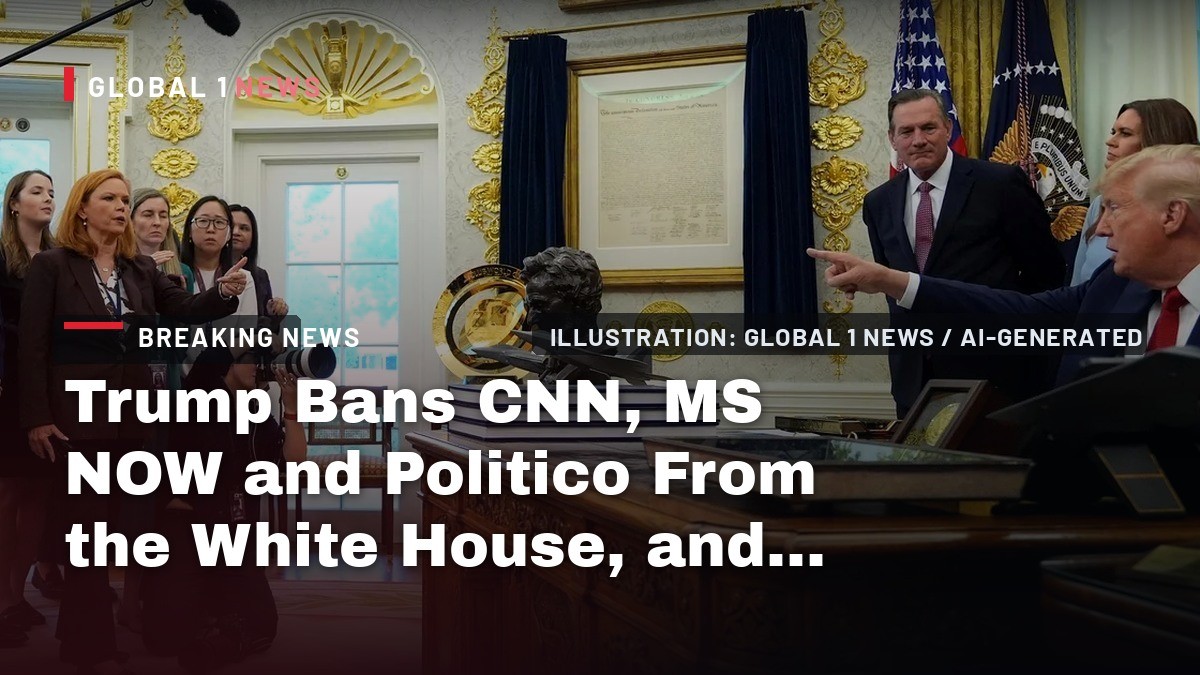
President Donald Trump has thrown the White House doors shut on three news organizations in a single social media post, and then told reporters in the Oval Office that he was not finished. It is the most direct use of presidential access as punishment in this White House so far, and every party involved is already framing it as a First Amendment fight.
Trump Bans CNN, MS NOW and Politico From the White House, and Threatens More
WASHINGTON, D.C. — President Donald Trump announced Friday that he is banning CNN, MS NOW and Politico from the White House "effective immediately," accusing the three outlets of reporting what he called fiction and lies. No enforcement step followed the announcement, reporters from all three organizations remained on the White House grounds into Friday evening, and the scope of what a ban would actually cover has not been defined by anyone in the administration.
What the President Said, and What He Would Not Say
Trump posted the announcement on Truth Social on Friday afternoon. "I am proud to announce that, effective immediately, I am banning Fake News CNN, MSNOW ... and Politico ... from the White House as a result of their constant 'reporting' FAKE NEWS!" he wrote. He followed it in the same post: "Media Outlets shouldn't be able to constantly write or report FICTION and LIES when they're covering the President of the United States, the Trump Administration, or the United States of America. Other Fake News Media Outlets to follow."
In the post he mocked MS NOW for changing its name from MSNBC, and described Politico as the recipient of what he called an illegal and ridiculous 8 million dollar subscription from the United States government under former President Joe Biden. He offered no examples of the reporting he objected to.
Minutes later, at an Oval Office event on health care policy, Trump was asked to explain the decision. "Because they're fake news," he said. "You get so tired of reading and seeing fake news." Asked why he had announced it that day, the president replied: "No reason."
He Said the Ban Should Go as Far as It Can
Speaking to reporters in the Oval Office, Trump described his own action as "the ban on the free press" and said he wanted it to reach as widely as possible. "I don't want them in my office. I don't want them here. I would say the ban would go as far as you can, and if they could straighten themselves out, I'd love it," he said.
He attributed the decision to what he called cumulative stories over the last two years rather than any single piece of reporting, adding: "You get sick of it." He also framed it as a judgment about accuracy rather than about the outlets' viewpoint: "The ban is because they are fake news, they cannot write the truth ... Now, if they want to write [such content], that's fine. But I don't have to let them into my — into the people's house."
He then widened the threat. "There may be others to join them," he said, singling out The New York Times and The Washington Post and calling both newspapers crummy. He also said the country needs a free press, but argued it should also be fair and honest.
Three Newsrooms, Three Statements, One Word in Common
CNN responded within hours, saying it stands fully behind its White House team and what it called their fair and accurate reporting. "We have a right under the U.S. Constitution to do that reporting without hindrance or interference from the government," the network said in a statement. "Should the ban which President Trump threatened go ahead, it would be an illegal assault on that fundamental and constitutionally-protected right."
Politico, which is owned by the German media group Axel Springer, said it would keep covering the White House exactly as before. "POLITICO will continue to fairly report on this White House and future ones," the outlet said. "We will vigorously defend our First Amendment rights against any attempt to restrict them."
MS NOW, the cable network formerly known as MSNBC, did not immediately comment. As of Friday evening its journalists were still working from the White House.
The Correspondents' Association Names It Plainly
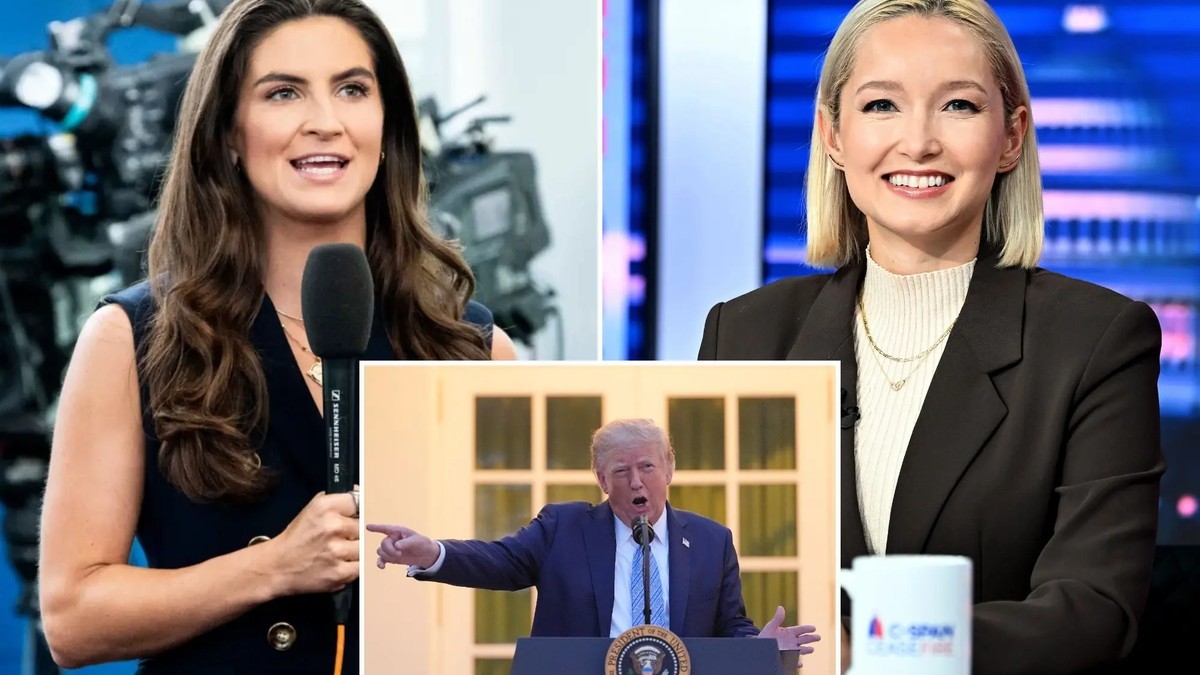
The White House Correspondents' Association, which represents the press corps, condemned the move through its president, Jacqui Heinrich, a senior White House correspondent for Fox News. "The president said it plainly in the Oval Office, describing his own planned action as a 'ban on the free press,'" Heinrich said in a statement.
She argued the constitutional protection does not turn on a president's opinion of a newsroom. "The Constitution protects the freedom of the press from government interference. That protection does not depend on whether the president likes a news organization's coverage, agrees with its reporting, or approves of the questions its journalists ask," she said.
Heinrich also framed the dispute as one that belongs to the public rather than to reporters. "This is about more than the rights of journalists. It is about the right of the American people to receive a full and independent account of the activities, policies and decisions of whoever occupies the nation's highest office," she said, adding that the association stands in defense of colleagues at CNN, MS NOW and Politico who are, in her words, being singled out for doing their jobs.
The Legal Ground Under the Announcement
Press freedom organizations were blunter. Bruce Brown, president of the Reporters Committee for Freedom of the Press, called a ban "flatly unconstitutional." He added: "The First Amendment is clear that once the White House invites in some journalists, it can't ban others because it doesn't like their reporting," describing the move as textbook viewpoint discrimination that would be quickly struck down by the courts if challenged.
Seth Stern, advocacy director at the Freedom of the Press Foundation, said it is difficult to imagine a more blatant violation of the First Amendment, and added that it would also be hard to imagine a dumber move. In his telling, the president's years of retaliation against the press have not produced the outcome he wanted, and the coverage has continued.
The precedent is mixed rather than settled. The U.S. Court of Appeals for the D.C. Circuit has previously held that once the White House opens general press facilities to journalists, access cannot be denied arbitrarily, and that restrictions on press passes must come with due process. But a divided appellate court said last year that the White House does have broader discretion over which journalists enter restricted spaces such as the Oval Office and Air Force One. That case, brought by the Associated Press, remains unresolved.
A Pattern This White House Has Been Building
Friday's announcement did not arrive from nowhere. In 2018, the White House revoked the credential of CNN reporter Jim Acosta, and a federal judge ordered the pass restored. Last year, the administration barred the Associated Press from press pool events in the Oval Office and on Air Force One after the wire service continued to use "Gulf of Mexico" instead of the president's preferred name for the body of water. That dispute is still being litigated.
The White House also took control of selecting the presidential press pool from the Correspondents' Association last year. The Pentagon attempted to impose a new press policy restricting journalists' ability to gather and report on sensitive information, which prompted a mass walkout by news organizations that refused to sign the pledge; a federal judge later ruled the policy unconstitutional. The Defense Department then issued a revised restrictive policy, which was also blocked, and that decision has been stayed pending appeal. Last month, the Treasury Department denied credentials to journalists seeking to cover a G20 meeting in North Carolina.
The Room Where a Ban Would Land
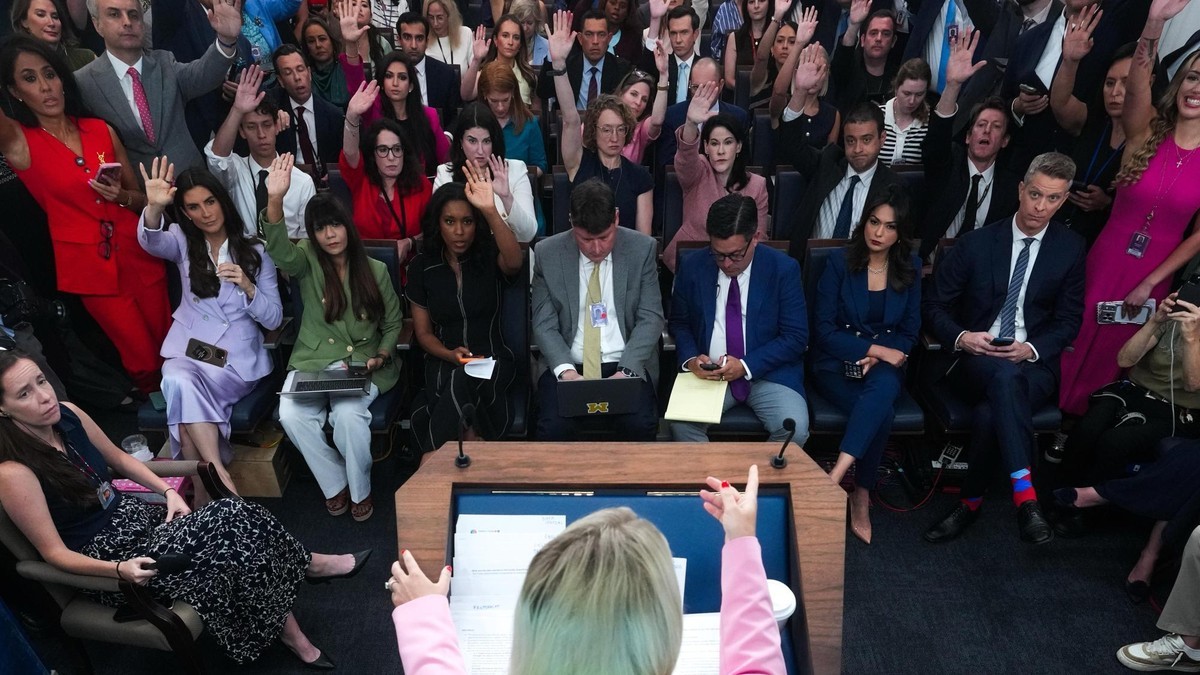
The practical site of this fight is a small theater in the West Wing. The James S. Brady Press Briefing Room was built in 1970, during the Nixon administration, to give a growing White House press corps more room, replacing a swimming pool installed in 1934 for Franklin Roosevelt's physical therapy. It holds 49 chairs. Each seat carries a plaque bearing the name of the news organization assigned to it, and the Correspondents' Association — not the government — decides who sits where. Roughly 200 journalists make up the White House press corps.
A ban would keep reporters from those seats, from Oval Office events and from press conferences. It is not yet clear whether any of that has actually been set in motion.
What the Public Says About Press Freedom
Public opinion on the question is more conditional than the principle suggests. A Pew-Knight analysis built on two surveys this year found that about three-quarters of U.S. adults value press freedom. Most said the government should not be able to require a news organization to take down a story that is critical of the government or clearly favors one political side. But about half said the government should be able to force a retraction when a story contains false information, and roughly six in ten said the same about a story that poses a risk to national security. The two polls surveyed 3,507 U.S. adults from March 23 to 29 and 3,488 U.S. adults from June 22 to 28, with margins of sampling error of about 1.9 and 1.8 percentage points.
Every President Has Been Tempted, and Told Not To
Other presidents have tested this same instinct. Al Jazeera's Alan Fisher noted that Lyndon Johnson used to rail about press coverage and that Richard Nixon wondered whether he could ban certain reporters from the White House, and that at every point they were told it was not a good look.
What Remains Unclear
Three things are unresolved. The first is scope: whether CNN, MS NOW and Politico are removed from the rotating press pool that travels with the president, barred from the White House grounds entirely, or kept out of the Oval Office alone. Trump indicated he favored the broadest version but gave no mechanism. The second is timing, which is complicated by the fact that the announcement was made effective immediately while the practice on the ground did not change on Friday. The third is whether any of the three outlets or a press freedom group files suit, and where.
Trump's other public business continues in parallel. He is due to address the United Nations General Assembly in New York, and to host Chinese President Xi Jinping at the White House in about a week.
By Jessica Ali, Staff Writer
This article was produced with AI-assisted research and editorial support. Sources: The Associated Press, Reuters, CNN, Politico, UPI, DW, Axios, The Guardian, BBC, Al Jazeera, The New York Post, Livemint, ANI, The Statesman, the White House Correspondents' Association, the Reporters Committee for Freedom of the Press, the Freedom of the Press Foundation, Pew Research Center and the White House archives.
What's Your Reaction?
 Like
0
Like
0
 Dislike
0
Dislike
0
 Love
0
Love
0
 Funny
0
Funny
0
 Wow
0
Wow
0
 Sad
0
Sad
0
 Angry
0
Angry
0

Editor-in-Chief at Global1.News. Atlanta-based journalist who cuts through the BS and tells it like it is. Lead anchor, host, and the voice you hear when the spin stops and the truth starts.











Comments (0)