
$100,000 To Work In US? Trump's Plan Threatens Indian Students' H-1B Dreams
The Trump administration is weighing a $100,000 fee for international graduates seeking employment in the United States under Optional Practical Training (OPT), a move that would fundamentally alter the economics of an American education for Indian students. According to a Wall Street Journal report published in late July 2026, the proposal is under active consideration at the White House, which said there is no imminent policy change but did not deny the plan exists.

The Trump administration is weighing a $100,000 fee for international graduates seeking employment in the United States under Optional Practical Training (OPT), a move that would fundamentally alter the economics of an American education for Indian students. According to a Wall Street Journal report published in late July 2026, the proposal is under active consideration at the White House, which said there is no imminent policy change but did not deny the plan exists. For India — the largest source of foreign students in America, with 363,019 enrolled in 2024/25 — this is not an abstract policy debate. It is a direct challenge to the pipeline that has sent hundreds of thousands of Indian graduates into the US technology workforce over the past two decades.
$100,000 OPT Fee: Trump's Latest Gambit Threatens Indian Students' US Dreams
New Delhi, India – July 31, 2026 — A Wall Street Journal report published this week has placed a new six-figure price tag on the American dream for international graduates, with the Trump administration considering a $100,000 fee for foreign students seeking to work in the United States after graduation under the Optional Practical Training (OPT) programme. The White House said no policy change is imminent but did not deny the proposal is under consideration, leaving hundreds of thousands of Indian students in limbo.
The Proposal: A $100,000 Price Tag on Post-Study Work
OPT is a programme that allows graduates on F-1 student visas to work in jobs related to their field of study after completing their education. For STEM graduates, employment authorisation can extend to 36 months, providing a critical bridge between a US degree and an employer-sponsored H-1B visa. The Wall Street Journal reported that the administration is now considering imposing a $100,000 fee on this pathway. The White House's response — neither confirming nor denying — suggests the proposal is being seriously evaluated.
The scale of the programme is substantial. The Institute of International Education reported that nearly 300,000 international students were on OPT as of last fall, roughly one-fourth of all foreign students in the US. The Times of India, citing the latest available data, put the figure at 419,000 foreign graduates working under OPT in 2024. A $100,000 fee applied across that population would represent a multibillion-dollar levy on the post-graduate workforce — and a prohibitive barrier for most individual students.
Why OPT Matters to Indian Students
India's stake in this programme is outsized. Open Doors 2025, released by the Institute of International Education on November 17, 2025, recorded 363,019 Indian students in the United States in 2024/25 — a 10 percent increase from the prior year and the largest of any source country. Total US international enrolment stood at 1,177,766, up 5 percent, meaning India alone accounts for nearly a third of all foreign students in America.
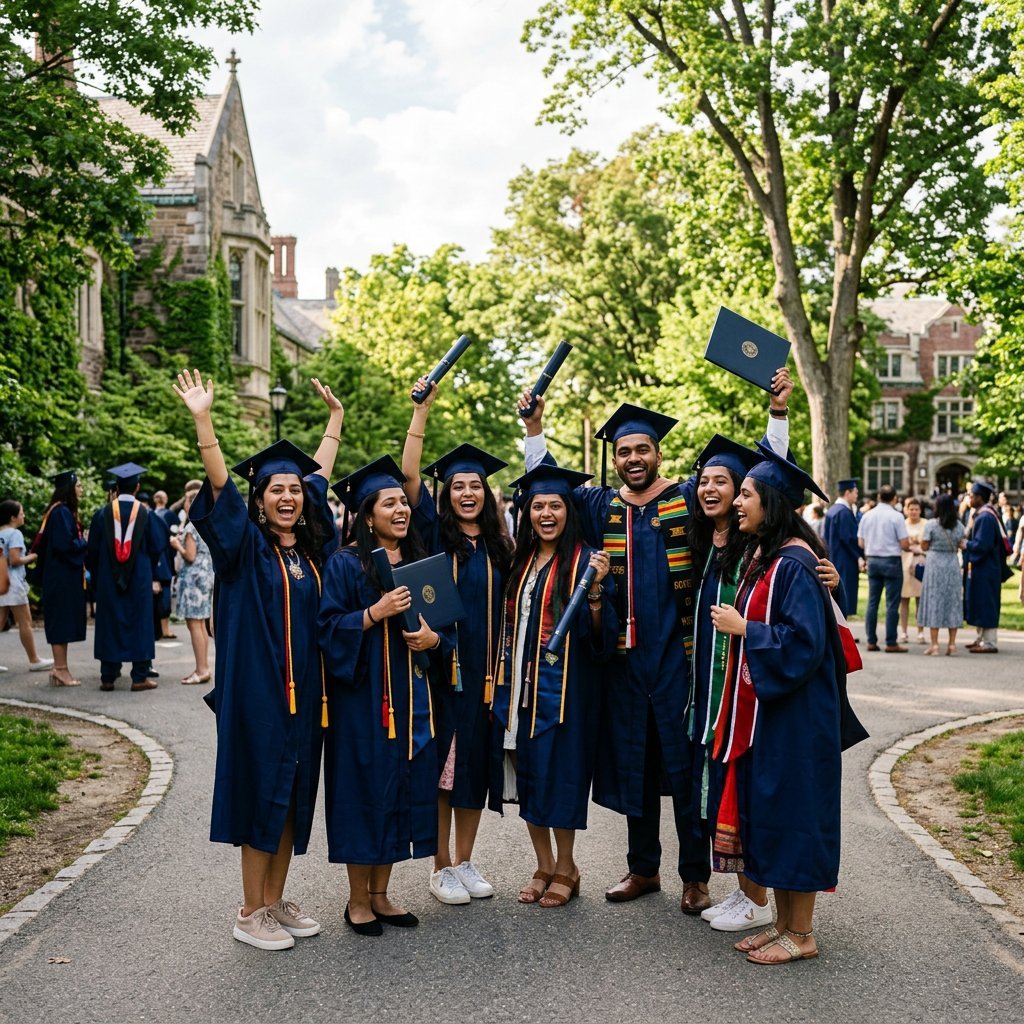
For these students, OPT is not a luxury; it is the primary mechanism by which a US degree converts into US employment. The 36-month STEM extension gives Indian graduates in engineering, computer science, and data analytics up to three years to secure an H-1B visa through the lottery system. Without OPT, the window between graduation and visa sponsorship narrows dramatically, and the practical value of a US education — already expensive at $50,000 to $70,000 per year at many institutions — diminishes correspondingly.
The Court Setback That Preceded This
This proposal follows a significant legal defeat for the administration on an identical fee structure. In September 2025, the White House required employers hiring new H-1B workers from abroad to pay a one-time $100,000 fee on top of existing visa charges. Previously, employers typically paid only a few thousand dollars in filing fees. A federal judge ruled that the administration exceeded its authority, determining that the fee functioned more like a tax than an administrative charge. The government appealed, but a federal appeals court in Boston recently refused to restore the fee while litigation continues. USCIS has paused collection of the $100,000 payment.
The OPT proposal appears designed to achieve through a different legal pathway what the H-1B fee could not. By attaching the charge to a student-visa programme rather than an employment visa, the administration may be attempting to sidestep the statutory constraints that doomed the earlier effort. Whether courts will view a $100,000 OPT fee as an administrative charge or a tax remains an open question — but the legal precedent from Boston suggests the administration faces an uphill battle.
A Pattern of Six-Figure Price Tags
The OPT fee is not an isolated proposal but part of a broader pattern. In February 2025, the administration pitched a 'Gold Card' residency programme at $5 million, later discussing a $1 million price point; it has not been implemented. In July 2026, reports emerged of a proposed $100,000 refundable bond for some green card applicants, also under consideration. The Economic Times has characterised the approach as 'keep announcing sky-high fees until one sticks.'
The strategy is clear: flood the policy space with aggressive pricing proposals, normalise the idea of six-figure fees for immigration benefits, and hope that courts or Congress accept at least one. For Indian applicants, the cumulative effect is uncertainty — planning a US education or career now requires betting on which fees will survive legal challenge and which will be struck down.
India's Official Response and Industry Exposure
India's government has responded with unusual directness. The Ministry of External Affairs said the H-1B fee hike is 'likely to have humanitarian consequences' — a pointed rebuke of a policy that affects hundreds of thousands of Indian professionals. Commerce minister Piyush Goyal went further, saying the US seems 'little afraid of our talent,' and urged NRIs to innovate in India rather than depend on American visas.
The economic stakes are substantial. India accounts for roughly 71 percent of H-1B visa holders, overwhelmingly in technology sectors. Indian IT firms — TCS, Infosys, and Wipro among them — rely heavily on H-1B visas for their US operations. A $100,000 OPT fee would not directly hit these companies, which hire experienced professionals rather than fresh graduates. But the pipeline matters: OPT is the entry point for the junior engineers and analysts who eventually become the senior H-1B workforce these firms deploy. Disrupting that flow would, within three to five years, constrict the talent pool available to Indian IT companies in the US market.
What This Means for India
The implications extend beyond individual students. Indian universities, which have expanded engineering and technology programmes in part to feed the US pipeline, may need to recalibrate. If the cost of a US work permit approaches $100,000, the return on investment for a US degree — already questioned by many Indian families — will face renewed scrutiny. Some students may redirect to Canada, the UK, or Australia, which have more permissive post-study work regimes. Others may stay in India, where the technology sector is growing but cannot absorb the full output of the country's engineering colleges.

There is also a strategic dimension. Piyush Goyal's comments reflect a broader government push to convert brain drain into reverse migration — to make India a destination for its own talent rather than an exporter. The OPT fee, if implemented, would accelerate that shift, though not necessarily in ways New Delhi controls. Indian students forced to return may bring valuable skills and global experience, but they will also face a domestic job market that pays a fraction of US salaries. The humanitarian consequences the MEA warned of are not rhetorical; they are the lived reality of families who have invested their savings in a US education that may no longer deliver a US career.
The Bottom Line
The $100,000 OPT fee proposal is the latest escalation in a sustained effort to price Indian talent out of the US labour market. With 363,019 Indian students in America, 419,000 foreign graduates on OPT, and India supplying 71 percent of H-1B holders, the policy targets the single largest demographic in the US skilled-immigration system. The courts have already blocked one $100,000 fee; whether they block this one remains to be seen. But the signal is unmistakable: the United States is redefining its relationship with foreign talent, and India — its largest supplier — must now plan for a future in which the American dream carries a six-figure price tag.
— By Dr. Raj Patel, Staff WriterThis article was produced with AI-assisted research and editorial support. Reporting is based on sources cited in the article.
What's Your Reaction?
 Like
0
Like
0
 Dislike
0
Dislike
0
 Love
0
Love
0
 Funny
0
Funny
0
 Wow
0
Wow
0
 Sad
0
Sad
0
 Angry
0
Angry
0

India/South Asia Correspondent at Global1.News. Analytical voice with a background in science and health journalism. Based in New Delhi, covering Indian politics, education, healthcare, technology, and policy. Breaks down complex data into clear, actionable reporting.














Comments (0)