
The Mecca Joint Defence Agreement: Saudi Arabia, Turkey and Pakistan Forge an Islamic NATO as the Iran War Grinds On
Saudi Arabia, Turkey and Pakistan signed a NATO-style mutual defence pact in Mecca on Friday amid the ongoing Iran war. The deal boosts collective deterrence, intelligence sharing and military ties as the Strait of Hormuz crisis threatens global energy flows. Jessica Ali breaks down what it means...
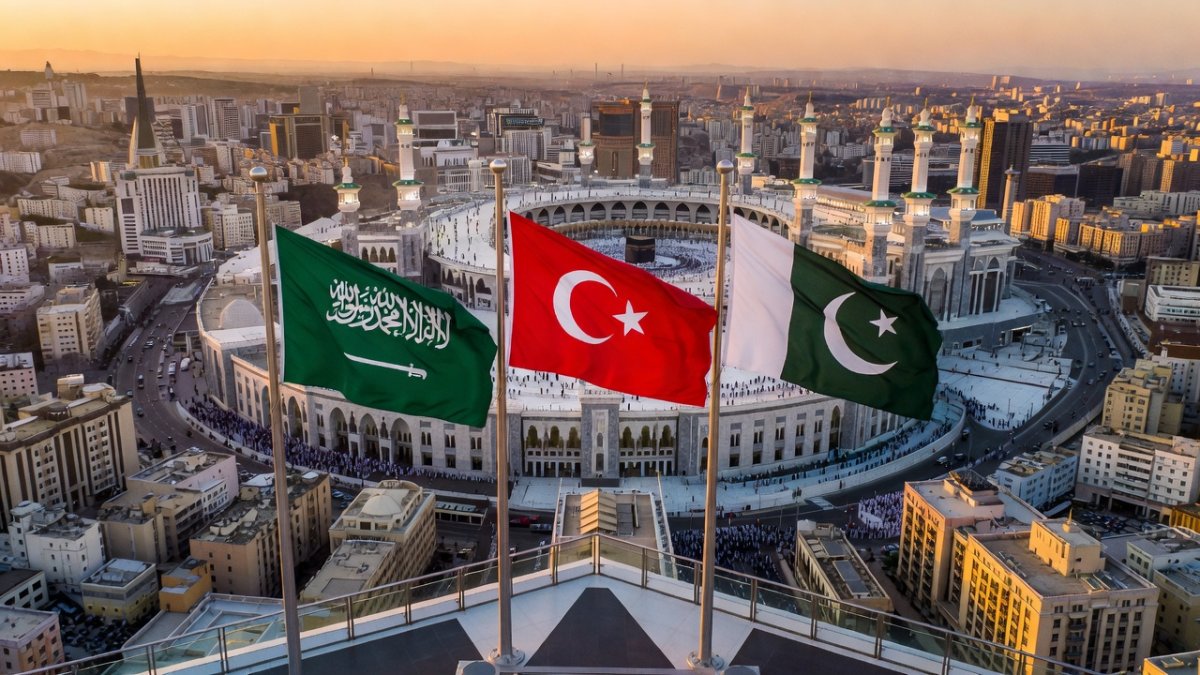
The world watches missiles fly over the Gulf as three major Muslim powers signed a mutual defence pact that could redraw alliances. On Friday in Mecca, Saudi Arabia, Turkey and Pakistan committed to treating an attack on one as an attack on all. The agreement responds directly to a war that has already disrupted energy markets and regional stability.
Mecca Joint Defence Agreement Reshapes the Middle East
Mecca, Saudi Arabia — Saudi Crown Prince Mohammed bin Salman, Turkish President Recep Tayyip Erdogan and Pakistani Prime Minister Shehbaz Sharif signed the Mecca Joint Defence Agreement today following the Mecca Summit on Joint Defence. The pact commits the three nations to collective defence, intelligence sharing, joint training and technology cooperation. A joint statement stressed their shared goal of promoting peace, stability and prosperity across the region and beyond. The signing took place on Friday, August 7, 2026, underscoring the urgency felt by all three capitals amid escalating regional tensions.
What the Mecca Pact Actually Says
The core clause mirrors NATO language: an armed attack on any signatory counts as an attack on all three. Pakistan's foreign ministry described the deal as one that will strengthen collective deterrence. Beyond the headline commitment, the agreement deepens day-to-day cooperation in intelligence, military training and defence technology development. Analysts note this builds on earlier bilateral ties, including the 2025 Strategic Mutual Defence Agreement between Saudi Arabia and Pakistan.
The pact's emphasis on technology cooperation opens doors for joint development of missile defense systems and cyber capabilities that none could achieve alone. Saudi funding could accelerate Turkish drone upgrades while Pakistani expertise in mountain warfare training adds depth to joint exercises. This layered approach means responses to threats can be calibrated quickly without endless bilateral negotiations.
The agreement also creates regular high-level military consultations that go beyond crisis response. These forums will review emerging risks from non-state actors and supply chain vulnerabilities in defense equipment. Over time this could standardize procurement across the three forces, cutting costs and boosting interoperability in ways that bilateral deals never managed.
The Iran War Context
Since February 28 this year, the United States and Israel have been locked in conflict with Iran and its regional allies after airstrikes killed several Iranian officials, including Supreme Leader Ali Khamenei. Iran and its partners have responded with missile and drone strikes on Saudi Arabia and other Gulf states while blockading shipments. The fighting has already sent waves of missile fire across Gulf oil exporters.
The Mecca agreement lands squarely inside this active war zone. Saudi Arabia has faced direct threats, and the three signatories clearly see value in closing ranks. The pact does not name Iran, yet every analyst quoted in today's coverage reads it as a Sunni counterweight to Iran-backed forces, as Iran International has noted.
Background on the conflict shows how proxy networks have stretched supply lines thin for all sides. Saudi Arabia's eastern provinces have absorbed repeated strikes that disrupted oil processing, forcing rapid repairs and heightened alerts. The three powers now see coordinated early warning as essential to avoid being picked off individually.
Why Now — The Strait of Hormuz Crisis
The United States is currently blockading Iran's ports and the Strait of Hormuz, through which roughly a fifth of the world's energy flowed before the war. Iran has been negotiating with Oman to reopen the waterway, claiming a deal on route coordinates is on the verge of being finalised. President Trump has said the war cannot go much longer and that a Hormuz agreement is close, one that would also address concerns over Iran's nuclear program.
Trump warned Iran it would face a very hard response if talks collapse, and he cancelled a threatened strike over the weekend citing progress. Energy markets are watching every development because any prolonged closure of the strait would spike prices worldwide. The Mecca pact arrives at exactly this pressure point, giving the three nations a framework to coordinate if the Hormuz situation deteriorates further.
Even a partial reopening carries risks if enforcement mechanisms remain unclear. The signatories know that any new blockade attempt could trigger immediate consultations under the pact. This readiness gives them leverage in back-channel talks while reassuring global buyers that alternative routing plans are already being modeled.
Three Armies, One Umbrella — What Each Country Brings
Pakistan enters as the Muslim world's only nuclear-armed state and brings decades of training experience with Saudi forces. Turkey contributes advanced drone technology and recent naval and air training exchanges with Pakistan. Saudi Arabia supplies funding muscle and strategic location at the heart of the Gulf. Earlier deals, such as Riyadh's 2023 purchase of Turkish drones described as Ankara's largest defence export contract, show the practical ties already in place.
This is a division of labour that multiplies each country's reach. The combined effect is a defence network that can share real-time intelligence and rotate training programs without waiting for outside approval.
Turkey's recent warship and aircraft exchanges with Pakistan have already produced shared tactics for protecting sea lanes. Saudi Arabia's financial backing can now scale those programs across all three militaries. The result is a practical web of capabilities that addresses both conventional threats and asymmetric attacks from proxies.
'Islamic NATO' or Something Looser?
Commentators are already labelling the pact an emerging Islamic NATO because of the collective-defence trigger. Yet the agreement stops short of creating a standing command structure or integrated forces. It focuses instead on consultation, shared exercises and technology cooperation. The joint statement avoided military bloc language and emphasised regional stability.
The label may overstate the formality, but it captures the direction of travel. Three large Sunni powers have tied their security futures together at a time when Iran-backed networks are active across multiple fronts. Whether it hardens into something more NATO-like will depend on how the current war evolves.
Analysts from outlets including Reuters and The Economist note that the absence of a permanent headquarters keeps political flexibility high. Each capital retains veto power over major decisions. This loose structure may prove more durable than rigid alliances when domestic politics shift or when economic pressures mount.
The Gulf's Nervous Neighbours
India is monitoring the Turkey-Pakistan leg of the triangle especially closely because of existing regional tensions. Experts quoted across Reuters, Al Jazeera and The Economist say the pact will reshape the security architecture of West Asia. Iran International framed the deal as tying three Sunni powers together against Iran-backed forces.
Global readers should feel the ripple effects in their fuel bills and supply chains. When three major energy players and military contributors coordinate this tightly, every shipping lane and oil terminal becomes part of the calculation. The agreement signals that these capitals will not face threats in isolation.
Neighbouring states are quietly recalibrating their own defence postures. Some are exploring quiet outreach to the Mecca signatories while others strengthen ties with alternative partners. The pact's ripple effects extend well beyond the three capitals and into the broader balance of power across Asia.
What Happens Next
The immediate test will be whether the Hormuz talks produce a lasting opening or collapse back into confrontation. Trump has tied any final deal to both the strait and nuclear concerns, and he has kept the option of force on the table. The Mecca signatories will now have to decide how tightly they coordinate responses if the war widens.
Coordination mechanisms will be tested first in intelligence sharing on proxy movements. Joint training cycles are expected to begin within months, focusing on rapid response to missile threats. The three capitals know that visible unity may deter further escalation even before any formal activation of the collective defence clause.
What It Means for the Global Economy
Energy traders are already pricing in the new reality. When Saudi Arabia, Turkey and Pakistan coordinate on Hormuz security, any disruption to tanker traffic hits harder and faster across Asia and Europe. Supply chains that rely on Gulf crude now face an extra layer of political risk that was absent just weeks ago.
Consumers worldwide will feel this in higher fuel costs and delayed shipments of everything from electronics to food. The pact gives the three nations a shared voice in protecting key lanes, yet it also raises the stakes if talks with Iran stall. Markets hate uncertainty, and this agreement just added another variable to an already volatile equation. Watch the oil terminals and keep an eye on those shipping lanes.
By Jessica Ali, Staff Writer
This article was produced with AI-assisted research and editorial support. Reporting is based on sources cited in the article.
What's Your Reaction?
 Like
0
Like
0
 Dislike
0
Dislike
0
 Love
0
Love
0
 Funny
0
Funny
0
 Wow
0
Wow
0
 Sad
0
Sad
0
 Angry
0
Angry
0

Editor-in-Chief at Global1.News. Atlanta-based journalist who cuts through the BS and tells it like it is. Lead anchor, host, and the voice you hear when the spin stops and the truth starts.












Comments (0)