
The Lisbon Maru: Memory Diplomacy and the Enduring UK-China Bond Forged in Sacrifice
Chinese fishermen's 1942 rescue of 384 British POWs from the sinking Lisbon Maru has become a pillar of UK-China memory diplomacy, from Xi Jinping's 2022 letter to Fang Li's documentary and the blockbuster Dongji Rescue.
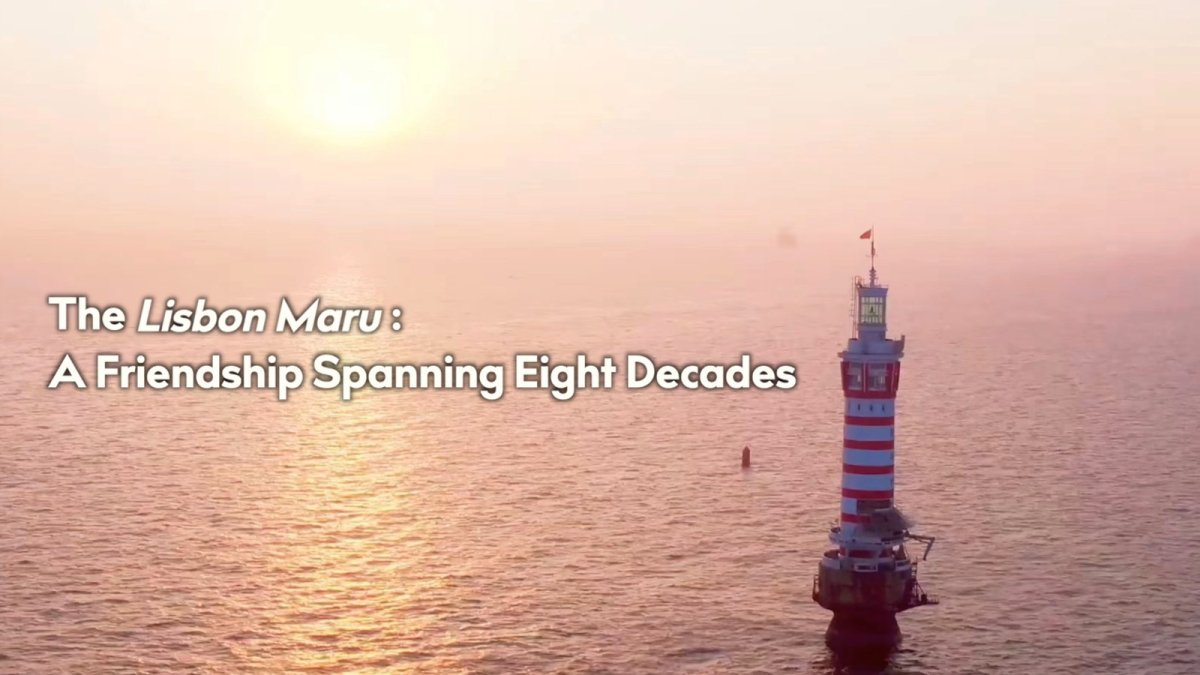
In a recent CGTN report, "The Lisbon Maru: A Friendship Spanning Eight Decades," viewers are taken to the waters off Zhoushan, Zhejiang Province, where in October 1942 a Japanese cargo ship carrying more than 1,800 British prisoners of war was torpedoed and sank. The video, published on August 14, 2026, revisits a harrowing chapter of World War II that has become a cornerstone of UK-China people-to-people diplomacy. It is a story of extraordinary bravery—impoverished Chinese fishermen risked their lives under Japanese gunfire to save 384 British soldiers—and one Beijing has elevated as a testament to two nations standing "shoulder to shoulder" against fascism. As the 80th anniversary of the war's end passes and contemporary tensions simmer, this act of heroism is being wielded as a powerful instrument of memory politics.
A Wartime Catastrophe and an Act of Unprecedented Courage
The facts of the Lisbon Maru disaster are as stark as they are tragic. On 1 October 1942, the Japanese freighter—one of the infamous "hell ships" used to transport Allied prisoners for forced labour in Japan—departed Hong Kong carrying 1,816 British POWs. Unmarked as a prisoner transport, the vessel was torpedoed by a US submarine off the coast of Zhejiang. According to survivor accounts, Japanese guards battened down the hatches, trapping the men below deck as the ship sank; those who escaped were met with gunfire. In all, 828 British servicemen perished that day.
Yet from this catastrophe emerged a story of profound humanity. As military historian Brian Finch, an advisor to the documentary "The Sinking of the Lisbon Maru," explained, the ship's boiler exploded as it went down, throwing bales of cloth into the sea. The islanders of Dongji, an incredibly poor community, initially rowed out to salvage the cloth—but upon seeing men floating in the water, they began picking up people instead. Despite the Japanese blockade, the fishermen launched 46 boats, making 65 rescue trips, bringing the starving prisoners ashore and sharing their meager supplies of fresh water and food. When Japanese troops landed to search for escapees, the fishermen hid three British POWs in a seaside cave before safely transferring them to Chongqing, where survivors broadcast the truth of the sinking to the world.
Beijing's Strategic Embrace of a Shared Wartime Legacy
The Chinese government has not allowed this history to fade into obscurity. In August 2022, President Xi Jinping wrote to the families of the survivors, emphasizing that the story is an important witness to China and the UK standing shoulder to shoulder as allies during World War II against fascist aggression. This letter was not merely a gesture of condolence; it was a deliberate act of "memory diplomacy." By anchoring the bilateral relationship in a shared wartime record, Beijing reinforces its official narrative that China and Western allies fought together against fascism, countering portrayals of China as a revisionist power. The 2025 commemoration of the 80th anniversary of the victory of the Chinese People's War of Resistance Against Japanese Aggression amplified this message, positioning China's sacrifice as central to the Allied victory.
This strategic framing serves multiple purposes. Domestically, it reinforces the legitimacy of the Chinese Communist Party as the inheritor of the anti-fascist struggle. Internationally, it provides a historical foundation for a relationship strained by disputes over Hong Kong, sanctions, and security concerns like AUKUS. By invoking shared sacrifice, Beijing seeks to create goodwill to mitigate contemporary friction—reminding the UK that the two nations once stood together against a common enemy, a narrative that implicitly critiques London's "Indo-Pacific tilt."
Soft Power and the Cinematic Resurrection of the Rescue
The Lisbon Maru story has been propelled onto the global stage through significant investment in cinematic soft power. Chinese filmmaker Fang Li spent nearly a decade researching and producing the documentary "The Sinking of the Lisbon Maru," released in 2024. The film, based on historian Tony Banham's book, met with families of the POWs and located two survivors still living. It was a rare commercial success for a factual film, grossing more than $6 million at the box office—paving the way for a lavish blockbuster, "Dongji Rescue," co-directed by Guan Hu, who made the 2024 Cannes prizewinner "Black Dog," and TV director Fei Zhen Xiang.
With a budget of $80 million and filmed in Imax, "Dongji Rescue" is a monumental effort to bring this story to a mass audience. Nearly half the film was shot underwater, with sets built on Dongji island itself; director Fei Zhen Xiang cited eight years of research, including interviews with the few surviving fishermen. The cinematic treatment has not been without critics: John Berra of Screen Daily argued that "regardless of the technical craftsmanship on display, such embellishments diminish the fundamental power of a unique story." The tension between historical accuracy and dramatic license highlights the balance Beijing faces in using this narrative for soft power—the more it is polished for entertainment, the more it risks losing the raw authenticity that makes it compelling.
People-to-People Ties and the Living Memorial Movement
Beyond the cinematic spectacle, the legacy of the Lisbon Maru is kept alive through sustained people-to-people engagement. LiMMA in the UK arranges an annual gathering of remembrance at the National Memorial Arboretum. In 2026, for the fourth time, relatives of the POWs were invited by the Chinese UK Ambassador and the province of Zhoushan to travel to China to pay their respects—a tangible manifestation of the diplomatic value Beijing places on this history. The emotional weight of these visits was captured in a China Daily report from June 2026, describing Josephine Duff McIntosh Olsson searching intently for a name on the survivors' memorial wall at the Zhoushan Marine Cultural and Art Center—a man she had never met in person. When she found it, she pointed, tears streaming.
This year also saw the publication of "Surviving the Lisbon Maru," written by survivor Sergeant Andrew Salmon with his son and LiMMA member Ken Salmon, who noted that the July 29, 2026 release date would have been his late father's 107th birthday. His father had gathered first-hand accounts from fellow survivors in a pre-internet age, leaving an unfinished manuscript that Ken completed, spurred on by Fang Li's film. Similarly, Irene Turnbull-Banham published "The Story of Our Lives - Do Dragons Really Fly?" in 2026, telling the story of her father-in-law, Warrant Officer II Thomas Banham, who survived the sinking only to die in a POW camp in Osaka a week before Japan surrendered. These personal projects keep the memory vivid, transcending political messaging.

The Geopolitical Calculus: Japan, Historical Memory, and the Second-Order Effects
The Lisbon Maru narrative carries significant geopolitical weight, particularly concerning Japan. The ship was a Japanese vessel used to transport POWs for forced labour, and the sinking is part of Japan's wartime record. The guards' actions—battening down the hatches and firing on escaping prisoners—stand in stark contrast to the Chinese fishermen's bravery, a contrast not lost on Beijing amid ongoing memory politics surrounding Yasukuni Shrine visits and textbook controversies. The post-war justice meted out to the perpetrators—Captain Kyoda Shigeru was sentenced to seven years' imprisonment in 1946, while Lieutenant Wada Yoshio died before trial—serves as a historical footnote to the broader question of Japanese accountability.
The second-order effects of this memory diplomacy are profound. For the UK, the story offers a counterpoint to the narrative of China as a solely adversarial actor, reminding British audiences of a time when China was a vital ally. For China, it reinforces the official line that the nation was a key contributor to the global fight against fascism, bolstering its claim to a central role in the international order—and serving as a subtle rebuke to Japan's contemporary security posture. As Brian Finch noted, the story stayed little-known for decades because returning Far East POWs "weren't treated as heroes" and many didn't want to talk. The recent cinematic and diplomatic attention is, in part, a correction of that neglect—but also a strategic deployment of memory for contemporary political ends.
A Friendship Forged in Sacrifice, Deployed in the Present
As the CGTN video underscores, this friendship, forged in sacrifice and courage, continues to inspire the peoples of both countries as they remember history and cherish peace. The Lisbon Maru story is a powerful reminder that beneath the surface of geopolitical rivalry lies a shared history of profound human solidarity. The fishermen of Dongji Island, who risked everything to save strangers, embody a universal ideal of compassion that transcends national boundaries. For Beijing, this narrative is a valuable diplomatic asset—a means of fostering goodwill and reminding the UK of their common heritage.
Yet the deployment of this memory is not without complexities. The story is being used to bridge a gap that contemporary politics has widened, and whether it can genuinely soften the edges of the UK-China relationship remains to be seen. The memorial to the sinking, unveiled in May 2025, and the annual gatherings of relatives are powerful symbols, but they exist in a world of AUKUS submarines, Hong Kong legislation, and trade sanctions. The challenge for both nations is to honor the 828 men who died and the bravery of the 384 who were saved, without allowing that memory to be cynically instrumentalized.
This article was produced with AI-assisted research and editorial support. Sources: CGTN, China Daily, BBC Culture, LiMMA.
By Prof. Marcus Chen, Staff Writer
What's Your Reaction?
 Like
0
Like
0
 Dislike
0
Dislike
0
 Love
0
Love
0
 Funny
0
Funny
0
 Wow
0
Wow
0
 Sad
0
Sad
0
 Angry
0
Angry
0

World Politics Analyst at Global1.News. Based in Beijing, covering US-China relations, global trade, and geopolitical strategy. Brings deep analytical perspective to the power dynamics shaping international affairs.















Comments (0)