
Paraguay senate impeaches President Peña, vice assumes office
Paraguay’s political landscape was dramatically reshaped on Friday when the Senate voted to impeach President Santiago Peña, removing him from office after a banking crisis that left millions of citizens unable to access their savings.
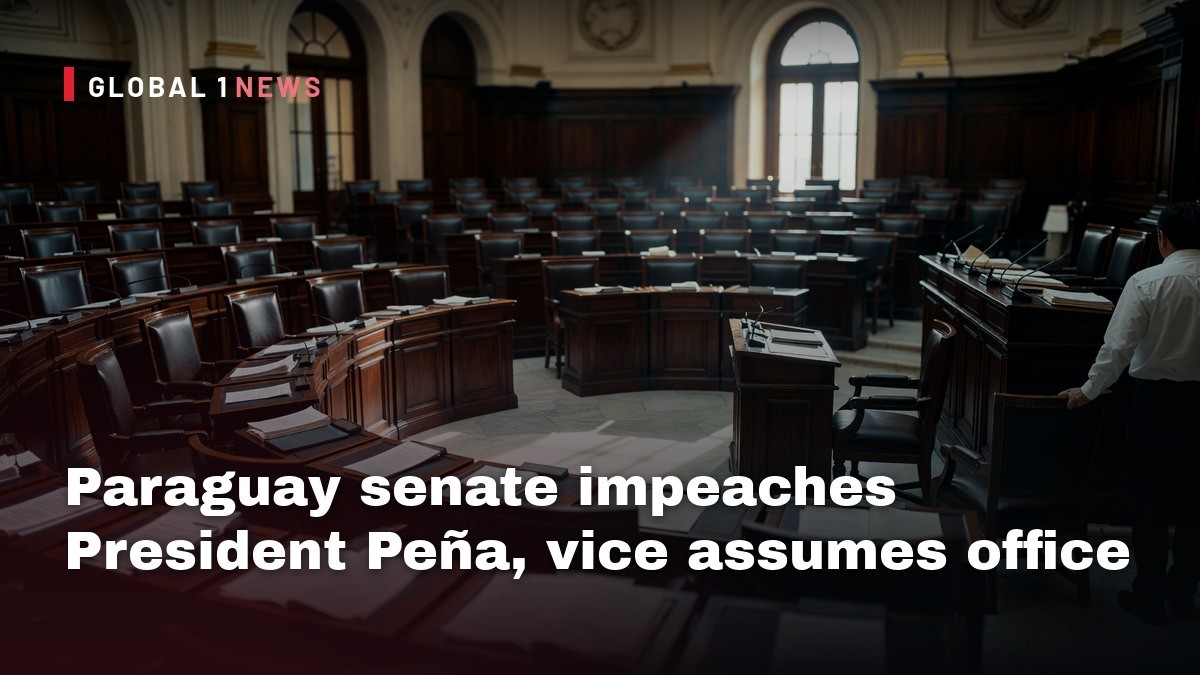
Paraguay’s political landscape was dramatically reshaped on Friday when the Senate voted to impeach President Santiago Peña, removing him from office after a banking crisis that left millions of citizens unable to access their savings. The decisive vote—44 out of 45 senators in favour, with one lawmaker absent—ushered former Vice‑President Pedro Alliana into the presidency, where he will serve the remainder of the term until 2028. The episode, driven by accusations of poor performance and alleged ties to the collapsed Ueno Bank, underscores how financial turmoil can ignite swift political change in Latin America, echoing similar upheavals across the continent.
From banking collapse to impeachment
The trigger for the impeachment was the sudden failure of Ueno Bank, a financial institution that had been a cornerstone for many Paraguayans. When the bank collapsed, it reportedly left millions of depositors stranded, unable to withdraw their funds. Public anger surged, and the Senate acted on the grounds that President Peña’s “poor performance in his duties” contributed to the crisis. Senate President Basilio Núñez announced the outcome, describing the president as guilty of inadequate stewardship of the economy.
Prosecutor Silvia Margarita González Vester confirmed that Peña was placed under house arrest immediately after his removal. The Attorney General’s office has opened a formal investigation into alleged irregularities, including breach of trust, influence peddling and misappropriation of public funds linked to the supervision and resolution of Ueno Bank. These charges reflect a broader regional pattern where leaders are held accountable for financial mismanagement, as seen in recent scandals in Brazil and Argentina.
Alliana’s promise to the affected depositors
Sworn in on the same day, Pedro Alliana pledged that no Paraguayan “compatriots who are now going through a difficult time as a result of the financial collapse will be abandoned.” He promised full compensation for those who lost their savings, signalling a government‑led remediation effort. Alliana’s promise mirrors the commitments made by other African leaders facing banking crises, where swift state intervention is often deemed essential to restore confidence.
While an impeachment motion against Alliana over the same crisis failed to secure congressional approval, the new president’s immediate focus is on stabilising the financial system and delivering relief to depositors. The Central Bank has already begun an initial payment programme, with José Maciel of the Deposit Guarantee Fund stating that eligible customers could receive up to approximately $1,600 per person, provided they have no outstanding loans and hold accounts with other Paraguayan banks. This phased approach aims to rebuild trust while the broader compensation framework is developed.
Political fallout and institutional reshuffling
The banking debacle has reverberated through Paraguay’s institutional fabric. Central Bank President Carlos Carvallo and Interior Minister Enrique Riera have both been removed from their posts, reflecting a swift purge of officials deemed responsible for oversight failures. Additionally, eight executives of Ueno Bank have been arrested, and police have conducted searches at several locations tied to Grupo Vázquez, the conglomerate that owned the failed bank.
These actions illustrate a broader trend across the continent where financial scandals precipitate rapid changes in governance structures. In Nigeria, for instance, recent banking reforms have seen senior officials replaced to restore market confidence. Paraguay’s response, though still unfolding, signals a determination to hold both public and private actors accountable.
Public outrage and street protests
Hundreds of demonstrators gathered outside the National Congress in Asunción on the day of the impeachment, celebrating the Senate’s decision and demanding the return of their savings. Protester Jessica Aquino, 32, voiced a common sentiment: “Justice has been done. Now we want him to give us back our money and go to jail.” Similar protests have erupted in other Paraguayan cities, with demonstrators staging nightly rallies to press for swift compensation.
At one rally, Cynthia Farina recounted how the crisis had impacted her family, noting that her son’s savings were tied up in Ueno Bank. Such personal testimonies highlight the human cost of the collapse, echoing the stories of ordinary citizens across Africa who have faced bank failures and the resulting loss of livelihood.
Regional spill‑over effects
The repercussions of the Ueno Bank failure have crossed Paraguay’s borders. Approximately 1,000 employees of ITTI, a technology firm linked to Grupo Vázquez in neighboring Argentina, were suspended for 30 days without pay. This illustrates how corporate groups operating across borders can transmit financial shocks throughout the region, a dynamic familiar to many African economies where cross‑border trade and investment are integral.
Moreover, the football sector in Paraguay has felt the impact, as Ueno Bank was a sponsor of top‑flight clubs and the national team. Players took to social media to acknowledge the crisis, underscoring how financial instability can affect even cultural institutions that bind societies together.
International reactions and diplomatic nuance
The United States Embassy in Paraguay issued a statement of solidarity with the Paraguayan people on the day of the impeachment, though it stopped short of commenting directly on President Peña’s removal. Such diplomatic caution is typical when foreign governments navigate internal political shifts, balancing respect for sovereignty with concerns over regional stability.
In the broader African context, similar diplomatic language has been employed by foreign missions during political transitions triggered by economic crises, reflecting a common approach to maintain constructive engagement while avoiding overt interference.
Looking ahead: rebuilding trust and institutions
President Alliana now faces the daunting task of restoring confidence in Paraguay’s financial system while delivering on his promise of full compensation. The phased payment programme launched by the Central Bank is a start, but the scale of the crisis—millions of depositors affected—means that a comprehensive settlement will require sustained political will and transparent mechanisms.
Paraguay’s experience offers a cautionary tale for other emerging economies: the intertwining of political leadership and private financial interests can precipitate systemic crises that quickly become political flashpoints. As the nation works to rebuild its institutions, the eyes of the continent are on how effectively it can turn this upheaval into a catalyst for stronger governance, greater accountability, and a more resilient financial sector.
This article was produced with AI-assisted research and editorial support. Reporting is based on the source material cited below. Sources: Daily Post Nigeria; dailypost.ng; Global1.News (07 November 2026).
By Sarah Okafor, Staff Writer
What's Your Reaction?
 Like
0
 Dislike
0
 Love
0
 Funny
0
 Wow
0
 Sad
0
 Angry
0

Africa Correspondent at Global1.News. Based in Lagos, covering politics, business, technology, and culture across the continent. Focused on telling African stories beyond the headlines — the innovation, entrepreneurs, and communities shaping the region's future.









Comments (0)