
Long March 7A Explodes in First Failure Since 2020, Raising Questions Over China's Ambitious Launch Tempo
A Long March 7A rocket exploded about 90 seconds after liftoff from Wenchang on 10 August, destroying the ChinaSat-4B satellite in the vehicle's first failure since 2020. Analysts weigh the impact on China's launch tempo, the shared YF-100 engine family, and Space Silk Road ambitions.
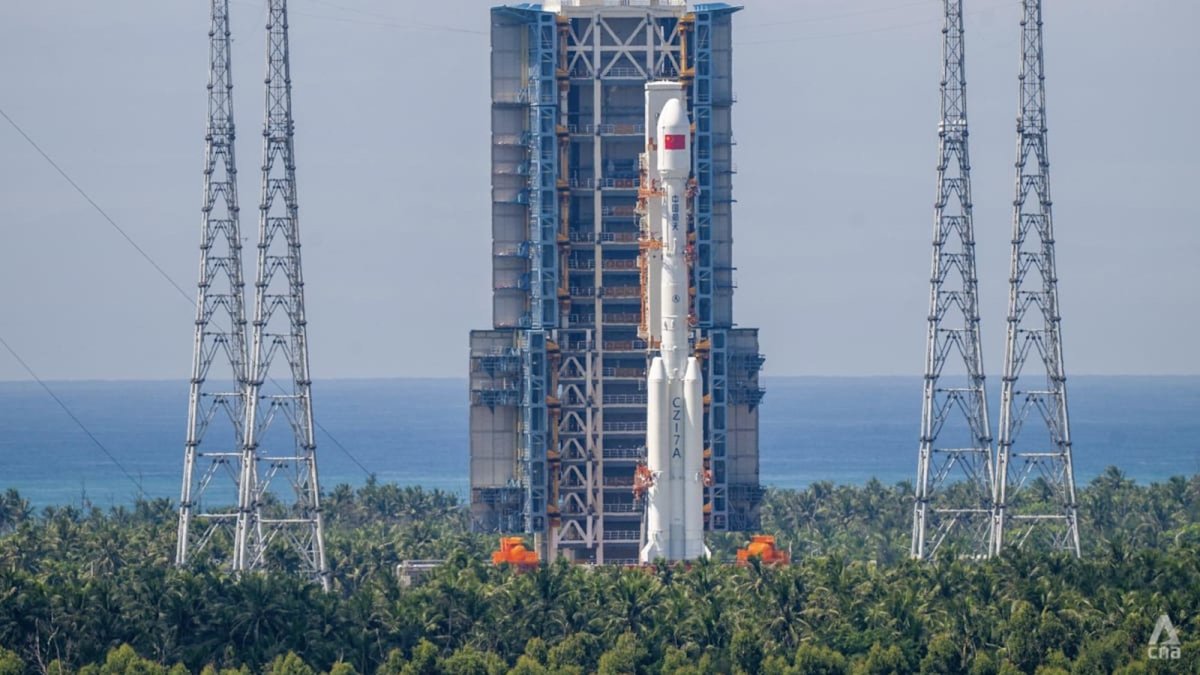
A Chinese Long March 7A rocket exploded roughly 90 seconds after liftoff from the Wenchang Space Launch Site on Hainan Island on Monday evening, marking the vehicle's first failure since its troubled maiden flight in 2020 and dealing a rare setback to a space program that has set records for launch cadence.
The rocket lifted off at 8:02 p.m. Beijing time (1202 GMT) on 10 August 2026, carrying the ChinaSat-4B communications satellite. Video footage and eyewitness accounts captured the vehicle breaking apart in a bright fireball over the South China Sea within about 85 to 90 seconds of launch. Xinhua, China's state news agency, reported that the rocket suffered an "anomaly during flight" and confirmed that both the launcher and its payload were lost. The cause of the failure is under investigation.
A Second Failure in 18 Missions
Monday evening marked the Long March 7A's 18th mission and its second failure since an unsuccessful maiden flight in March 2020. After that initial failure, the rocket successfully reached space a year later and subsequently completed more than a dozen successful missions, according to Chinese launch records reviewed by Reuters. The vehicle's previous mission before Monday was on 29 July, when a Tianlian data-relay satellite was sent into orbit.
Jonathan McDowell, an astronomer and spaceflight expert at Durham University, said the footage indicated the rocket was destroyed at relatively low altitude and velocity, meaning the payload never reached orbit. "It is very significant. A failure on (the) first launch is not unexpected. A failure on launch number 18 raises doubts as to the rocket's reliability," McDowell told CNA. He added that he expects no further CZ-7A launches until the end of the year.
The failed mission carried ChinaSat-4B, also known as Zhongxing-4B, believed to be from the same family as ChinaSat-4A, which China placed into orbit in 2024. State media has described ChinaSat-4A as a satellite offering voice and data transmission as well as radio and TV broadcasting services. The satellite was intended for a high orbit.
Technical Profile and Shared Systems
The Long March 7A is a medium-lift rocket primarily used to send satellites into high orbit. It is a new-generation member of the Long March family, using a kerosene and liquid-oxygen propellant combination designed to replace older, more toxic propellant systems. The rocket shares propulsion and integration systems with other vehicles in China's current fleet, which means the investigation could have implications beyond this single mission.
Clayton Swope, deputy director of the Aerospace Security Project at the Center for Strategic and International Studies (CSIS), said he expects "a significant pause on the launch of a variety of CALT-built rockets using similar engines." CALT, the China Academy of Launch Vehicle Technology, is a subsidiary of state-owned China Aerospace Science and Technology Corporation (CASC) and a key developer of the Long March family, including the 7A.
"China is going to want to understand what caused this issue before launching another Long March 7 and, possibly, before launching a rocket that uses the YF-100 engines or a variant," Swope said. The YF-100 is a liquid-fuel engine used across several newer-generation Long March rockets, including models in the 5, 6 and 7 series.
Investigators Focus on Propulsion and Structure
Svetla Ben-Itzhak, assistant professor of space and international relations at Johns Hopkins University's School of Advanced International Studies (SAIS), noted that the failure occurred "relatively early" in the flight, so "investigators may be particularly interested in the vehicle's propulsion and structural integrity." She said the incident interrupted a "fairly long period of demonstrated reliability" for the Long March 7A.
"If it is specific to the 7A, the effects could remain quite contained," Ben-Itzhak said. She also placed the failure in broader context: "For more mature programmes, such as China's, spacefaring nations plan for absolute success but risk-manage for failure. Launch failures are an unavoidable part of operating a space programme, especially at the scale and tempo that China is conducting them."
Record Cadence Meets Rising Risk
China conducted a record 93 space launches in 2025, up sharply from 68 in 2024 and 67 in 2023, according to the state-run People's Daily. Before Monday, China's most recent launch failure was in April 2026, when the Tianlong-3 commercial rocket did not complete its maiden flight. In January, separate missions by a Long March 3B and the commercial Ceres-2 rocket also went awry. Pandaily reported that the Long March 7A failure was China's fourth orbital launch failure of 2026 and that the accident triggered a stand-down on the vehicle, reshuffling follow-on missions including LandSpace's Zhuque-3 maiden attempt.
The failure pattern is not unique to China. In December 2025, Japan's flagship H3 rocket failed during a mission, losing a navigation satellite, before bouncing back with a successful launch in June 2026. In July 2024, SpaceX's workhorse Falcon 9 broke apart in space, resulting in the loss of 20 Starlink satellites — its first mission failure in more than seven years. US aviation regulators temporarily grounded the Falcon 9 before clearing its return to space 15 days later.
Strategic Stakes Beyond the Launch Pad
China's space program is not merely a scientific endeavor. It functions as a strategic national-power tool tightly woven into military, economic and diplomatic objectives, according to analyses by the United States-China Economic and Security Review Commission (USCC). Beijing uses space capabilities to advance the Belt and Road Initiative and expand what analysts call the Space Silk Road, building long-term dependencies through satellites, launch services and ground infrastructure offered to partner nations.
Launch failures carry commercial consequences. They can erode confidence among state-linked and foreign customers who purchase Chinese launch services or rely on Chinese-built satellites. Insurance premiums for future missions may rise, and competitors in the United States, Europe and India could see an opening to capture contracts from risk-averse clients. The timing is particularly sensitive given China's push to position itself as a launch-services provider for the Global South, where cost considerations often outweigh the risk tolerance of Western customers.
Impact on Upcoming Missions
The immediate question is whether the failure will delay China's ambitious 2026 manifest. The Chang'e-7 lunar mission is scheduled to launch in the second half of 2026 from Wenchang, targeting the moon's south pole to examine surface characteristics and resources such as permanent shadowed regions, and to test technologies for lunar landing and surface mobility. In July, the China National Space Administration announced the arrival of the Long March 5 rocket at the Wenchang launch complex for assembly and testing with the Chang'e-7 spacecraft.
The Long March 5 is a different rocket from the Long March 7A, so the 10 August failure does not by itself establish that Chang'e-7 will be delayed. However, if the investigation identifies issues with shared components such as the YF-100 engine or common integration systems, the pause could extend beyond the 7A. Chinese authorities have not indicated how long the fleet might be grounded. Any delay beyond a few weeks could disrupt an ambitious 2026 launch manifest that includes scientific, military and commercial payloads.
Reliability, Tempo, and the Path Forward
The Long March 7A's record — 16 successful missions out of 18 attempts — is respectable by global standards, but the failure raises questions about the sustainability of China's launch tempo. The program's rapid expansion has been a point of national pride and a pillar of Beijing's technological self-sufficiency narrative. Each failure invites scrutiny not only of engineering practices but also of the pressure to maintain record cadences.
For now, the focus will be on the investigation's findings. The pattern of Chinese launch failures in 2026 — four in eight months — suggests that the pace of operations may be outpacing the industry's ability to absorb lessons from each anomaly. As Ben-Itzhak noted, failures are an unavoidable part of operating a space program at scale. The question for Beijing is whether the current tempo is sustainable, and whether the strategic benefits of the Space Silk Road can withstand the reputational costs of repeated setbacks.
This article was produced with AI-assisted research and editorial support. Sources: BBC News, Reuters, CNA, Rio Times, IBTimes.
By Prof. Marcus Chen, Staff Writer
What's Your Reaction?
 Like
0
Like
0
 Dislike
0
Dislike
0
 Love
0
Love
0
 Funny
0
Funny
0
 Wow
0
Wow
0
 Sad
0
Sad
0
 Angry
0
Angry
0

World Politics Analyst at Global1.News. Based in Beijing, covering US-China relations, global trade, and geopolitical strategy. Brings deep analytical perspective to the power dynamics shaping international affairs.














Comments (0)