
The cows were their livelihood. The goats, their insurance. Then the flood came.
When the Brahmaputra swelled beyond its banks on 19 July, the floodwaters that surged through Assam did more than drown fields—they threatened the very foundations of rural economies that depend on livestock.
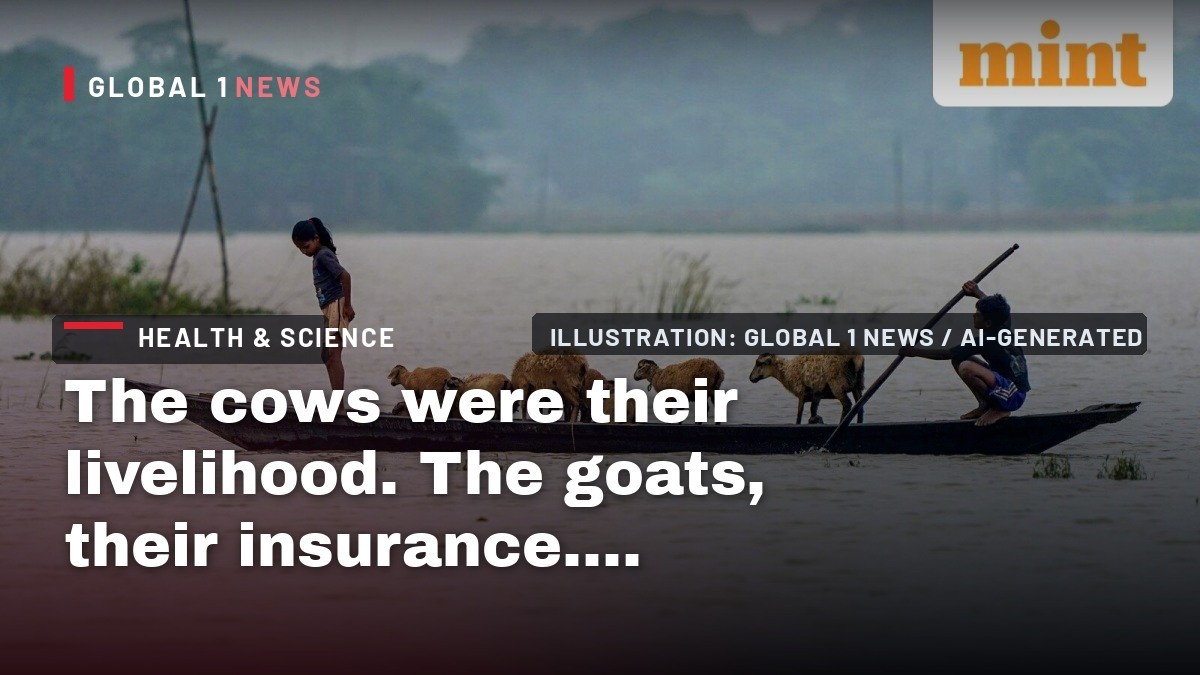
When the Brahmaputra swelled beyond its banks on 19 July, the floodwaters that surged through Assam did more than drown fields—they threatened the very foundations of rural economies that depend on livestock. In the dairy‑centric hamlet of Nepali Khuti, a family’s herd of 24 Jersey cows was lost in a single night, erasing a livelihood that generated roughly ₹ 2.25 lakh a month. Yet a few kilometres away in Bonqual Balichapori, the same deluge was absorbed by a community that has, over decades, engineered its homes and habits to coexist with the river. The contrast between these two villages illustrates how generational knowledge, adaptive architecture, and policy gaps intersect in a state where nearly 40 % of land is flood‑prone.
Livestock as the economic backbone of Assam’s flood‑prone districts
For families like Krishna Prasad Sharma’s, dairy cattle are not merely an asset; they are the core of a cash‑flow system that funds education, health care and daily consumption. Sharma’s herd of 24 cows produced about 150 litres of milk each day, sold at ₹ 50–70 per litre in the nearby markets of Sivasagar and Nazira. This translated into a monthly turnover of approximately ₹ 2.25 lakh, half of which was reinvested in feed, medicine and shed maintenance, while the remainder covered household expenses and school fees. The goats, kept as a safety net, were sold only in emergencies for ₹ 10,000–18,000 each, and the small poultry operation added a modest ₹ 330 per kilo of eggs.
When the flood struck, Sharma’s cows were tethered in a shed that quickly filled with water. The ropes, designed to keep the animals in place, turned into lethal nooses, and all but one animal perished. The loss of the herd therefore represents not just an emotional blow but a financial shock that Sharma estimates will take four to five years to recover. The incident underscores a broader vulnerability: the Assam State Disaster Management Authority reported that more than one million livestock were affected by this year’s floods, a figure that reflects the sector’s sheer scale across the state’s 563 villages.
Generational resilience versus rapid, unplanned development
Villages such as Nepali Khuti have historically relied on accumulated knowledge of flood patterns, learning over generations how to respond when rivers breach. Yet the same knowledge is being strained by accelerated development that alters river courses, reduces natural floodplains and increases runoff. The article notes that the village’s traditional layout—homes clustered along the Dikhow river—now lies under a thick crust of silt and debris, a direct consequence of upstream land‑use changes and hill‑side erosion.
In contrast, Bonqual Balichapori demonstrates a different model of adaptation. The indigenous Mising community has, over three to four decades, built bamboo stilt houses—‘chang ghor’—elevated 12–13 feet above ground level. When floodwaters rise, they simply pool beneath the raised floors, leaving livestock, typically pigs, on dry roads. Children navigate the water with ease, and the community’s routine damage from the same rain system was limited to minor disruptions. This architectural resilience, combined with a proactive approach to riverbank protection, illustrates how cultural practices can mitigate flood impacts when they are supported by stable land‑use policies.
Economic implications of flood‑induced livestock loss
The immediate economic loss for Sharma’s family is stark: a herd that generated ₹ 2.25 lakh per month is reduced to a single surviving cow, cutting daily milk output to a fraction of its former level.
Beyond the household, the broader livestock sector in Assam faces systemic risk. The ASDMA’s data on 106 fatalities and the inundation of 563 villages highlight the scale of disruption. With only about 16,500 sq km of the state’s 31,500 sq km of flood‑prone area protected by any flood control infrastructure, the majority of agricultural and livestock holdings remain exposed. The loss of livestock not only reduces immediate income but also erodes the insurance function that goats and chickens provide, amplifying vulnerability during future shocks.
Policy gaps in flood mitigation and livestock protection
Assam’s 2025‑26 Economic Survey identifies that roughly four times the national average of land is flood‑prone, yet flood protection covers only about half of the identified vulnerable area. The Rashtriya Barh Ayog’s recommendations have yet to translate into comprehensive state‑level interventions that address livestock-specific risks. Current disaster response mechanisms focus on human safety and infrastructure, while compensation schemes for livestock loss remain fragmented.
In the absence of robust policy, families like Sharma’s rely on ad‑hoc measures—such as the bamboo pole rescue that saved them from drowning—but lack systematic support for rebuilding herds. The article’s description of the family’s SUV being upended illustrates that asset loss is not limited to livestock; however, financial recovery pathways for livestock are less clear, especially when insurance products for smallholders are scarce.
Community‑driven adaptation: lessons from Bonqual Balichapori
Bonqual Balichapori’s approach offers a template for low‑cost, culturally appropriate adaptation. The stilt houses, built on bamboo frames, allow floodwaters to pass without damaging the living space. Moreover, the community invests in riverbank reinforcement; Bina Loi’s family spent about ₹ 50,000 on labour and excavators to raise their bank against erosion, protecting a milk‑based income of ₹ 14,400–18,000 per month from 12–15 litres of milk sold at ₹ 40 per litre.
Such investments, while modest compared to large‑scale engineering projects, yield high returns in terms of livelihood security. They also demonstrate the importance of local agency: the community identifies its own risk points—such as ‘bheti’ erosion—and mobilises resources to address them. Scaling this model could involve state subsidies for stilt‑house construction, technical assistance for riverbank reinforcement, and micro‑credit schemes tailored to livestock‑dependent households.
Gender dimensions of livestock resilience
The narrative of Hopun Dao, a widowed indigenous woman who works as a daily‑wage labourer, highlights the gendered nature of livestock as a safety net. With a husband deceased for over a decade, her livelihood hinges on the ability to move her four goats, nine chickens and a hen to higher ground during floods. She employs a simple yet effective technique—sliding a new vertical bamboo pole into the base of her house to elevate the structure and constructing a bamboo raft (‘bui’) to transport animals.
For women in similar contexts, livestock represents both a source of income and a form of social security, especially when formal employment opportunities are limited. Policies that support women’s access to credit for livestock purchase, training in flood‑resilient animal husbandry, and inclusion in disaster planning can strengthen household resilience and reduce gendered poverty traps.
Path forward: integrating traditional knowledge with state support
The divergent experiences of Nepali Khuti and Bonqual Balichapori underscore a crucial insight: resilience is not solely a function of wealth or technology, but of how communities align their practices with the hydrological realities of their environment. To bridge the gap, Assam’s government must translate the Rashtriya Barh Ayog’s flood‑risk maps into actionable programs that fund stilt‑house construction, subsidise riverbank reinforcement, and develop livestock insurance schemes tailored to smallholders.
At the same time, preserving and scaling indigenous knowledge—such as the use of bamboo poles for rapid house elevation—can enhance the effectiveness of top‑down interventions. Collaborative platforms that bring together district disaster officers, agricultural extension services, and community elders could codify best practices and ensure that rapid, unplanned development does not erode the very resilience that has sustained these villages for generations.
This article was produced with AI-assisted research and editorial support. Reporting is based on the source material cited below. Sources: Livemint; livemint.com; Global1.News (20 September 2026).
By Dr. Raj Patel, Staff Writer
What's Your Reaction?
 Like
0
Like
0
 Dislike
0
Dislike
0
 Love
0
Love
0
 Funny
0
Funny
0
 Wow
0
Wow
0
 Sad
0
Sad
0
 Angry
0
Angry
0

India/South Asia Correspondent at Global1.News. Analytical voice with a background in science and health journalism. Based in New Delhi, covering Indian politics, education, healthcare, technology, and policy. Breaks down complex data into clear, actionable reporting.














Comments (0)