
Thailand's Big Plan to Win Global Investors in Trade and Industry
Bangkok is making its boldest pitch yet to global investors. With supply chains redrawing across the world, Thailand this week unveils a public-private blueprint — "Reinvent Thailand, Resilient Asean" — that business leaders say positions the kingdom as Southeast Asia's safest haven for trade and in
Bangkok is making its boldest pitch yet to global investors. With supply chains redrawing across the world, Thailand this week unveils a public-private blueprint — "Reinvent Thailand, Resilient Asean" — that business leaders say positions the kingdom as Southeast Asia's safest haven for trade and investment, culminating in the Bangkok Business Summit on Thursday.
Thailand's Big Plan to Win Global Investors in Trade and Industry
Bangkok, Thailand — Thailand is moving from dialogue to action. This week, the kingdom will unveil its most ambitious economic blueprint in decades, a public-private initiative designed to reposition the country as the undisputed hub of Southeast Asian trade and investment. The "Reinvent Thailand, Resilient Asean" initiative, which culminates in the Bangkok Business Summit on Thursday, is not merely a policy document. It is a strategic declaration aimed at global capital markets, multinational corporations, and regional partners, promising a future built on neutrality, infrastructure, and human capital.
The initiative, which began last year, represents a rare convergence of Thailand's most powerful economic institutions. The private sector's Joint Standing Committee on Commerce, Industry and Banking (JSCCIB) has joined forces with the Fiscal Policy Office, the Bank of Thailand, and the National Economic and Social Development Council (NESDC) to craft a unified vision. The goal is to address structural bottlenecks that have long hampered growth, overhaul workforce capabilities, accelerate decarbonisation, and dismantle barriers for businesses and investors. For Thai readers and regional investors, this is the clearest signal yet that Bangkok is serious about shedding its middle-income status and claiming a leadership role in the new global economy.
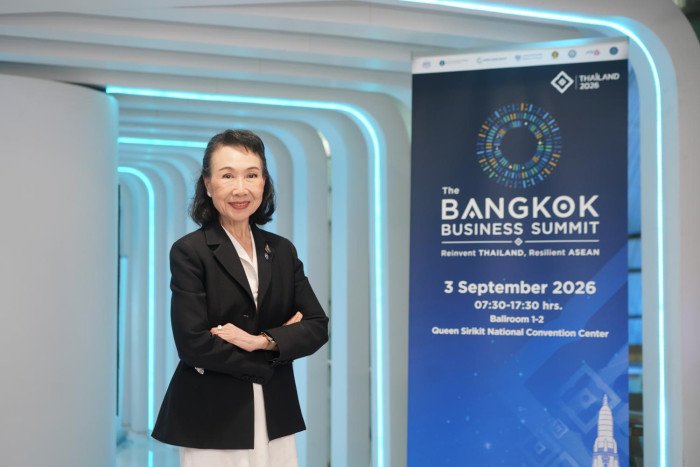
The timing is deliberate. With the global supply chain in flux due to geopolitical fragmentation and the rapid rise of new technologies, Thailand is positioning itself as the safe harbour. The summit, scheduled for the Queen Sirikit National Convention Center, will feature keynote addresses from Prime Minister Anutin Charnvirakul, Finance Minister Ekniti Nitithanprapas, and Bank of Thailand governor Vitai Ratanakorn. Hundreds of local and international business leaders are expected to attend, one of the largest economic gatherings in the kingdom this year. The message is clear: Thailand is open for business, and it is ready to lead ASEAN into a new era of resilience.
A Safe Haven in a Fragmented World
Poj Aramwattananont, chairman of the Thai Chamber of Commerce and the Thai Board of Trade, delivered a blunt assessment of Thailand's competitive advantage. "The chamber believes Thailand is in a very important position for global trade and investment," he said. "Based on geopolitics, geography and geoeconomics, we are the centre. We have very good friendships with every country in the world. We never take sides in politics." This neutrality, he argued, is a priceless asset in a world increasingly divided into rival blocs.
Mr. Poj's message to investors is distilled into a single phrase: "One word — safe haven. Safe area, safe and good people... with the infrastructure to support investment, imports and exports. Thailand is the best for investment and trade." This is not mere boosterism. The country's geographic position at the heart of mainland Southeast Asia, its deep-water ports, and its extensive highway and rail links to China, India, and the rest of ASEAN make it a logistical linchpin. For Thai businesses, this positioning offers a hedge against the volatility of great-power competition, allowing the kingdom to serve as a neutral ground for manufacturing and transshipment.
Beyond Cheap Labor: The New Thai Competitiveness
The Federation of Thai Industries (FTI) is spearheading a shift away from the old model of competing on cost. Chairwoman Pimjai Leeissaranukul emphasized that Thai businesses are now focusing on technical capacity and trust. "Thailand is neutral. We have perfect infrastructure and confident supply chains waiting for foreign investors," she said. This confidence is backed by hard numbers: Thailand's supply chains have been growing for more than 60 years, with deep competencies across advanced automotive, integrated circuit design, printed circuit boards, and semiconductors.
The human capital story is equally compelling. Thailand produces at least 30,000 engineering graduates and 100,000 STEM graduates each year. This pipeline of talent is critical for investors looking to move beyond simple assembly operations into higher-value design and engineering work. For the Thai workforce, this represents a significant upgrade in job quality, moving from factory floor labour to knowledge-intensive roles. The FTI's message is that Thailand is no longer a place to make things cheaply; it is a place to make things intelligently.
Seven Pillars for the Future Economy
Phacharaphot Nuntramas, chief economist at Krungthai Bank, outlined the specific sectors that will drive the next phase of growth. Seven key industries have been identified for future development: agriculture and food processing, automotive, smart electronics and digital services, medical and wellness, tourism, retail and trading, and the creative economy. These sectors were chosen not for their current size, but for their potential to integrate advanced technology and sustainability.
This selection reflects a sophisticated understanding of global demand. Agriculture and food processing, for instance, is being reimagined as a high-tech sector incorporating precision farming and traceability. The automotive industry is pivoting towards electric vehicles and advanced components. The medical and wellness sector leverages Thailand's existing strengths in healthcare tourism while adding biotech and pharmaceutical research. For investors, this provides a clear roadmap of where government incentives and infrastructure spending will flow over the coming decade.
Resilient Asean: The Regional Star
The second component of the initiative, "Resilient Asean", frames Thailand's ambitions within the broader regional context. The bloc is described as a "resilient, flexible and dynamic star on the global stage". Mr. Phacharaphot elaborated: "Asean is currently the world's rising star — a safe geopolitical haven insulated from global conflicts, advanced in technology adoption offering business efficiency, and primed for the low-carbon economy." This regional framing is crucial for Thai readers, as it positions the kingdom not as a lone actor, but as a leading voice in one of the world's fastest-growing consumer markets.
The strategic logic is sound. As global supply chains actively relocate away from geopolitical conflict zones, they are seeking destinations that are safe, efficient, and low-carbon. "Globally, supply chains are actively relocating away from geopolitical conflict zones towards destinations that are safe, efficient and low-carbon — attributes Thailand offers," Mr. Phacharaphot noted. By aligning its national strategy with the broader ASEAN narrative, Thailand is effectively marketing the entire region to global investors, with Bangkok as the gateway and the nerve centre.
The Bangkok Business Summit: A Catalyst for Action
The upcoming summit on Thursday is designed to be a working session, not a talking shop. The World Bank is slated to launch its report on Thailand's path to high-income status, titled "Building Thailand's Future Today", at the event. This report will provide an external validation of the government's strategy and offer concrete policy recommendations. Sessions will cover energy transition, climate-resilient infrastructure, future industries, human capital, agribusiness, and wellness — a comprehensive agenda that touches every aspect of the economy.
The summit also serves as a public-private catalyst for the IMF-World Bank Annual Meetings in Bangkok in October. By demonstrating a unified front between the government, the central bank, and the private sector, Thailand aims to present itself as a model of economic governance for the developing world. The presence of Prime Minister Anutin Charnvirakul and Finance Minister Ekniti Nitithanprapas underscores the political commitment at the highest levels. For Thai businesses, this is an opportunity to network with global institutional investors and secure partnerships that would otherwise be out of reach.
Market Confidence: The SET Index Speaks
The financial markets are already voting with their feet. Stock Exchange of Thailand (SET) president Asadej Kongsiri reported that the SET Index has risen almost 30 percent since the beginning of the year, ranking fourth highest globally. This surge reflects investor confidence, continued foreign investment inflows, upgraded credit ratings, and clear government policy direction. The rally is not speculative froth; it is backed by tangible improvements in the business environment and a clear strategic vision.
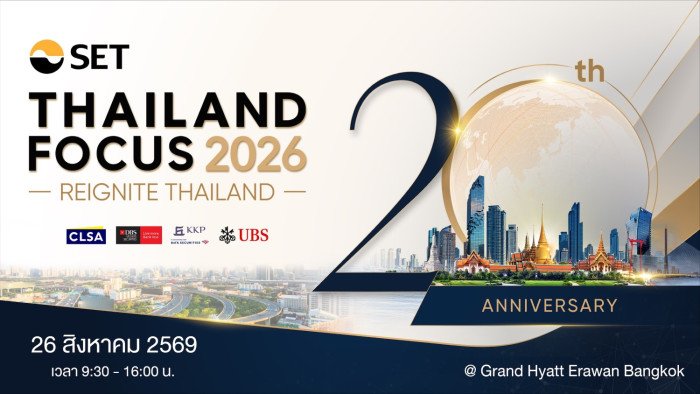
This momentum was on full display at Thailand Focus 2026, the SET's flagship investor event held last week at the Grand Hyatt Erawan Hotel in Bangkok. The event featured 78 Thai listed companies and was presided over by Deputy Prime Minister and Finance Minister Ekniti Nitithanprapas. The strong turnout from international fund managers signals that the "Reinvent Thailand" message is resonating. For Thai retail investors, the rising index is a welcome reversal after years of underperformance, but the deeper significance lies in the structural reforms that are underpinning the gains.
A Two-Year Roadmap to 2028
The initiative is explicitly designed as a two-year strategic direction leading to 2028, when Thailand will chair ASEAN. This timeline provides a clear horizon for investors and policymakers alike. The summit is the first major milestone, but it is followed by a series of implementation steps that will be monitored by the JSCCIB and the public agencies involved. The goal is to move from "dialogue to action", ensuring that the blueprint does not gather dust on a shelf.
For Thailand, the stakes could not be higher. The country faces competition from Vietnam, Indonesia, and Malaysia for the same foreign investment dollars. However, the combination of political neutrality, deep supply chains, and a skilled workforce gives Bangkok a unique edge. The "Reinvent Thailand, Resilient Asean" initiative is a bet that the future belongs to those who can offer safety, efficiency, and sustainability in equal measure. As the world's supply chains redraw their maps, Thailand is making a compelling case that it should be at the centre of the new geography of trade.
The coming months will test whether the rhetoric translates into reality. The IMF-World Bank meetings in October will bring the world's financial elite to Bangkok, offering a global stage for Thailand's transformation. For now, the message from the summit is one of confidence and ambition. Thailand is not just adapting to the new global economy; it is seeking to define it.
By Ann Srisawat, Staff Writer
This article was produced with AI-assisted research and editorial support. Reporting is based on sources cited in the article.
What's Your Reaction?
 Like
0
Like
0
 Dislike
0
Dislike
0
 Love
0
Love
0
 Funny
0
Funny
0
 Wow
0
Wow
0
 Sad
0
Sad
0
 Angry
0
Angry
0

Southeast Asia Correspondent at Global1.News. Based in Bangkok, covering Thai and Southeast Asian politics, economy, technology, and culture. Deep regional perspective on one of the world's most dynamic regions.















Comments (0)