
Citi's China-US Corridor Revenue Surges 44% on Trade Hedging
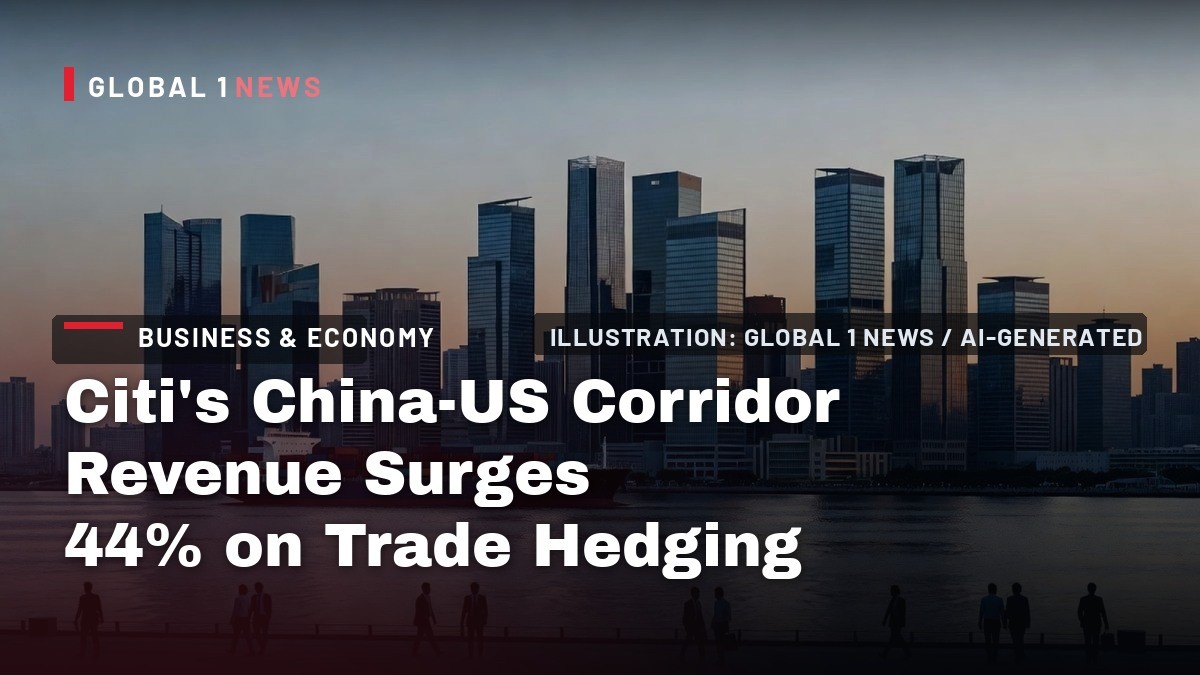
Citi reports a 44% revenue surge on its China-US corridor as mainland firms hedge trade risk and embrace Going Global 3.0 amid US-China turbulence, with Hong Kong's cross-border business ranking first among all Citi corridors.
Banking Through the Storm: Citi's China-US Corridor Keeps Growing
Escalating trade friction between Washington and Beijing has not stopped the money from moving. Citi reported steady revenue growth across its North America-China corridor in the first half of 2026, with mainland Chinese companies leaning harder on global banks to hedge currency risk, restructure supply chains and raise capital abroad, executives said at a media briefing in Hong Kong on Monday.
"Our revenue has not decreased - there has been growth," the bank's China CEO Zhang Wenjie said, citing a 44 per cent year-on-year revenue surge across the China-US corridor in the first half of the year. Geopolitical headwinds, he argued, have actually boosted demand for cross-border financial services.
Tags: Citi, China-US corridor, trade hedging, Hong Kong, Zhang Wenjie, Going Global 3.0, Chinese banks, cross-border finance, Aveline San, CitiToken, Alibaba share placement, dual-hub strategy
The Numbers Behind a Corridor That Refuses to Slow
The growth is not confined to one product line. Citi said its Hong Kong-mainland China corridor has become the bank's largest and most active international banking route globally, with revenue from mainland clients' cross-border business through Hong Kong ranking first among all Citi corridors in the first six months of 2026, up 20 per cent year on year.
Aveline San, Citi Hong Kong CEO, said mainland enterprises are using Hong Kong to "centralise treasury operations, manage multicurrency liquidity and raise international capital." Total capital raised year to date for mainland clients from global capital markets reached US$30 billion as of August, according to the bank.
The corridor's momentum was on full display on August 23, when Alibaba Group Holding priced a HK$80 billion (US$10.2 billion) share placement to fund its artificial intelligence buildout - the largest primary follow-on share sale ever by a Hong Kong-listed company. Citigroup served as one of three co-bookrunners on the transaction.
Why Chinese Firms Are Hedging Instead of Retreating
The strategic picture is counterintuitive at first glance. Rather than pulling back from the US market, mainland companies have responded to tariff pressure and sanctions uncertainty by deepening their use of international banks for foreign exchange hedging, trade exposure management and capital-flow reconfiguration.
"Because North America remained a vital market, Chinese enterprises increasingly turned to international banks to execute foreign exchange hedging, manage trade exposure and reconfigure capital flows," Zhang said.
Analysts following the trend note that hedging demand typically spikes when policy risk rises, and the past year has supplied ample uncertainty: renewed US tariff rounds, blacklisting of Chinese chipmakers and repeated threats of financial sanctions. For global banks with US and Chinese balance sheets, that volatility is translating into fee income rather than contraction. The pattern echoes the 2018-2019 trade war, when Chinese companies first built up hedging books with international lenders - except this time the scale is larger and the toolset more sophisticated, ranging from plain-vanilla currency forwards to blockchain-based liquidity platforms.
'Going Global 3.0': From Made in China to Created in China
Citi executives framed the growth as evidence of a structural shift in how Chinese companies expand overseas - what the bank calls a "Going Global 3.0" phase.
Moving beyond low-cost manufactured exports and cross-border acquisitions, Chinese firms are now deploying entire high-tech supply chain ecosystems abroad, with focus shifting towards green energy, electric vehicles, consumer electronics and AI infrastructure.
"We are seeing Chinese firms move away from competing strictly on cost," Zhang said. "Today, they are exporting advanced technology, localised supply chains and high-value innovations that actively contribute to the economic development of host countries."
The bank's business tied to Central Asia doubled over the past six months, and activity is also surging across Southeast Asia, the Middle East and Latin America, executives said. That diversification matters for the corridor story: the more nodes a Chinese company builds overseas, the more treasury, hedging and financing services it needs - and the more of those flows run through the banks that maintain both a mainland and an international footprint.
Hong Kong's Comeback as the Treasury Hub
Underpinning the corridor is a "dual-hub strategy" in which mainland parent companies keep domestic headquarters while establishing regional treasury centres in Hong Kong to orchestrate international capital.
The trend reinforces Hong Kong's role as the region's corporate treasury hub, even as other financial centres compete for the same flows. Citi is expanding its network of dedicated "China desks" - hubs staffed by senior Chinese-speaking bankers - adding locations in Brazil and Europe to complement existing centres in Hong Kong, Singapore, Dubai, London, New York and South Africa.
Financial technology is expanding in tandem. CitiToken Services, the bank's blockchain-based platform enabling 24-7 real-time liquidity transfers across global time zones, has drawn strong demand since its 2025 launch, San said. For corporate treasurers managing cash across a dozen jurisdictions, the appeal is immediate: settlement that does not wait for banking hours.
What Japan's Banks See From the Sidelines
The Citi numbers sharpen a contrast closer to home for Tokyo readers. Japan's three megabanks - Mitsubishi UFJ Financial Group, Sumitomo Mitsui Financial Group and Mizuho - have been steadily reducing their China exposure, with corporate loan volumes in the Chinese market shrinking by up to 40 per cent over the past five years as they pivot toward Southeast Asia and India.
That divergence is not a judgement on China's economy so much as a reflection of different strategies under the same geopolitical current. While Japanese banks have chosen de-risking and diversification into faster-growing ASEAN and Indian markets, US-based Citi is monetising the corridor itself - profiting from the very turbulence that makes Japanese institutions cautious.
The two approaches also differ on technology. Japan's megabanks are jointly developing a stablecoin for business payments, with live commercial transactions targeted for the current fiscal year, while Citi is pushing blockchain-based liquidity tools to corporate treasurers across Asia. Both are betting that digital settlement infrastructure will define the next decade of cross-border finance - they are just building for different geographies.
What to Watch For
The durability of the Citi corridor will hinge on whether hedging demand remains a structural feature or fades with the next phase of US-China trade talks. The August 23 Alibaba placement, co-run by Citi, suggests equity capital markets activity from mainland issuers is regaining momentum in Hong Kong - a trend that would extend well beyond the bank's own books.
For Japanese businesses and financial institutions, the Citi data is a reminder that China remains the world's largest trading nation and that the "corridor economy" - companies, capital and supply chains moving between China and the West - is still very much open, even as governments trade blows. The winners, as Citi's growth shows, are the intermediaries positioned in the middle.
For Tokyo, the question is whether Japan's own banks are leaving fee income on the table by retreating from a corridor that Citi says is growing at 44 per cent. The answer will become clearer as Japanese institutions report their China strategies in the coming quarters - and as the region's corporate treasurers decide whose balance sheet they trust with the next round of hedges.
By Kenji Tanaka, Staff Writer
This article was produced with AI-assisted research and editorial support. Sources: South China Morning Post, ANI, CNBC.
What's Your Reaction?
 Like
0
Like
0
 Dislike
0
Dislike
0
 Love
0
Love
0
 Funny
0
Funny
0
 Wow
0
Wow
0
 Sad
0
Sad
0
 Angry
0
Angry
0

Japan Correspondent at Global1.News. Tokyo-based voice covering Japanese politics, technology, economy, and culture. Tracks the intersection of tradition and innovation in one of the world's most dynamic societies.













Comments (0)