
Thailand's New Deportation Rules Put 'Undesirable' Foreigners on Notice
BANGKOK — Thailand has taken a significant step in reshaping how it manages foreign nationals deemed disruptive to public order, publishing new deportation regulations in the Royal Gazette this week. The Prime Minister's Office Regulation on Deportation B.E.
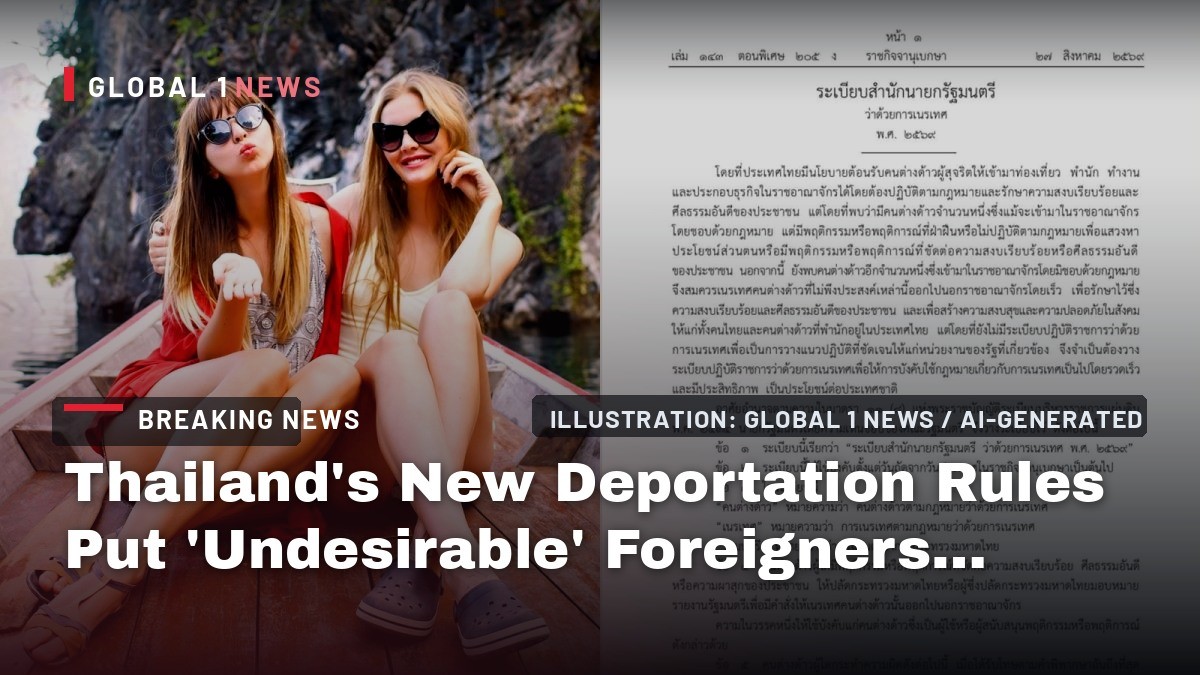
BANGKOK — Thailand has taken a significant step in reshaping how it manages foreign nationals deemed disruptive to public order, publishing new deportation regulations in the Royal Gazette this week. The Prime Minister's Office Regulation on Deportation B.E. 2569 (2026), signed by Prime Minister Anutin Charnvirakul on 26 August, introduces streamlined procedures for government agencies to act more swiftly and efficiently in deportation cases. The regulation took effect on 28 August, the day after its official publication, signaling the government's intent to tighten oversight of foreign conduct within the kingdom.
For a nation that welcomed over 28 million international visitors in 2024 and hosts millions of long-term expatriates, migrant workers, and retirees from across ASEAN and beyond, this regulatory shift carries profound implications. The new rules do not merely affect those who break the law — they touch upon the daily lives of foreigners whose behavior might be judged against Thai cultural and moral standards, a concept deeply rooted in the kingdom's Buddhist-influenced social fabric.
What the New Regulation Says
Under Clause 4 of the regulation, foreigners whose conduct or circumstances are considered contrary to public order, public morality, or public welfare may now face deportation. The permanent secretary of the Interior Ministry, or an official assigned by that office, is required to report such cases to the interior minister for consideration of a deportation order. Notably, the provision also extends to foreigners who "use or support" such conduct, broadening the scope beyond direct actors to include facilitators or backers.
The regulation deliberately does not define a specific list of behaviors covered under Clause 4. This leaves authorities with considerable discretion to assess whether an individual's conduct falls within the grounds of public order, morality, or public welfare. For Thai officials, this flexibility aligns with longstanding administrative practices where moral considerations — often informed by Buddhist principles of harmony and social propriety — play a role in governance. However, for foreign residents and visitors, this ambiguity may raise questions about predictability and due process.
Deportation After Prison: A New Timeline
Clause 5 introduces detailed procedures for foreigners who have been convicted of certain offenses. The interior minister may order the deportation of a foreigner after they have completed a final sentence and been released from prison, provided specific conditions are met. While the regulation does not enumerate the exact offenses in the published summary, the mechanism is clear: prison authorities must notify the Interior Ministry of relevant foreign inmates at least 50 days before their release so that deportation proceedings can be initiated in a timely manner.
This 50-day notification window is a practical measure designed to prevent gaps between a foreigner's release from prison and their removal from the kingdom. For Thailand's correctional system, which houses inmates from neighboring countries such as Myanmar, Cambodia, Laos, and Vietnam, this provision ensures that deportation becomes a seamless part of the post-release process rather than an afterthought. The regulation also allows deportation orders to include a ban on re-entering Thailand, a tool that authorities can use to deter repeat offenses.
Safeguards and International Obligations
Despite the tougher stance, the regulation contains important checks. Clause 6 requires authorities to take into account Thai laws and regulations, Cabinet resolutions, and Thailand's obligations under relevant international law when issuing deportation orders. This provision anchors the deportation process within the broader legal framework, preventing arbitrary or hasty decisions that could violate treaty commitments.
More critically, the rules provide exceptions concerning people who could face torture, cruel or inhumane treatment, degradation, or enforced disappearance if returned to their country. This non-refoulement principle, a cornerstone of international refugee law, reflects Thailand's engagement with global human rights standards even as it tightens domestic enforcement. For a country that has historically been a transit point for refugees from Myanmar and other conflict zones, this safeguard is not merely symbolic — it is a practical necessity that aligns with Thailand's diplomatic relationships and its aspirations within the ASEAN community.
Diplomatic Channels for Third-Country Transfers
Clause 8 introduces a novel mechanism for international cooperation. Another country or an international organization may request through diplomatic channels that Thailand send a deportee to its territory or to a third country. This request must be made within seven days of the deportation order, the requesting party must agree to cover relevant expenses, and the deportee must give written consent. This provision opens the door for creative solutions in cases where a deportee cannot safely return to their home country but may have viable options elsewhere.
For Thailand's neighbors, this clause could facilitate regional burden-sharing on migration issues. ASEAN countries have long grappled with irregular migration and human trafficking, and this mechanism provides a formal pathway for cooperative solutions. The seven-day window, while tight, reflects the government's desire for efficiency without entirely closing off diplomatic alternatives.
What This Means for Foreigners in Thailand
For the estimated 4 to 5 million foreigners residing in Thailand — including Western retirees in Chiang Mai, Japanese engineers in Bangkok's industrial estates, and millions of migrant workers from Myanmar, Cambodia, and Laos — the regulation signals a more assertive approach to behavioral oversight. The absence of a defined list of prohibited behaviors means that authorities will assess cases individually, drawing on Thai legal traditions and social norms.
Thai society places a high value on respect, politeness, and non-confrontation, values rooted in Theravada Buddhist teachings. Behavior that might be tolerated in other countries — public drunkenness, disrespect toward religious symbols, or aggressive disputes — could potentially be interpreted as contrary to public morality under this regulation. Foreigners who have lived in Thailand for years understand these unwritten rules, but the new regulation gives them formal legal weight.
The tourism industry, which contributes roughly 12% to Thailand's GDP, will be watching closely. While the regulation targets deportations rather than tourist visas, the message is clear: Thailand welcomes visitors but expects adherence to local norms. The government of Prime Minister Anutin Charnvirakul, who also serves as interior minister, has prioritized public order as part of his administration's agenda, and this regulation is a concrete manifestation of that priority.
Regional Implications for ASEAN
Thailand's new deportation rules carry significance beyond its borders. As a founding member of ASEAN and a regional hub for commerce and travel, Thailand's immigration policies often set precedents for neighboring countries. The regulation's emphasis on efficiency and international cooperation could serve as a model for other Southeast Asian nations grappling with similar challenges of managing foreign populations while maintaining public order.
For ASEAN citizens working in Thailand — whether construction workers from Isaan's neighboring countries or professionals from Singapore and Malaysia — the regulation underscores the importance of compliance with Thai laws and social expectations. The provision allowing third-country transfers through diplomatic channels may also facilitate regional solutions for stateless persons or those unable to return home, a persistent issue in Southeast Asia.
Thailand's obligations under international law, explicitly referenced in Clause 6, signal that the kingdom remains engaged with global norms even as it asserts its sovereign right to deport. This balancing act — between domestic enforcement and international responsibility — is a delicate one, and the regulation attempts to navigate it with explicit safeguards.
A Measured Approach Forward
The new deportation regulation represents a significant administrative reform, but it is not a radical departure from Thailand's existing legal framework. The Immigration Act B.E. 2522 (1979) already provided grounds for deportation, and the new rules streamline procedures rather than create entirely new powers. What is new is the explicit focus on public morality and welfare as grounds for deportation, and the detailed procedural timelines designed to make enforcement more predictable.
For the foreign community in Thailand, the practical advice remains unchanged: respect Thai laws, customs, and cultural sensitivities. For Thai authorities, the regulation provides a clearer toolkit for maintaining social harmony. And for the region, it demonstrates that Thailand is serious about managing its borders and its social order in a manner consistent with both domestic priorities and international commitments.
As the regulation takes effect, its implementation will be watched closely by diplomats, human rights organizations, and the millions of foreigners who call Thailand home, whether temporarily or permanently. The balance between welcoming hospitality and firm governance has always been a defining feature of Thailand's approach to foreigners — this regulation is the latest expression of that enduring tension.
By Ann Srisawat, Staff Writer
This article was produced with AI-assisted research and editorial support. Sources: Khaosod English
What's Your Reaction?
 Like
0
Like
0
 Dislike
0
Dislike
0
 Love
0
Love
0
 Funny
0
Funny
0
 Wow
0
Wow
0
 Sad
0
Sad
0
 Angry
0
Angry
0

Southeast Asia Correspondent at Global1.News. Based in Bangkok, covering Thai and Southeast Asian politics, economy, technology, and culture. Deep regional perspective on one of the world's most dynamic regions.














Comments (0)