
Teachers' group slams P3.34 billion budget cut for SUCs, flags P10.8 billion for confidential funds
ACT condemns P3.34B cut to SUCs in 2027 NEP while P10.8B goes to confidential funds. UP loses P2.95B, PGH threatened. 49 of 116 SUCs affected. ACT urges Congress to restore funds.
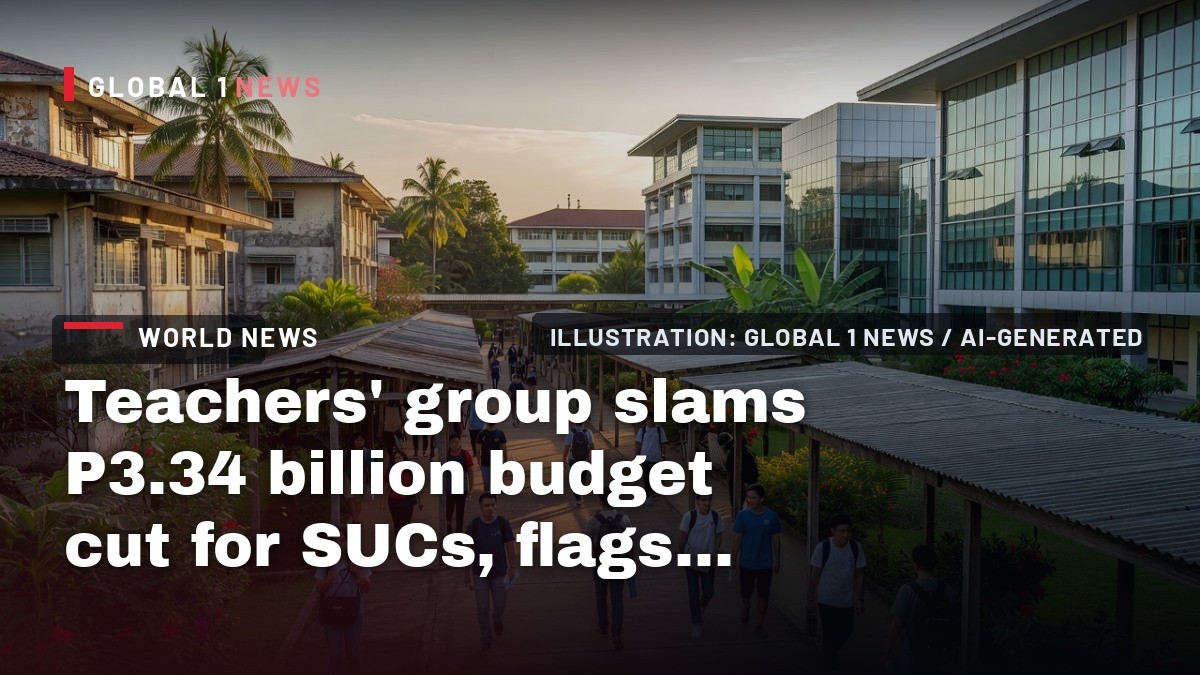
MANILA — There is a saying in every Filipino household: kapag may tiyaga, may nilaga. But for the country's state universities and colleges (SUCs), it seems the pot is running dry even before the water boils. The Alliance of Concerned Teachers (ACT) has come out swinging against the proposed P3.34-billion reduction in the budget for SUCs under the 2027 National Expenditure Program (NEP), even as P10.8 billion has been earmarked for confidential and intelligence funds (CIF). For teachers, students, and parents who have long looked to public education as the great equalizer, this is a bitter pill to swallow.
The numbers, laid bare in the NEP, paint a stark picture of priorities. While our public universities are being asked to tighten their belts, the Office of the President alone is set to receive P4.56 billion — or 44.9 percent of the total CIF allocation. For the 49 SUCs facing direct budget cuts, this is not just an accounting exercise; it is a decision that will echo in classrooms, laboratories, and hospital wards across the archipelago.
ACT's condemnation: A direct assault on the right to education
ACT chairperson Ruby Bernardo did not mince words when she condemned the proposed cuts. In a statement, she declared that "the cutbacks in education are directly depriving the young Filipinos of their rights to education." It is a sentiment that resonates deeply in a country where a college diploma is often seen as the only ticket out of poverty — a lifeline for the anak ng magsasaka from Nueva Ecija, the daughter of a jeepney driver in Quezon City, or the son of an OFW in Cavite who sends remittances home precisely so his children can finish school.
The teachers' group is not just pointing at the numbers; they are pointing at the consequences. When a state university loses funding, it is not just a line item that disappears. It means fewer scholarships, delayed maintenance of aging buildings, and overstretched faculty who already juggle multiple classes just to make ends meet. It means students may have to shell out more for laboratory fees or forego essential learning materials. For many Filipino families, the difference between a P500 monthly miscellaneous fee and a P1,000 one can be the difference between staying in school and dropping out.
Bernardo's call is clear: lawmakers must reject the proposed cuts and fully restore the P3.34-billion reduction across all 49 affected SUCs. The question now is whether Congress will listen to the teachers, or to the allure of expanded confidential funds.
The numbers behind the outrage: P3.34 billion cut vs. P10.8 billion CIF
Let us break down the figures, because in budget discussions, the devil is always in the details. The 2027 NEP proposes a P3.34-billion slash in the budgets of state universities and colleges. At the same time, P10.8 billion has been allocated for confidential and intelligence funds across various agencies. Of that amount, the Office of the President gets the lion's share at P4.56 billion — nearly half of the entire CIF pot.
To put this in perspective, P3.34 billion could fund thousands of scholarships, repair hundreds of classrooms, or equip laboratories with the tools needed for scientific research. Instead, it is being taken away from institutions that serve millions of Filipino students. Out of 116 SUCs nationwide, 49 will suffer direct budget slashes. Seven others will receive nominal increases of less than one percent — increases so small they are practically symbolic, barely enough to cover inflation, let alone improve the quality of education.
The contrast is jarring. On one hand, we have the Department of the Interior and Local Government (DILG) receiving a P22-billion budget increase in the NEP, with P16 billion of that going to the Philippine National Police (PNP). On the other hand, our universities — the very institutions tasked with building the nation's human capital — are being asked to do more with less. It is a trade-off that ACT argues is fundamentally misguided.
Confidential and intelligence funds are not inherently wrong; they serve legitimate national security purposes. But the scale of the allocation, especially to the Office of the President, raises questions about proportionality. Is it truly in the national interest to pour billions into intelligence operations while our public universities struggle to keep their lights on?
The heavy toll on UP System, PGH, PNU, and PUP
No institution bears the brunt of these cuts more than the University of the Philippines (UP) System. The country's premier state university is facing the single largest budget slash — a staggering P2.95 billion. This is not just a blow to UP's academic programs; it directly threatens the operations of the Philippine General Hospital (PGH), the country's premier government tertiary medical facility.
PGH is not just any hospital. It is where the poorest of the poor go when they have nowhere else to turn. It is where a tricycle driver from Tondo can receive life-saving treatment without worrying about exorbitant hospital bills. It is where medical students train to become the next generation of Filipino doctors who will serve in rural health units and barangay health centers. Cutting PGH's funding is not an abstract policy decision; it is a decision that could mean longer waiting lines, fewer available beds, and reduced capacity to serve the most vulnerable.
Specialized institutions are also feeling the pinch. The Philippine Normal University (PNU), the country's center for teacher education, faces a cut of P394.9 million. This is deeply ironic — we are cutting the budget of the very institution that trains our teachers, even as we complain about the quality of basic education. The Polytechnic University of the Philippines (PUP), which prides itself on providing affordable education to working-class students, faces a P291.8-million reduction. PUP is where many working students — those who juggle night shifts at fast-food chains or call centers with daytime classes — pursue their dreams. Every peso cut from PUP's budget is a peso that could have gone to subsidizing tuition, improving facilities, or hiring more faculty.
These are not just institutions; they are lifelines. For many Filipino families, sending a child to a state university is the culmination of years of sacrifice. The parents scrimp and save, the student works part-time, and the entire extended family rallies around the dream of a diploma. Budget cuts threaten to unravel that dream.
DILG and PNP increases: A question of priorities
The juxtaposition of the SUC budget cuts with the DILG's P22-billion increase is hard to ignore. Of that amount, P16 billion is earmarked for the Philippine National Police. To be clear, public safety is important. Our police officers deserve adequate funding for equipment, training, and salaries. But the question is one of balance.
When we invest heavily in law enforcement but starve our educational institutions, we are addressing the symptoms rather than the cause. Crime and social unrest often have their roots in poverty and lack of opportunity. By cutting education budgets, we are potentially sowing the seeds of future problems. A well-educated populace is less likely to turn to crime and more likely to contribute to economic growth. It is a simple equation that seems to be lost in the budget deliberations.
ACT's point is not that the PNP should not receive funding, but that the priorities are skewed. The P3.34 billion cut from SUCs is less than a fifth of the P16 billion increase for the PNP. Restoring the education budget would not even require touching the police budget; it would simply require a more equitable distribution of resources.
Moreover, the P4.56 billion allocated to the Office of the President for confidential funds is a significant sum. While we do not know the specifics of how these funds will be used — and by their nature, confidential funds are not subject to public scrutiny — the sheer size of the allocation invites questions. Could some of that money be better spent on scholarships, research grants, or infrastructure for our state universities?
A call to lawmakers: Restore the funds, protect the future
ACT has issued a clear demand: lawmakers must immediately reject all proposed budget cuts and fully restore the P3.34-billion reduction across all 49 affected SUCs. This is not a radical request; it is a call to honor the constitutional mandate that the state shall protect and promote the right of all citizens to quality education at all levels.
The ball is now in the court of Congress. During budget deliberations, our senators and representatives have the power to amend the NEP. They can choose to restore the cuts, or they can choose to let them stand. The teachers' group is urging them to side with the students, the teachers, and the families who depend on state universities.
It is worth noting that this is not just about the 2027 budget. It is about the signal we are sending to the next generation. When we cut education funding, we are telling our youth that their dreams are not a priority. When we increase confidential funds while slashing school budgets, we are telling them that secrecy is more important than opportunity.
For the 49 SUCs facing cuts, the impact will be felt immediately. Class sizes may grow, research projects may be shelved, and maintenance may be deferred. For the seven SUCs receiving nominal increases of less than one percent, the situation is hardly better — these increases will be eaten up by inflation, leaving them effectively stagnant.
What this means for Filipino students and families
At the heart of this budget battle are real people. Consider the nursing student at a provincial SUC who dreams of working abroad to support her family. Consider the education major at PNU who wants to teach in her hometown's public school. Consider the engineering student at UP who hopes to design infrastructure that can withstand typhoons. These are not statistics; they are the future of our nation.
For families, the stakes are equally high. Many parents make tremendous sacrifices to send their children to state universities precisely because they are more affordable than private institutions. If budget cuts lead to higher fees or reduced services, those families will be squeezed even further. In a country where many households live paycheck to paycheck, even a small increase in education costs can be devastating.
The bayanihan spirit — that communal unity that has long defined Filipino culture — is being tested. Will our lawmakers come together to protect education, or will they prioritize other interests? The answer will determine not just the 2027 budget, but the trajectory of our nation for years to come.
As the budget deliberations unfold, ACT and other education advocates will be watching closely. They have thrown down the gauntlet, and now it is up to Congress to respond. For the sake of millions of Filipino students, their families, and the future of our country, we can only hope that the right choice is made.
This article was produced with AI-assisted research and editorial support. Sources: The Philippine Star.
By Bella Reyes, Staff Writer
What's Your Reaction?
 Like
0
Like
0
 Dislike
0
Dislike
0
 Love
0
Love
0
 Funny
0
Funny
0
 Wow
0
Wow
0
 Sad
0
Sad
0
 Angry
0
Angry
0

Philippines/Southeast Asia Correspondent at Global1.News. Manila-based journalist covering Philippine politics, environment, maritime security, and social issues. Passionate about marine conservation and the communities protecting the Philippines' natural heritage.













Comments (0)