
Taiwan Overtakes China as Singapore’s Largest Trading Partner, Cementing a Deep but Carefully Bounded Economic Alliance
In a historic shift for Northeast Asian trade dynamics, Taiwan surpassed China in 2025 to become Singapore’s largest merchandise trading partner for the first time on record. According to data from Singapore’s Ministry of Trade and Industry, bilateral trade reached approximately S$170.3 billion (US$134 billion), edging past Singapore’s trade with China (S$162.9 billion) and Malaysia (S$145.0 billion). Just one year earlier, Taiwan had ranked fourth among Singapore’s trading partners. The surge,
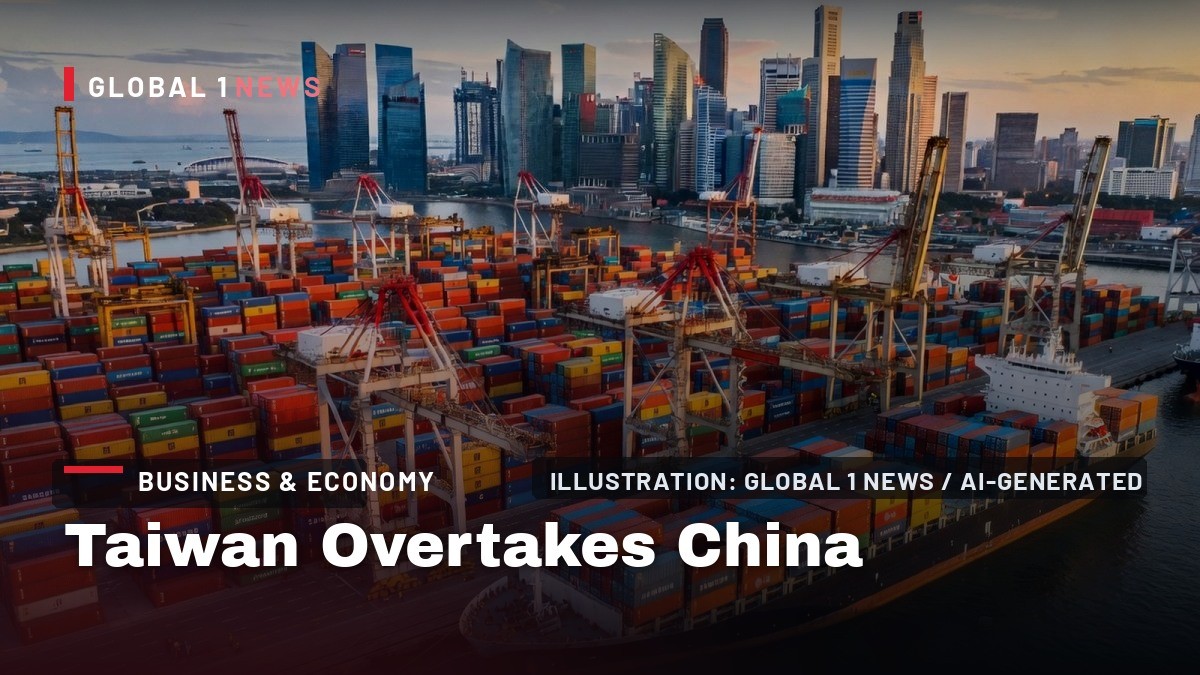
In a historic shift for Northeast Asian trade dynamics, Taiwan surpassed China in 2025 to become Singapore’s largest merchandise trading partner for the first time on record. According to data from Singapore’s Ministry of Trade and Industry, bilateral trade reached approximately S$170.3 billion (US$134 billion), edging past Singapore’s trade with China (S$162.9 billion) and Malaysia (S$145.0 billion). Just one year earlier, Taiwan had ranked fourth among Singapore’s trading partners. The surge, driven overwhelmingly by semiconductor and AI-related commerce, reflects a deepening economic symbiosis between the two economies. Yet, as analysts in both capitals are careful to note, this commercial intimacy operates within a strict diplomatic framework: Singapore values Taiwan as a critical node in its diversified economic portfolio, but official policy remains firmly anchored in the One China principle, and there is no discernible incentive in Singapore to revisit that position.
The Semiconductor Symbiosis: Complementary Roles in the AI Supply Chain
The explosive growth in bilateral trade is not a story of competing industries but of deep complementarity. Taiwan’s semiconductor industry accounts for over 60 percent of global foundry revenue and more than 90 percent of leading-edge chip manufacturing, anchored by TSMC and its extensive foundry ecosystem. Singapore, by contrast, has carved out a distinct niche further down the value chain, supplying equipment, materials, assembly, advanced packaging, and test capacity. The city-state also operates as the regional logistics and headquarters hub through which chips and intermediate inputs circulate across Asia.
The numbers illustrate the interdependence with striking clarity. In 2025, roughly 80 percent of Taiwan’s exports to Singapore were semiconductors and related products, while approximately 60 percent of Singapore’s exports to Taiwan consisted of semiconductor equipment and intermediate goods. The trade surge runs in both directions: Singapore’s non-oil domestic exports to Taiwan grew 37.4 percent last year, the strongest performance among all of the city-state’s major trading partners. As both economies occupy different stages of the AI production chain, they have formed what trade officials describe as a highly complementary and closely linked cooperative network in Asia’s AI industry chain—a relationship that shows no signs of slowing.
National AI Strategies Reinforce Economic Interdependence
Both governments have implemented national AI strategies that are likely to deepen this complementarity further. Singapore Prime Minister Lawrence Wong recently established a National AI Council alongside a series of national AI missions targeting advanced manufacturing, financial services, connectivity, and healthcare. In a notable move for regional standard-setting, Singapore also unveiled the world’s first governance framework for agentic AI at the World Economic Forum in January 2026, positioning the city-state as a rule-maker in the rapidly evolving AI landscape.
Taiwan has pursued a parallel path with its Ten AI Initiatives Promotion Plan, an interagency effort that channels government funding into silicon photonics, quantum technology, and AI robotics while building the infrastructure, talent base, and capital markets necessary to transform the island into a “smart technology island.” Each set of measures raises domestic demand for end-use AI applications and embeds the technology into existing business models, feeding a virtuous cycle of rising demand and supply across both economies. For scholars of regional political economy, this represents a textbook case of how national industrial policies can create mutually reinforcing growth dynamics between two mid-sized, trade-dependent economies.
ASTEP and the New Southbound Strategy: Foundations Laid Years Ago
Trade of this magnitude does not scale overnight, and the groundwork for this surge was laid more than a decade ago. The Agreement between Singapore and the Separate Customs Territory of Taiwan, Penghu, Kinmen and Matsu on Economic Partnership (ASTEP), signed in November 2013, eliminated Singaporean tariffs on all Taiwanese imports while Taiwan phased out duties on nearly all Singaporean goods, including electronics, machinery, and chemicals. ASTEP also streamlined customs procedures and rules of origin for electronics, protected covered investments against forced technology transfer and local-content requirements, and enabled digitally supplied services to operate without requiring a local physical office.
Complementing ASTEP was Taiwan’s New Southbound Strategy, implemented under former President Tsai Ing-wen’s administration. That policy leveraged Singapore as a regional platform for Taiwanese investment and technology to expand into ASEAN and South Asian markets. The strategy effectively positioned Singapore not merely as a trading partner but as a gateway—a role that has only grown in importance as global supply chains have reorganized around resilience and diversification. For Singapore, the arrangement offers a hedge: by maintaining deep ties with Taiwan’s semiconductor ecosystem, the city-state insulates itself from over-reliance on any single regional partner, including China.
Capital Flows Follow Trade: Singapore Replaces Hong Kong for Taiwanese Wealth
The economic relationship extends well beyond goods. Two-way financial flows between Taiwan and Singapore have increased significantly, driven by Taiwan’s remarkable economic performance. Taiwan’s economy grew 8.7 percent in 2025, its fastest rate in 15 years, and the Taiwan Stock Exchange Capitalization Weighted Stock Index (TAIEX) more than doubled to a total market capitalization of US$4.4 trillion. The combined wealth of Taiwan’s 50 richest individuals rose 56 percent in a single year to a record US$308 billion, up from US$197 billion. KPMG Taiwan and E.Sun Bank project Taiwan’s high-net-worth population will reach 124,000 in 2026, holding combined assets of NT$46.1 trillion (US$1.47 trillion).
Much of that capital is now seeking foreign destinations, and Singapore is the primary beneficiary. Hong Kong, once the default offshore haven for Taiwanese wealth, has lost its appeal as Beijing has tightened political control over the territory. The shift has been dramatic: more than 80 percent of Taiwanese offshore assets were once concentrated in Hong Kong, but today an estimated 60-70 percent are managed in Singapore, amounting to roughly US$326 billion. Singapore’s combination of political stability, a low tax rate, mature private banking systems, and accessible residency pathways has made it the preferred alternative. This financial migration reinforces the trade relationship, creating a self-reinforcing cycle of economic integration that is likely to persist regardless of political headwinds.
Strategic Implications: Economic Depth Within Diplomatic Limits
For observers of Asian geopolitics, the Singapore-Taiwan relationship offers a nuanced counterpoint to the binary narratives that often dominate discussions of cross-strait tensions. Singapore has consistently maintained that its economic engagement with Taiwan does not constitute support for Taiwanese independence or international recognition. Official diplomacy remains limited within the One China framework, and Singapore has repeatedly affirmed its commitment to that principle. The city-state’s approach reflects a pragmatic balancing act: maximizing economic benefits from Taiwan’s technological prowess while avoiding any action that would jeopardize its broader relationship with Beijing.
This strategy carries significant implications for the wider Indo-Pacific economy. As the United States and its allies push for supply chain diversification away from China, Singapore’s role as a neutral hub connecting Taiwanese manufacturing with global markets becomes increasingly valuable. The city-state’s political stability, rule of law, and world-class infrastructure make it an ideal intermediary for multinational corporations seeking to maintain access to Taiwanese semiconductors without concentrating all operations on the island. For Korea, which competes with both Taiwan and Singapore in advanced memory and foundry markets, the deepening Taipei-Singapore axis represents both a competitive challenge and a potential model for how to manage economic interdependence with political sensitivity.
The trajectory of Singapore-Taiwan trade suggests that economic logic will continue to drive the relationship forward, even as the diplomatic framework remains frozen. Both economies have invested heavily in AI infrastructure and talent, and their complementary positions in the supply chain create powerful incentives for continued integration. Yet the limits of this relationship are equally clear: Singapore will not become a defender of Taiwan’s international status, and it has no incentive to do so. The city-state’s approach—deep economic engagement within a carefully maintained diplomatic boundary—may well serve as a template for other regional actors navigating the increasingly complex terrain between economic opportunity and geopolitical risk.
This article was produced with AI-assisted research and editorial support. Sources: The Diplomat
By Prof. David Park, Staff Writer
What's Your Reaction?
 Like
0
Like
0
 Dislike
0
Dislike
0
 Love
0
Love
0
 Funny
0
Funny
0
 Wow
0
Wow
0
 Sad
0
Sad
0
 Angry
0
Angry
0

East Asia/Technology Correspondent at Global1.News. Seoul-based voice covering Korean politics, technology, business, and culture. Analyzes how technology and geopolitics intersect across East Asia.











Comments (0)