
TCS Just Committed $7.4 Billion to a One-Gigawatt Data Center — the Services Era Is Over
Tata Consultancy Services' HyperVault unit has secured 264 acres in Hyderabad for an up-to-1GW AI data center campus, with partners investing up to $7.4 billion. A hosting founder on what it means when the world's biggest IT services firm becomes a landlord of compute.
TCS Just Committed $7.4 Billion to a One-Gigawatt Data Center — the Services Era Is Over
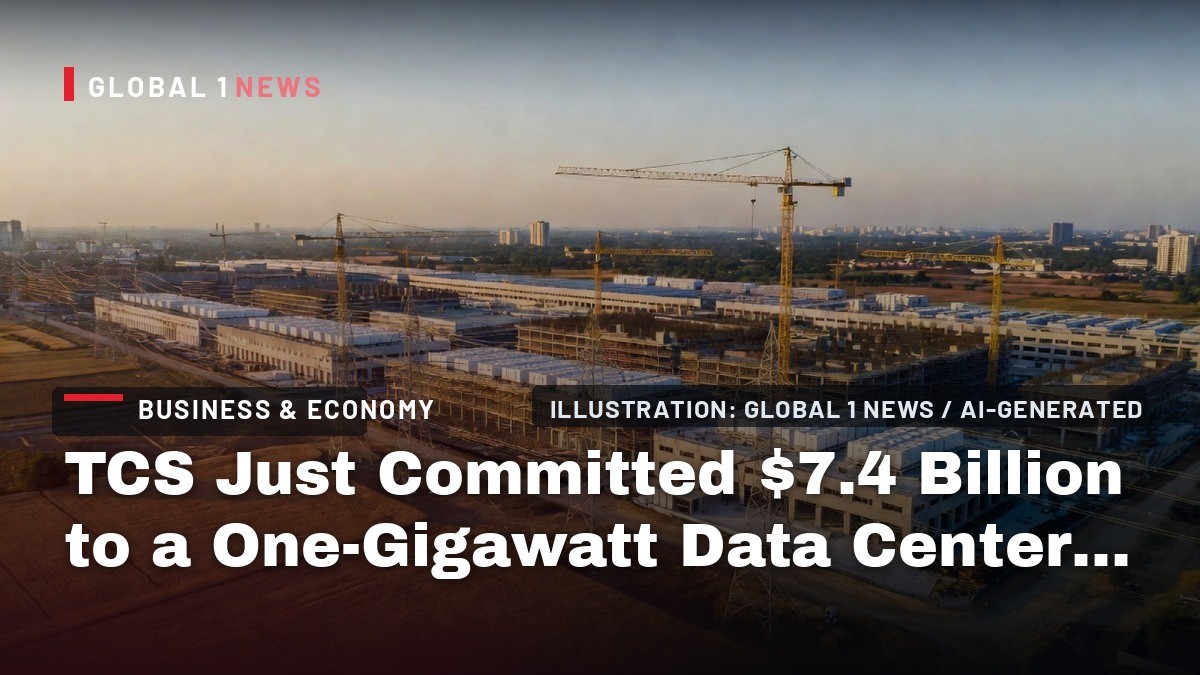
Let me tell you something that should have every IT services firm on earth sweating this weekend. On Saturday, Tata Consultancy Services — the company that practically invented the global outsourcing industry, 584,000 employees, roughly $30 billion a year in revenue — locked down 264 acres in Hyderabad to build an AI data center campus of up to one gigawatt. Total commitment, with partners: up to 700 billion rupees, about $7.4 billion of real money. And it is not going to code. It is going to concrete, copper, cooling and kilowatts.
I have been saying for months that the center of gravity in this industry is moving from services to compute. TCS just proved it with a check the size of a small country's budget. Every hosting provider should read the room.
What TCS Actually Announced — and Why Hyderabad Won
Here is the story from Saturday's announcement and the regulatory filing. HyperVault, TCS's dedicated data center subsidiary, has secured 264 acres at Bharat Future City in Hyderabad, in the state of Telangana, to develop an AI data center campus of up to one gigawatt — purpose-built for frontier AI companies and hyperscalers, with high-density GPU deployments, direct-to-chip liquid cooling and bigger power blocks. HyperVault and its partners expect to invest up to Rs 70,000 crore — about $7.41 billion, per Reuters. Construction is targeted for early 2027, phased "in line with customer demand and technology requirements," and the project is expected to create several thousand direct and indirect jobs.
Telangana fought for this one. Chief Minister A. Revanth Reddy called it historic; IT minister D. Sridhar Babu, who led the negotiations, said it grew out of a conversation with Tata Sons chairman N. Chandrasekaran at Davos in January. Telangana beat five competing states. TCS CEO K. Krithivasan called it the advance of the company's "Infrastructure-to-Intelligence" strategy — AI-ready infrastructure fused with its cloud, engineering and AI services.
Why This Is a Bigger Deal Than the Rupee Amount
Here is the context most coverage is missing. TCS is not a startup chasing a moonshot. It is a 56-year-old pillar of Indian capitalism, majority-owned by Tata Sons, which also controls Tata Power, Tata Projects and Tata Communications. It reported $2.5 billion in annualized AI revenue last fiscal year, doubled year over year. It laid off about 12,000 people in that year, citing a "skill mismatch," while quietly building toward a workforce of AI agents. And now it is becoming a landlord of compute.
This is a structural pivot, not a side bet. HyperVault already had a strategic partner before this weekend: TPG, which put $1 billion into the venture last November for a stake between 27.5 and 49 percent. TCS and TPG committed roughly $2 billion in core equity, with the rest of the build financed by debt. TCS has separately disclosed an OpenAI deal to develop AI infrastructure in India — 100 megawatts initially. It is co-developing rack-scale AI infrastructure with AMD on the Helios platform, with a blueprint supporting up to 200 megawatts. And it can call on the whole Tata ecosystem — Tata Power for electricity, Tata Projects for construction, Tata Communications for connectivity — plus GE, Honeywell, ABB and Siemens.
The company that spent five decades selling software services at a margin is now assembling every piece of the AI infrastructure stack under one roof, from the power switch to the rack to the integration contract. When TCS says it is not treating data centers as a real estate play, it means something specific: it wants to own the compute its AI services run on, the way AWS owns its compute. That is the toll booth logic I keep writing about. Whoever owns the iron collects the margin on everything above it.
The Two Readings — a Pivot That Makes Sense, or a Services Company About to Learn What Power Bills Feel Like
There are two honest ways to read this, and both are true.
Reading one: this is a brilliant vertical integration play from a position of strength. TCS runs the IT estates of half the Fortune 500, so it knows which clients are about to sign billion-dollar AI deals before the clients do. It can build to suit, phase against real demand, and cross-sell from the data center contract to the services on top. And India is the cheapest serious build market left — Nomura puts data center construction there at $6-7 million per megawatt against $10-14 million in the US and Europe, with effective power around 6-7 US cents per kilowatt-hour once you layer in open access and renewable PPAs. Backed by Tata Power, it is not a gamble — it is an industrial conglomerate doing what industrial conglomerates do.
Reading two: TCS is about to learn what every hosting founder already knows: a gigawatt on a press release is not a gigawatt in the ground. One gigawatt of IT load is roughly the electricity consumption of 750,000 homes. India's grid is adding capacity fast, but transmission and substations are already the bottleneck — flagged in August — and more than half of India's existing data centers sit in water-stressed regions. The marquee anchor, OpenAI, is contracted for 100 megawatts — a tenth of the campus — with an option, not a commitment, for more. Options are not revenue. Phased buildouts tied to demand are how sensible operators work, but they make "up to one gigawatt" a ceiling, not a pipeline. And a $7.4 billion, largely debt-funded build lands on a balance sheet that spent 56 years being admired for cash generation. Debt changes how a services company behaves. Ask any hyperscaler.
The Secondary Bottleneck Nobody's Talking About — the Words TCS Won't Define
Here is the part I keep coming back to, the part every infrastructure founder should watch: the undefined promises in the announcement. "Green energy." "Water-neutral design principles." Neither term is defined anywhere in the release, and The Next Web called that out within hours.
This matters because the reporting regime is coming for those words. The European Union already forces every data center above 500 kilowatts to report its total and drinking water consumption annually to a public database. India's data localization push and the state-level scramble for AI investment point the same direction: governments that hand out 10-year power-duty exemptions and fast-track environmental clearances will start asking what they got in return. Telangana is targeting nearly five gigawatts of data center capacity by 2030, with $10-20 billion in the pipeline. When a state that size starts writing checks for water and power, it will demand definitions.
Water-neutral is the tell. Hyderabad sits in a region where water is a political issue, not an engineering footnote. A 160-megawatt facility can need as much as 4.2 billion liters of water a year depending on cooling design, and 59 percent of Indian districts faced water scarcity in 2025. Every operator there — TCS, Adani, the Brookfield-backed CtrIS, the 28 data centers under construction in Mumbai alone — will be asked to prove its water math. If you cannot show the balance sheet of your cooling loop, the word "neutral" will come back to bite you in a regulatory filing, a community hearing, or a drought year. The secondary bottleneck on the Indian AI buildout is not the GPU. It is not even the power plant. It is the fine print nobody has defined yet.
What This Means for Independent Hosting Providers
If you are running an independent hosting or colo operation, this is not a story about India. It is a story about your next five years. Here is what I would do:
First — recognize who your new competitors are. It is no longer just hyperscalers and specialist AI clouds — the IT services giants are building their own iron. When your customer's systems integrator owns the data center down the road, the conversation about where workloads live changes. Compete on service, speed and the human relationship — the things a 584,000-person services machine cannot move quickly.
Second — do not build your capacity plan on scarcity that is about to be flooded. India alone has gigawatt announcements from TCS, Adani and Reliance — and that is one country. Every one of those gigawatts eventually lands as wholesale supply. If you are signing a five-year colo contract today at AI-scarcity prices, build in flexibility. The spread between announced and delivered capacity is where this cycle's winners and losers are made.
Third — treat "announced" as zero, and "phased" as the only honest word in the release. TCS has 264 acres and an anchor customer for 100 megawatts of a possible 1,000. That is a sound build, but it is not a gigawatt. When you hear a headline number, ask what is contracted, what is optioned, and what is hope. Hope does not pay power bills.
Fourth — get your water and power numbers honest before someone else does. The EU reporting regime is spreading. If you cannot state your water usage and power source mix in numbers a regulator can audit, fix that now. The operators who disclose first will win hyperscaler contracts in drought-prone markets. The ones who hide behind "neutral" will be explaining themselves in hearings.
Fifth — watch India as your early-warning system for global pricing. When the cheapest serious build market on earth starts delivering real capacity, it puts a ceiling on what AI compute can charge everywhere else. India's cost advantage — cheaper land, cheaper power, build costs 30 to 50 percent lower — is the long-term answer to whether AI compute prices stay stratospheric. They will not. Plan margins accordingly.
The Bottom Line
Here is what the announcement actually told us. The last major category of technology company that made its living purely from human expertise has decided the future is physical. TCS, the original arbitrage on cheap talent, is betting $7.4 billion that the arbitrage of the next decade is cheap power, cheap land and owned compute. When the company that built its empire billing for people starts billing for megawatts, the services era as we knew it is done — not dying slowly, but becoming the foundation layer for the machines.
For us independents, that is both a warning and an opening. The giants will bring capital, land and captive demand. They will also bring debt, undefined promises, and a gigawatt of distance between their press releases and their power-on dates. The hosting businesses that survive this cycle will be the ones that stay small enough to move, honest enough to publish real numbers, and smart enough never to confuse an announcement with a delivery. The machines are coming. Make sure you own the ground they stand on — or at least the contract that feeds them.
— Allan Ali, Founder
This article was produced with AI-assisted research and editorial support. Sources: Reuters, Telangana Today, The Times of India, The Next Web, Economic Times Data Center, Moneycontrol, Data Center Knowledge, Nomura Research.
What's Your Reaction?
 Like
0
Like
0
 Dislike
0
Dislike
0
 Love
0
Love
0
 Funny
0
Funny
0
 Wow
0
Wow
0
 Sad
0
Sad
0
 Angry
0
Angry
0

Publisher of Global1.News. Automation architect, systems builder, and the guy making sure the truth gets published.













Comments (0)