
Togo's Sacred Stone Emerges White, Promising Peace and Prosperity
In a sacred wood on the shore of Lake Togo, the Guin people gathered this week for a moment three and a half centuries in the making: the 363rd unveiling of the Ekpessosso, the sacred stone that carries the message of the gods for the year ahead. When the priests emerged cradling an oval stone glowing white, relief and joy rippled through the crowd — white is the colour that promises peace, purity and prosperity for the new ancestral year.
In a sacred wood on the shore of Lake Togo, the Guin people gathered this week for a moment three and a half centuries in the making: the 363rd unveiling of the Ekpessosso, the sacred stone that carries the message of the gods for the year ahead. When the priests emerged cradling an oval stone glowing white, relief and joy rippled through the crowd — white is the colour that promises peace, purity and prosperity for the new ancestral year.
Togo's Sacred Stone Emerges White, Promising Peace and Prosperity
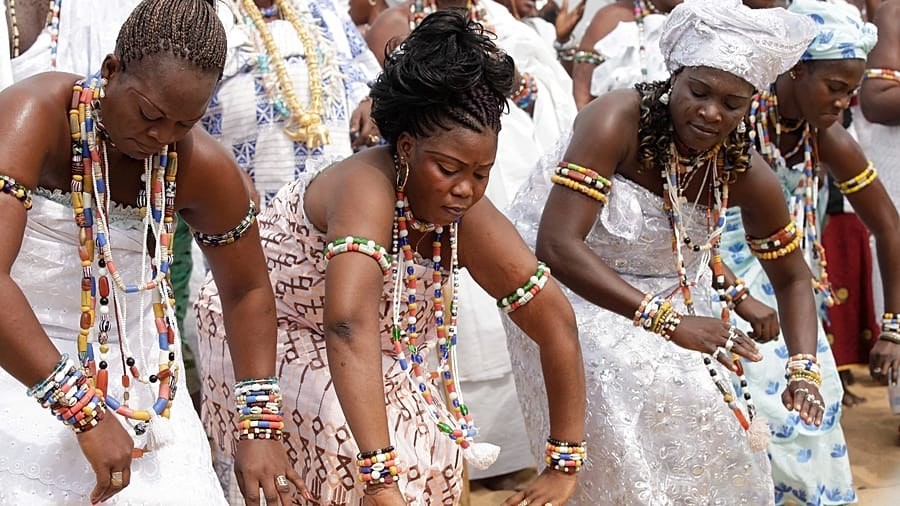
Aneho, Togo — The announcement came from a small podium in Glidji-Kpodji Square, near the southern city of Aneho, as hundreds of Voodoo priests, priestesses and believers — dressed in white loincloths and strings of pearls — chanted and danced into the night. This was no ordinary festival: for the Guin people of southeastern Togo, the annual Epe-Ekpe, or Ekpessosso, marks the start of a new ancestral year, and the colour of the sacred stone is read as a divine forecast for the twelve months ahead.
A White Stone, a Propitious Year
The colour of the stone speaks a language older than the colonial borders that now divide this coast. White, the shade that emerged this week, carries the most welcome message of all: peace, purity and prosperity. Sky blue would have promised abundant food crops for the season ahead. Red, the colour every soul in the crowd dreaded, would have signalled famine, war and misfortune. A multicoloured stone, the elders say, is the harbinger of disease or a major epidemic.
Wlomo Nomo Combietey VIII Nii Labite, the guardian of the sacred wood, stood before the assembled faithful and explained the divine signal with the calm authority of a man who has read these signs for decades. The crowd responded not with applause but with a deep, rhythmic chant.
"Helu-lo, helu-lo," they sang in the Mina language — woe to evil spirits. The words repeated hundreds of times, a spiritual shield against the misfortunes that the red or multicoloured stones would have foretold. The chanting grew louder as priests lifted the white stone higher for all to see, its pale surface catching the light of the torches that ringed the square.
The priest's proclamation came with the gravity of a state address: "The white stone heralds a year of purity, peace and prosperity." The words hung in the warm September air, and the crowd's response was immediate and electric. Priestess Pierrette Ahouefa, her face radiant with emotion, exclaimed above the din: "The gods have answered our prayers." Around her, other priestesses nodded and raised their arms in gratitude.
The dancing that followed was not mere celebration — it was communion, the faithful moving for hours in trance-like states. The rhythm that drove them came from the mystical Aklima tam-tam drum, which had been carried by canoe across Lake Togo to the sacred wood earlier in the day. The drum's journey across the water is itself a ritual, a re-enactment of the ancestral passage that brought the Guin people to this shore generations ago.
Three and a Half Centuries of Faith
Its origins date back to 1663, when settlers from the former Gold Coast — the land we now call Ghana — brought their sacred practices to the Togolese coast. For 363 years, through colonial rule, independence, political upheaval and the march of modernity, the Guin people have gathered every September to read the stone's message. The 2024 ceremony was the 361st edition, and this week's unveiling continues an unbroken chain of faith that spans more than three and a half centuries.
The Guin people's story is one of migration and resilience. In the 17th century, they left the Accra region of present-day Ghana, driven by conflict and the search for new lands. Under King Foli Bebe, they founded a kingdom on the shores of Lake Togo, establishing the communities that still thrive today around Aneho and Glidji. The sacred forest of Gbatsome became the spiritual heart of this new kingdom, a place where the gods of the ancestors could be honoured far from their original home.
Oral traditions have carried the memory of this migration through the generations — no ancient manuscripts, but a story that lives in gestures, music and storytelling, passed from elder to child. The Epe-Ekpe festival is the most visible expression of this living history, a performance of identity that reconnects the Guin people to their roots every single year.
The sacred forest of Gbatsome remains the site where the most important rites unfold. It is here that the priests retreat before the unveiling, here that the stone is kept in the months between festivals, and here that the spiritual power of the Guin people is concentrated. The forest is not merely a location — it is a living entity, a repository of ancestral presence that the community protects with fierce devotion.
That the festival has been held every September for more than 350 years without interruption is a fact that deserves reflection. Wars have come and gone, empires have risen and fallen, yet every year the priests of the Guin people have entered the sacred wood and emerged with the stone's message — a continuity that endures beyond the reach of politics and time.
Voodoo at the Heart of Togolese Life
To understand the weight of this ceremony, one must understand Voodoo's place in Togolese society. Togo's population stands at about seven million, and 51 percent practice Voodoo — surpassing Christianity and Islam combined. This is not a marginal faith or a fading superstition; it is the majority religion of a nation, woven into the fabric of daily existence.
The belief system emerged in the late 16th century in the town of Tado, which sits on the Mono river separating Togo from Benin. From this spiritual birthplace, Voodoo spread across the region, adapting to local conditions while maintaining its core principles. Followers worship a single god — known as Mahu or Segbo-Lissa — but they approach this supreme being through more than 200 deities, each with their own domain, personality and powers.
Voodoo takes multiple forms across Togo and the wider West African region. There is the Voodoo of the royal courts, of the villages concerned with harvests and family matters, and of the healers who use herbs and spirits to treat ailments that resist conventional medicine. All share a common foundation: the belief that the spiritual world is not distant but present, active and engaged with human affairs.
For the majority of Togolese who practice Voodoo, the religion shapes daily life in ways both profound and practical. Festivals mark the agricultural calendar, healing ceremonies address suffering, and community rituals maintain social cohesion — the faith is not confined to temples but permeates the ordinary rhythms of work, family and community life.
The Guin people are part of a wider Voodoo and Vodun cultural family that extends across West Africa and into the diaspora. In Benin, the Vodun tradition flourishes with its own festivals and practices. In Ghana, similar belief systems persist among various ethnic groups. And across the Atlantic, in Haiti, Brazil, Cuba and the United States, the descendants of enslaved Africans have preserved and transformed these traditions into new forms that still echo their West African origins.

UNESCO Recognition: A Heritage Milestone
In December 2025, the world formally acknowledged what the Guin people have always known: that this ceremony is a treasure of humanity. The "bearing of the sacred stone or the rites of the New Year in the Guin country" was inscribed on UNESCO's Representative List of the Intangible Cultural Heritage of Humanity during the 20th session of the Intergovernmental Committee in New Delhi. This week's 2026 unveiling is therefore the first since that historic recognition, adding a new layer of significance to an already sacred occasion.
For the Guin people, the UNESCO inscription is more than a certificate or a plaque. It is international validation of a spiritual practice that has sometimes been misunderstood or dismissed — a declaration that the rituals performed on the shores of Lake Togo are as worthy of preservation as any cathedral, palace or museum collection.
The full ritual cycle is far more extensive than the single unveiling that draws the crowds — about twenty distinct rites spread over seven months, following a lunar calendar the priests track with precision. The unveiling of the stone is the climax, but the cycle begins long before and continues long after.
Among the associated rites, Yeke-Yeke stands out as a communal meal that reinforces social bonds and shares the blessings of the ancestors. Kpanchonchon offers a more exuberant expression — a lively parade in which participants paint their faces and bodies in vivid colours. These rites are not mere preliminaries but essential components of a holistic system of belief and practice.
The initiated women known as guin-yehuesi play a central role in the ritual cycle. These women, who have undergone years of training and initiation, manage many of the ritual tasks and lead ceremonies with authority and skill. Their presence challenges any simplistic notion of Voodoo as a male-dominated faith — in the Guin tradition, women hold spiritual power that rivals and sometimes exceeds that of their male counterparts.
Rituals That Bind a Community
The preparations for this year's festival began long before the crowds gathered in Glidji-Kpodji Square. Priestess Jeanne Sika explained the meticulous process: "The rituals began in early June in all the convents and the sacred forest. Each step is followed to the letter." Her words reflect the seriousness with which the Guin people approach their spiritual obligations — nothing is left to chance, no detail is too small to be observed.
The three-month initiation that precedes full participation in the rituals takes place in the secrecy of shrines, away from public view. During this period, initiates learn the songs, dances, prayers and protocols that they will need for the rest of their spiritual lives. It is an intense education, demanding discipline, dedication and a genuine calling to serve the spirits.
Behind the scenes, craftspeople work for months to create the colourful necklaces and ceremonial items the festival requires — sacred objects that will be worn, used and eventually stored in the shrines. Their work is itself a form of devotion, honouring the spirits through the skill of their hands.
The rites serve multiple functions that extend far beyond the purely religious. They are healing ceremonies, offering comfort to the sick and the troubled. They are recreational events, providing joy and entertainment to communities whose lives are often marked by hardship. And they are instruments of social cohesion, bringing together kings, district chiefs, priests and priestesses in a shared expression of identity and purpose.
Several hundred people, mostly Voodoo priests and priestesses, gather each year at Glidji-Kpodji Square for the unveiling. But the impact of the festival extends far beyond those who attend in person. Families prepare special meals. Children learn the songs and stories. Elders share their memories of festivals past. The entire community, whether present in the square or not, participates in the spiritual renewal that the festival represents.
The deep sense of identity and continuity that the festival sustains is perhaps its most precious gift. In a world of rapid change and constant disruption, the Epe-Ekpe festival anchors the Guin people to their past, their ancestors and their land. It tells them who they are and where they come from — and it gives them confidence in facing whatever the future may bring.
What to Watch For
For believers, the white stone's message is clear: the coming year will be one of peace, purity and prosperity. The faithful will carry this assurance into their daily lives, facing challenges with the confidence that the gods have blessed their path.
The UNESCO recognition is already beginning to transform the region's relationship with the wider world. Cultural and heritage tourism interest in the Aneho and Glidji area is growing, as travellers seek authentic experiences that connect them to living traditions rather than museum displays. The festival offers exactly that — a chance to witness a ceremony that has been performed for more than three and a half centuries, unchanged in its essential elements.
Togo is part of a broader West African revival of Voodoo and Vodun festivals. Benin's famous Voodoo festival in Ouidah draws thousands of visitors each January, including Afro-descendants from the diaspora reconnecting with their ancestral spiritual heritage. The growing interest in these festivals reflects a wider movement of cultural pride and spiritual reclamation across the region.
The Togolese government has taken notice, promoting heritage tourism as a way to share the nation's cultural wealth with the world while generating economic opportunities for local communities. The UNESCO inscription has given this effort new momentum, providing international recognition that can be leveraged to attract visitors, funding and scholarly attention.
The Guin people are navigating the balance between modernity and ancestral tradition with remarkable skill, embracing education and economic development while maintaining the rituals that define their identity. The festival is not a relic of the past but a living practice that adapts without losing its essential character.
To travellers and culture lovers, I extend an invitation that comes from the heart of West Africa: come next September to Glidji-Kpodji, stand on the shores of Lake Togo, and witness one of the oldest living festivals on the continent. The drums will be beating and the sacred stone will once again emerge from the forest — a reminder that some traditions are not merely preserved but lived.
This article was produced with AI-assisted research and editorial support. Sources: Africanews, AFP, UNESCO Intangible Cultural Heritage.
By Amara Diop, Staff Writer
What's Your Reaction?
 Like
0
Like
0
 Dislike
0
Dislike
0
 Love
0
Love
0
 Funny
0
Funny
0
 Wow
0
Wow
0
 Sad
0
Sad
0
 Angry
0
Angry
0

West Africa/Sahel Correspondent at Global1.News. Dakar-based journalist covering politics, security, climate, and development across Francophone and Anglophone West Africa. Tells the stories of a region undergoing profound transformation.














Comments (0)