
Alberta referendum expected to bring finality, but also more questions on separation
Alberta’s province‑wide referendum on 21 October will decide whether the province remains within the Canadian federation or triggers a second binding vote on secession.
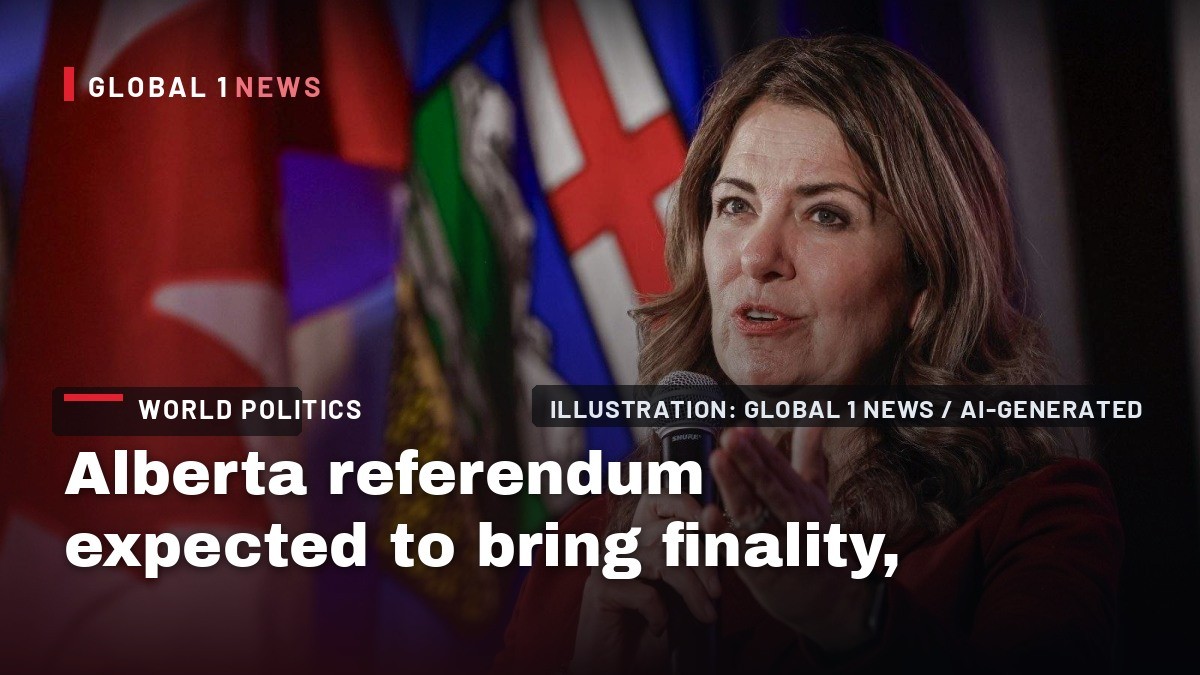
Alberta’s province‑wide referendum on 21 October will decide whether the province remains within the Canadian federation or triggers a second binding vote on secession. Early polling suggests a majority will choose to stay, yet the very act of voting has amplified the conversation about western alienation and the future of separatist sentiment in the province.
What the vote means for Albertans today
Premier Danielle Smith, who has publicly pledged to vote for staying in Canada, has warned that a “stay” result should be accepted and the province should move on. She framed the referendum as a chance to settle the question once and for all, echoing Prime Minister Mark Carney’s description of the vote as a “dangerous bluff” that would, if decisive, “settle this question.”
Opposition leaders within the independence movement, however, dispute the notion that a single vote can close the debate. They argue that the underlying grievances—particularly the perception that Ottawa benefits from Alberta’s resource‑driven economy without giving back—remain potent. The referendum therefore serves as both a test of current public sentiment and a catalyst for ongoing political mobilisation.
Western alienation as the engine of separatism
Political‑science professor Julian Castro‑Rea of the University of Alberta notes that Alberta’s sense of alienation from the national capital is a long‑standing feature of the province’s relationship with Ottawa. He explains that even if the referendum is lost, “the westernisation will still be around,” because Albertans have historically related to the rest of Canada through a lens of perceived neglect.
This feeling of being sidelined, especially in the context of federal energy policies, fuels the separatist narrative. The sentiment is less about a distinct cultural identity—unlike Quebec’s francophone nationalism—and more about a belief that the federal system does not fairly compensate Alberta for its contribution to the national economy.
Comparisons with Quebec, Scotland and Brexit
Analysts frequently draw parallels between Alberta’s movement and other secessionist drives. Quebec’s recent election of a minority Parti Québécois government, which has promised a third independence referendum, provides a contemporary benchmark. Yet experts stress that the catalysts differ: Quebec’s push is rooted in a distinct language and cultural heritage, whereas Alberta’s is driven by economic grievances and western alienation.
International comparisons to Brexit and Scotland’s independence campaign also surface. Graeme Young, a professor at the University of Glasgow, points out that Scotland’s 2014 referendum faltered largely due to uncertainties over economics—pensions, currency, and EU membership. He argues Alberta’s campaign is “underprepared,” lacking the extensive research and long‑term planning that characterised Scotland’s decade‑long push.
The “knife at the throat” strategy and its limits
University of Toronto’s Andrew McDougall likens Alberta’s referendum to Quebec’s “knife at the throat” tactic, where the threat of secession is used to extract concessions from the federal government. He suggests that the vote could serve as a bargaining chip, pressuring Ottawa on issues such as energy policy, fiscal transfers and regulatory frameworks.
Former UCP premier Jason Kenney, however, warns that wielding such a threat can backfire. He cautioned that “making the threat by holding a knife to the throat of the federation” could relegate Alberta to a “have‑not” status, akin to Quebec’s economic challenges, and could erode investor confidence. The economic fallout of a lost referendum, followed by a renewed push for separation, could be “catastrophic,” he warned.
Historical roots of Alberta’s separatist sentiment
Alberta’s modern separatist sentiment has simmered for roughly half a century, gaining momentum in recent years. The province’s creation in 1905, alongside Saskatchewan, from the Northwest Territories, gave it a relatively recent provincial identity compared with Quebec’s centuries‑old nation‑building. This shorter historical arc means Alberta lacks the entrenched nationalist symbols that fuel Quebec’s and Scotland’s movements.
Nevertheless, the province’s resource‑rich economy and its perceived marginalisation in federal decision‑making have kept the idea of “western alienation” alive. Premier Smith’s criticism of former Prime Minister Justin Trudeau’s policies as oppressive to western sovereignty reflects a continuity of grievance that has been repackaged under each new federal administration.
Potential pathways after the referendum
If the majority votes to stay, the immediate political landscape will likely shift toward managing the aftermath of the campaign. Federal‑provincial relations could see renewed negotiations on energy policy, especially as the Carney government seeks to move past the “dangerous bluff” narrative. Alberta’s leaders may leverage the referendum’s high turnout to press for greater fiscal autonomy or policy concessions.
Conversely, a narrow or contested result could keep the separatist movement alive, providing a platform for future leaders to reignite the debate. As Castro‑Rea observes, the feeling of alienation can endure indefinitely, meaning the “knife” metaphor may reappear in future political calculations, especially if federal policies continue to be viewed as unfavourable to Alberta’s economy.
What Canadians should watch for
Beyond the immediate vote, observers across the country will be tracking how the referendum influences broader national cohesion. The outcome will inform whether western provinces feel empowered to use similar tactics to extract concessions, or whether the federal government can present a unified response that diminishes the appeal of secessionist rhetoric.
For Canadians, the referendum underscores a persistent tension between regional economic interests and national policy. As the nation grapples with housing affordability, climate commitments and Indigenous reconciliation, the balance between accommodating regional grievances and maintaining a cohesive federation will remain a defining challenge for Parliament Hill and the Prime Minister’s Office.
This article was produced with AI-assisted research and editorial support. Reporting is based on the source material cited below. Sources: Global News Canada; globalnews.ca; Global1.News (17 October 2026).
By Alex Thompson, Staff Writer
What's Your Reaction?
 Like
0
Like
0
 Dislike
0
Dislike
0
 Love
0
Love
0
 Funny
0
Funny
0
 Wow
0
Wow
0
 Sad
0
Sad
0
 Angry
0
Angry
0

Canada Correspondent at Global1.News. Based in Toronto, covering Canadian politics, energy, trade, and US-Canada relations. Provides the Canadian perspective on North American and global affairs.











Comments (0)