
Romania Shoots Down Two Drones Over the Black Sea and Points to a New Russian Model
Romanian F-16s shot down two drones over the Black Sea on 17 October after they entered national airspace near Sulina. The defence ministry named no origin in writing; the interim defence minister later said on television they were new Russian turbo-jet models.
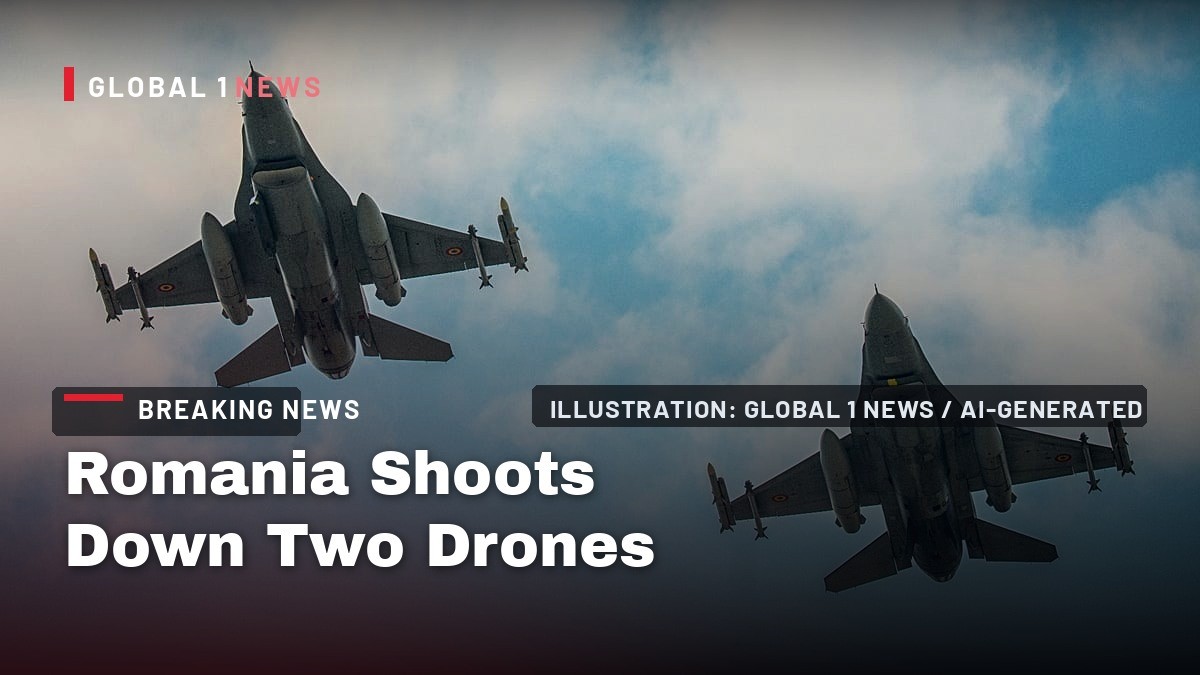
Romania scrambled two F-16s from the 86th Air Base at Borcea on Saturday evening and shot down two drones that crossed into its airspace over the Black Sea. They were the fifth and sixth drones destroyed over Romanian territory this year. Within hours, the interim defence minister was on television naming the Russian Federation as the origin of the aircraft.
Romania Shoots Down Two Drones Over the Black Sea and Points to a New Russian Model
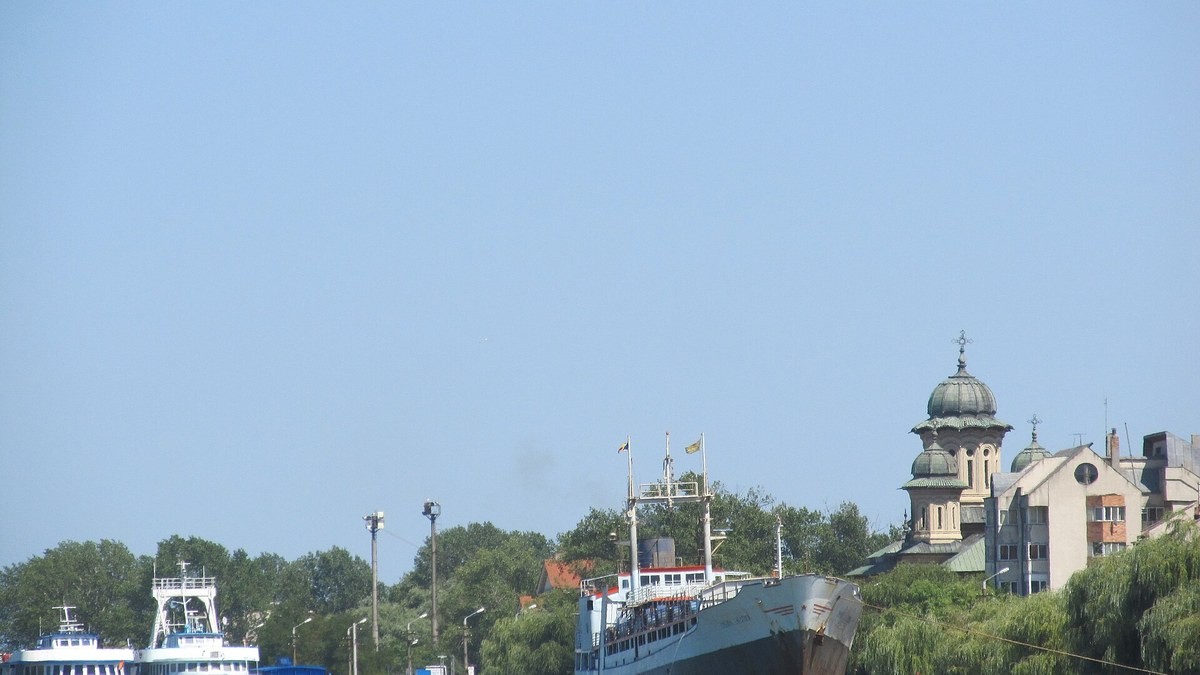
Sulina, Romania — 17 October 2026 — The engagement lasted six minutes from first intrusion to second kill. Both drones went down over Romanian territorial waters. No casualties were reported. The Defence Ministry's written statement did not name a country of origin. The minister, speaking later to Pro TV, did.
The Engagement Off Sulina
The sequence is set out in the Defence Ministry's own press release. Radar picked up a group of aerial targets flying approximately 120 kilometres east of Snake Island, heading southwest. The F-16s were scrambled at 17:43 local time. At 17:59 the first target entered Romanian airspace. It was shot down at 18:01. A second target entered at 18:01 and was shot down by the other F-16 at 18:05.
The ministry identified both as drones and said they were destroyed over Romanian territorial waters. Its statement said further information would follow. Interim Defence Minister Radu Miruta posted on Facebook within the hour. "Two drones were engaged and shot down a few minutes ago by Romanian military pilots over the Black Sea, moments after they had illegally entered our country," he wrote. He added: "Congratulations, colleagues! None of the work done so far has been in vain!"
What the Ministry Said, and What the Minister Said Next
The distinction matters. The ministry's official release described the targets as "jet-powered attack drones from the Geran family" and stopped there. It did not name a country. DW, citing agency reporting, noted that no information had been released on the country of origin.
Miruta went further on Pro TV's news bulletin later on Saturday. He said the aircraft belonged to the Russian Federation and appeared to be new models. "The drones that came in today were no longer ones flying at 150 km/h, but drones flying at 450 km/h, which leads us to think they are the new models of drones developed by the Russian Federation, those turbo-jet drones," he said. That is the minister's assessment, delivered to a television channel. It is not a ministry finding in writing. No launch site has been established by any source. No Russian comment on Saturday's shootdown was available.
Why 450 Kilometres an Hour Changes the Arithmetic
The previous intercepts, Miruta said, involved aircraft flying at roughly 150 km/h. At three times that speed, the geometry of air policing tightens sharply. He said the pilots were vectored to meet the drones on the approach rather than after they crossed.
"We monitor permanently what happens in the airspace near Romania, precisely in order to take measures when what we see outside the airspace approaches and enters Romania," he said. "That is the reason the performance of the Romanian pilots was achieved today." He said the method involved modelling a future trajectory and choosing engagement points that would not endanger the population below, and called the result "a calculated, thought-through effort." His summary of the timing: "Two drones were shot down today at an interval of 3 minutes... shot down 2 minutes after they entered national airspace. That means the models we use for deciding when to launch aircraft preventively are proving effective."
The Week That Led to Saturday Evening
Saturday was not the first alert of the week. In the night of 14-15 October, Romanian radar detected a group of air targets near Snake Island. Two Spanish Air and Space Force F-18s took off from the 57th Mihail Kogalniceanu Air Base. At 1:34 a.m. a drone was detected inside Romanian national airspace above territorial waters south-east of Sulina for about one minute before disappearing. Two Romanian F-16s then took off from Fetesti after further targets were detected about 77 km east of Snake Island. A RO-ALERT message went out at 4:57 a.m. for northern and eastern Tulcea county and was lifted at 5:46 a.m.
Separately, the Defence Ministry reported a radar target moving over Ukrainian territory toward the border in the northern part of Tulcea County. Two Spanish F-18s were scrambled from Mihail Kogalniceanu. A text alert went to residents in northern Tulcea County. No incursion into national airspace was reported in that episode. Defence Industry Europe reported that Saturday's interceptions followed four brief drone incursions earlier in the week that did not result in engagements.
Seven Missing and a Canal That Feeds the World
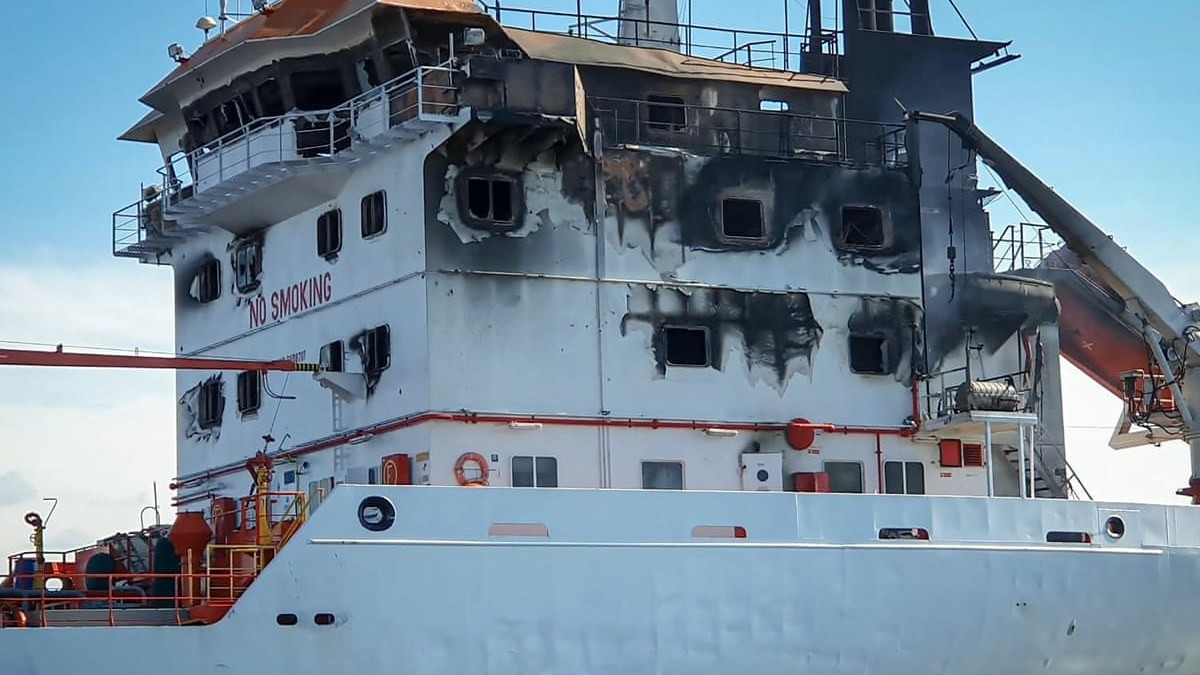
The week's damage was done at sea. On Wednesday evening and early Thursday, 14-15 October, two unmanned chemical tankers were struck near the mouth of the Sulina Canal. The San Marino-flagged Wine Trader, travelling from Tunisia to Romania, was hit 13 nautical miles south-east of the canal, one mile outside Romanian waters, at around 7 a.m. on Thursday. Of its 12 crew, five were rescued and seven were missing. The ship caught fire. It did not sink.
The Comoros-flagged Yara J was struck 8-10 miles south-east of Sulina inside Romanian waters late on Wednesday. Its crew doused the flames themselves. All were safe. President Nicusor Dan, at the EU summit in Brussels, said: "Two drones hit them." He declined to say whether Russia was responsible. A NATO military source told Reuters the drones that caused the fires were of Russian origin. Bulgarian Prime Minister Rumen Radev put it differently: "We don't believe that Ukraine will attack its own ships and crews. There is no logic here. So the results of this attack favour Russia. However, we don't have any solid evidence that the drones are Russian."
There Will Be a Reaction
Dan did not wait for attribution to draw a line. "Commercial ships are being attacked and sunk. Seafarers killed, injured and missing, very close to the shores of Romania and Bulgaria. This is unacceptable and it has to stop," he wrote on X. He added: "Lives, global trade, and critical infrastructure are at stake." Asked about a response, he said: "There will be a reaction from the Romanian state" once more information is gathered. He also said Romania needs "equipment to deal with a new kind of challenge."
On Thursday he met NATO Secretary-General Mark Rutte and Radev. The three agreed "to strengthen our defences in the Black Sea," according to the Guardian. Rutte wrote on X that NATO had strengthened its posture along the eastern flank "including with increasing counter-drone capabilities" and would "continue to work closely with our Allies in the Black Sea, adjusting our deterrence and defense posture as needed."
The Question Article 5 Has Not Answered
Article 5 carries the alliance's mutual defence guarantee. Whether it reaches the shipping attacks that preceded Saturday is a live question, and it turns on geography. Romanian defence analyst Radu Tudor told AP the strikes raised the issue of the exclusive economic zone. "It's a matter of discussion whether the exclusive economic zone is included in the Article 5-type reaction or not. And it seems that until now, it isn't — which raised a lot of questions," he said.
Tudor's broader assessment: "Tens of incidents are happening and Russia is getting closer to NATO borders. ... Words are not enough." A source in Romania's defence sector, not authorised to speak publicly, told AP the attacks are designed to hurt Ukraine economically and that "Romania is not the target right now." AP also noted that while most of the drones have come from Russia, Ukrainian drones have crossed the border too.
NATO's Tuesday Meeting and France's Offer
Foreign Minister Oana Toiu wrote on X: "The Black Sea will be safe again." She framed the stakes in economic terms: "The Black Sea serves as a critical maritime artery for the global export of grain, energy resources, and industrial commodities, making its stability vital to international food and energy security." She said NATO will discuss Black Sea "defence and deterrence" at a North Atlantic Council meeting on Tuesday. No decision has been taken. Article 5 has not been invoked.
After the EU leaders' summit in Brussels on Friday, Dan said France had offered to help Romania with equipment to ensure security in the Black Sea. "Romania has allies, and in times of need, we receive their help, and, of course, there is the SAFE program, which, once the contracts are finalized, will provide permanent, definitive protection in the Black Sea," he said. Tuesday is also the day Parliament is scheduled to vote on the Niculescu government. The prime minister-designate submitted his programme and 17 proposed ministers on Thursday. He needs 233 votes.
Romania's Record Since the First Shootdown
Before Saturday, four drones had been destroyed in Romanian airspace. The first came on Friday 24 July in Buzau county, the first time the NATO member had shot down a drone after dozens of incursions. Reuters reported at the time that the army said the origin was not yet identified and that the drone appeared to be a Shahed. A second was destroyed on Saturday 25 July near Sfantul Gheorghe. A third went down on 26 July over the Black Sea; Dan called the breaches "inadmissible and intolerable." A fourth was destroyed in August by a Spanish F-18 in Galati county.
As of 28 April 2026, Romania had recorded seven airspace violations by Russian drones since the start of the year, the discovery of munition fragments 11 times, and 18 air policing scrambles, a Defence Ministry spokesperson told ABC News. For the whole of 2025 the figures were nine violations, fragments found 16 times and 21 air policing missions. Since the invasion began: 25 violations, fragments found 47 times, 53 scrambles.
What Is Not Established
The location of Saturday's shootdowns is on the record twice, and the two accounts differ. Miruta's own posts put the first drone 25 km south-east of Sulina and the second 20 km east of the town. AFP reported both as "some 20km (13 miles) south-east of the town of Sulina." Both versions stand.
The October shipping count is similarly unresolved. AP reports drone attacks on at least seven cargo vessels in the Black Sea this month off the coasts of Romania and Bulgaria. Reuters and DW report at least five other cargo ships hit near those coasts over the previous 10 days, with at least 23 sailors reported missing or dead, plus the two tankers struck on Wednesday and Thursday. The counts measure overlapping sets. No single reconciled total exists. No fragments from Saturday's drones have been reported recovered. No casualties were reported. No launch site has been established. On 28 July 2026, Russian Foreign Ministry spokeswoman Maria Zakharova called Romanian complaints about airspace violations "groundless." That was July. On Saturday's shootdown, Moscow has said nothing.
This article was produced with AI-assisted research and editorial support. Sources: AGERPRES, Radio Romania International, Euronews, DW, the Guardian, Al Jazeera, the Associated Press, Arab News/AFP, Gandul, Defence Industry Europe, Reuters and ABC News. Photographs: Associated Press via Euronews, Nenea hartia/Wikimedia Commons (CC BY-SA 4.0), and Arsvom/AFP via Getty Images.
By Jessica Ali, Staff Writer
What's Your Reaction?
 Like
0
Like
0
 Dislike
0
Dislike
0
 Love
0
Love
0
 Funny
0
Funny
0
 Wow
0
Wow
0
 Sad
0
Sad
0
 Angry
0
Angry
0

Editor-in-Chief at Global1.News. Atlanta-based journalist who cuts through the BS and tells it like it is. Lead anchor, host, and the voice you hear when the spin stops and the truth starts.















Comments (0)