
RNC's First Midterm Convention Opens in Dallas as Trump, Vance Headline
The Republican National Committee on Saturday released the full speaker lineup for its first-ever midterm convention, a two-day Dallas showcase next week designed to project unity and energy as the party stares down a difficult November landscape with control of Congress hanging in the balance. RNC's First Midterm Convention Opens in Dallas Washington, D.C.
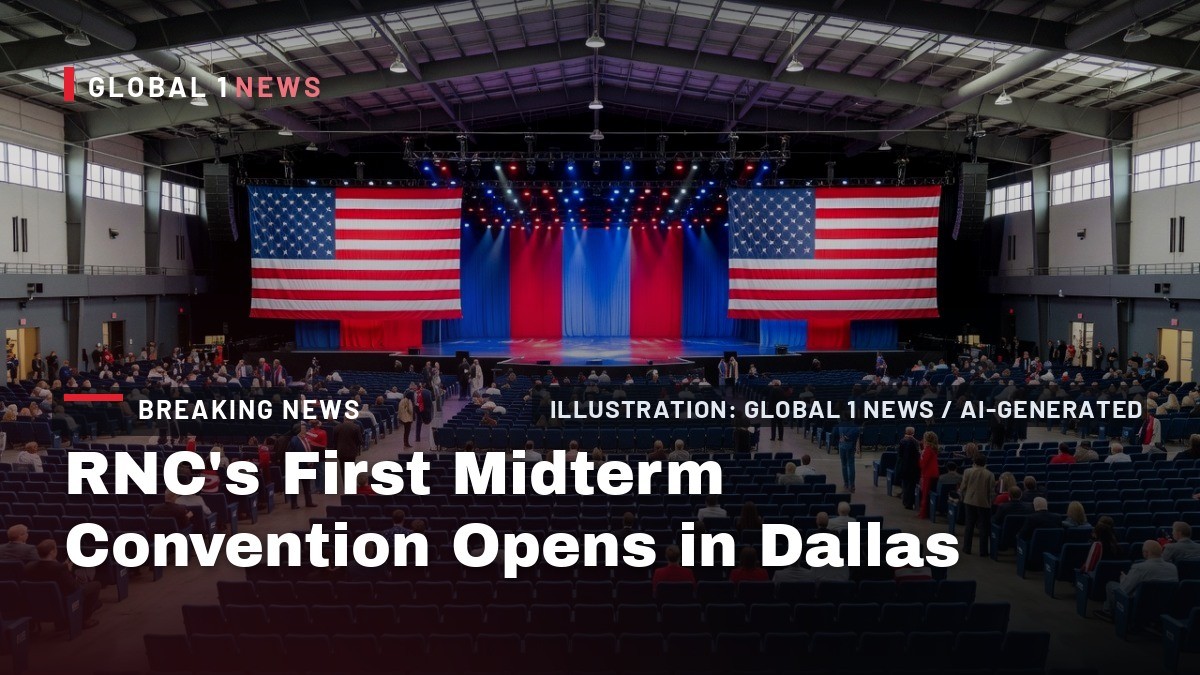
The Republican National Committee on Saturday released the full speaker lineup for its first-ever midterm convention, a two-day Dallas showcase next week designed to project unity and energy as the party stares down a difficult November landscape with control of Congress hanging in the balance.
RNC's First Midterm Convention Opens in Dallas
Washington, D.C. — The Republican National Committee's unprecedented midterm convention, set for Sept 9-10 in Dallas, will feature President Donald Trump as the headline act on Night One and Vice President JD Vance taking the lead on Night Two, with Trump delivering closing remarks and expected to attend both days. The event arrives at a moment of acute Republican anxiety, with the party defending narrow majorities in both chambers, Trump's approval rating mired in the 30s in most polls, and voter anger over the Iran war and persistent price pressures threatening to upend the GOP's grip on Congress.
The convention, announced Saturday Sept 5, marks a strategic departure for the RNC, which has traditionally reserved its major gatherings for presidential election years. Party officials are framing the Dallas event as a six-hour-per-day policy and candidate showcase, running roughly 4 p.m. to 10 p.m. each day, covering more than 100 topics with a candidate showcase each night. But the timing — eight weeks before the Nov 3 midterms — and the speaker list make clear the event is as much about political survival as it is about policy messaging.
The Unusual Convention
No national party committee has ever staged a formal midterm convention of this scale, and the RNC's decision to do so now reflects a recognition that the traditional campaign playbook may not be sufficient in this cycle. The event will also honor the late conservative activist Charlie Kirk, who was killed one year ago Thursday, adding an emotional undercurrent to the proceedings.
RNC Chairman Joe Gruters cast the convention as a stark choice for voters, framing Republicans as the party of everyday Americans and Democrats as captives of their most extreme elements.
"Republicans are the party of hardworking, patriotic Americans who believe in a fair day's pay, safe streets, secure borders, and a government that gets out of our way and lets Americans win again," Gruters said in the announcement. "Democrats have taken a different path. They have chosen a path hijacked by the radical Left and defined by their most extreme, out-of-touch, anti-American views. Come November, the American people are going to see this choice clearly and they are going to deliver a landslide for common sense."
The convention's policy agenda includes the administration's crackdown on fraud, tax cuts contained in the One Big Beautiful Bill Act, expanded healthcare access through the TrumpRx initiative, border and immigration enforcement, education and school choice, and contrasting GOP candidates with what party officials describe as "extreme liberal Democrat policies."
The Speaker Lineup
Beyond Trump and Vance, the speaker roster reads like a who's who of the administration and the party's most prominent figures. Health and Human Services Secretary Robert F. Kennedy Jr. is scheduled to speak, as is Treasury Secretary Scott Bessent. Former White House Press Secretary Karoline Leavitt and Donald Trump Jr. round out the family and administration contingent.
The candidate slate is equally notable, featuring Texas Attorney General and GOP Senate nominee Ken Paxton and Michigan Senate nominee Mike Rogers — both locked in competitive races that could determine Senate control. House Speaker Mike Johnson of Louisiana and Sen. Ted Cruz of Texas are expected to use the event to draw sharp contrasts with Democratic opponents, specifically calling out New York City Mayor Zohran Mamdani and Michigan Senate candidate Abdul El-Sayed as examples of a party they say has veered toward socialism.
Notably absent from the Dallas stage will be Senate Majority Leader John Thune of South Dakota. CBS News reported that Thune will skip the convention itself but is expected to attend fundraisers in Dallas that week, a scheduling choice that underscores the delicate balance Republican leaders are trying to strike between embracing Trump and maintaining their own institutional identities.
'Run on My Record': The Rose Garden Pitch
The convention comes on the heels of a Sept 2 White House Rose Garden "end of summer BBQ" dinner that Trump hosted for more than two dozen vulnerable Republican lawmakers. At that event, Trump delivered a direct message: run on his record, and he will campaign alongside them in the races that matter most.
"All you have to do is talk about it, and you're going to win and you're going to win big," Trump told the assembled lawmakers, according to pool reports. He acknowledged the historical headwinds facing his party, saying, "Whether you're a good president or a great president, you lose the midterms. We're going to turn that around because there's no reason for it."
Trump pledged to spend the 30 days before the election campaigning hard in battleground states, specifically listing Senate races in Alaska, where GOP Sen. Dan Sullivan faces Democratic former Rep. Mary Peltola, and Texas, where Paxton is running against Democratic state Rep. James Talarico. Trump joked about Paxton's suits and television presence but called him one of the best attorneys general in the country, according to attendees.
The Rose Garden dinner and the Dallas convention are part of a coordinated effort to nationalize the midterms around Trump's agenda and personality, even as polling suggests that approach carries significant risk.
A Party Tied to Trump
The decision to tie downballot candidates so tightly to Trump is a calculated gamble, and Republican strategists are divided on whether it will pay off. Downballot Republicans have increasingly tied themselves to Trump to turn out low-propensity conservative voters, who may not otherwise show up in a non-presidential election year. The strategy is straightforward: energize the base, even if it means alienating some suburban swing voters who have drifted from the party.
RNC national press secretary Natalie Baldassarre warned lawmakers considering distancing themselves from Trump that doing so risks alienating their base and losing 15 to 20 percent of key Republican voters, according to Politico. That warning reflects a broader party consensus that Trump's voters are essential to any Republican victory, even in districts where his personal popularity lags.
But the approach has its critics within the party. Rep. Don Bacon of Nebraska, a moderate who is retiring rather than running for reelection, said Trump is hurting GOP chances in his Omaha-area district, which forecasters expect Democrats to flip. Bacon's assessment is echoed by polling data: House Majority PAC surveys show Trump underwater in every district recently polled, including a South Texas district he won by 18 points in 2024.
The tension between these two realities — Trump's hold on the base and his weakness with the broader electorate — defines the strategic challenge facing Republicans as they head into the final eight weeks of the campaign.
The Money Question
One of the most closely watched dynamics of the 2026 cycle is how Trump's political operation deploys its substantial financial resources. MAGA Inc., the primary super PAC aligned with Trump, is sitting on a war chest of roughly $400 million, according to Republican operatives familiar with the group's finances. Downballot Republicans want a significant portion of that money directed to their races, and they want Trump's operation to spend it aggressively.
"We need his money and we need his voters," one anonymous GOP consultant told Politico, capturing the sentiment of many Republican candidates who see Trump as both their greatest asset and their most significant liability.
Trump's operation has already begun spending. Two ads are airing through the nonprofit Keep America Great: one echoes the taxes-on-tips and taxes-on-overtime message that proved popular in 2024, and the other is a tribute to Trump featuring Dana White's speech from the 2024 Republican National Convention. The ads are designed to reinforce Trump's economic message and his personal brand simultaneously, targeting the low-propensity voters the party needs to turn out.
The question is whether $400 million — even deployed strategically — can overcome the structural headwinds facing the party. Historical precedent suggests the president's party typically loses seats in midterms, and the current political environment offers little reason to believe this cycle will be different.
Battleground Math
The math is daunting for Republicans. They hold narrow majorities in both chambers, leaving little room for error. Trump has pledged to campaign in all roughly 35 races likely to decide control of Congress, a grueling schedule that will test his stamina and his appeal in districts that may not be friendly territory.
The Senate map is particularly challenging. In Alaska, Sullivan is fighting for his political life against Peltola, who has proven herself a formidable candidate in a state that often rewards ticket-splitting. In Texas, Paxton is running against Talarico, a young Democratic state representative who has energized the party's base in a state that has not elected a Democrat to statewide office in decades but is becoming increasingly competitive.
Michigan presents another critical test. Rogers, the GOP nominee, is running against El-Sayed, a progressive Democrat who has drawn national attention and significant fundraising support. The race is seen as a bellwether for the party's ability to compete in the industrial Midwest.
House races are equally fraught. The South Texas district that Trump won by 18 points in 2024 is now considered competitive, according to House Majority PAC polling, a sign that even reliably Republican areas are not immune to the national mood. Bacon's Nebraska district is expected to flip to Democrats, and forecasters have identified dozens of other GOP-held seats that are vulnerable.
The Dallas convention is designed, in part, to change the narrative — to shift attention from the administration's struggles to the contrast between Republican and Democratic candidates. Whether that message can break through remains an open question.
What Democrats Are Planning
Democrats are watching the Republican maneuvering with a mix of confidence and caution. The party's strategists believe the political environment favors them, with Trump's approval rating stuck in the 30s and voter frustration over the Iran war and the economy providing a steady tailwind. But they also recognize that Trump has defied political gravity before, and they are preparing for a brutal final eight weeks.
Democratic messaging is expected to focus on the issues that polling shows are hurting Republicans most: the economy, prices, and the human and financial costs of the Iran conflict. The party is also planning to tie downballot Republicans to Trump's most controversial positions, hoping to paint the entire GOP ticket as extensions of the administration.
The contrast the RNC is drawing — Republicans as the party of "common sense" versus Democrats as "socialists" — is a direct response to this Democratic strategy. By highlighting figures like Mamdani and El-Sayed, Republicans are trying to define the Democratic Party by its most progressive voices, hoping to scare moderate voters back into the GOP column.
Whether that framing will resonate is uncertain. Mamdani, the New York City mayor, has become a lightning rod for conservative criticism, and El-Sayed's progressive bona fides are well established. But Democrats believe their candidates' positions on kitchen-table issues will ultimately matter more than ideological labels.
What's at Stake
The stakes of the Nov 3 election could hardly be higher. Control of both chambers of Congress is on the line, and with it the fate of the Trump administration's legislative agenda for the next two years. A Republican loss in either chamber would effectively end the president's ability to advance his priorities through Congress and would likely trigger a wave of investigations and oversight hearings from Democratic majorities.
For Republicans, the Dallas convention is an opportunity to reset the narrative and project confidence heading into the final stretch. For Trump, it is a chance to demonstrate that he remains the party's dominant force and that his political operation can deliver when it matters most. For downballot candidates, it is a chance to stand alongside the president and vice president, hoping that association will energize the voters they need while not alienating the ones they can't afford to lose.
The convention's success or failure will be measured not in applause lines or media coverage, but in the results eight weeks from now. If Republicans manage to hold their majorities, the Dallas experiment will be hailed as a masterstroke. If they lose, it will be remembered as a symbol of a party that misread the moment.
For now, the party is projecting unity and confidence, with Gruters promising a "landslide for common sense" in November. The coming weeks will test whether that confidence is justified or misplaced.
This article was produced with AI-assisted research and editorial support. Sources: AP News, Washington Examiner, HuffPost, CBS News, Politico.
By Jessica Ali, Staff Writer
What's Your Reaction?
 Like
0
Like
0
 Dislike
0
Dislike
0
 Love
0
Love
0
 Funny
0
Funny
0
 Wow
0
Wow
0
 Sad
0
Sad
0
 Angry
0
Angry
0

Editor-in-Chief at Global1.News. Atlanta-based journalist who cuts through the BS and tells it like it is. Lead anchor, host, and the voice you hear when the spin stops and the truth starts.












Comments (0)