
Tamil Nadu Unveils Super El Nino Shield in Record Agriculture Budget
Tamil Nadu Agriculture Minister R. Vinoth has activated district-level contingency plans across 12 vulnerable districts to counter a predicted Super El Nino event expected to disrupt the 2026 southwest monsoon. The revised Agriculture Budget 2026-27 allocates Rs 58,374 crore with targeted measures for Kuruvai paddy and long-term resilience. This response directly addresses risks to delta farmers and national food grain targets amid below-normal rainfall forecasts.

Tamil Nadu Agriculture Minister R. Vinoth has activated district-level contingency plans across 12 vulnerable districts to counter a predicted Super El Nino event expected to disrupt the 2026 southwest monsoon. The revised Agriculture Budget 2026-27 allocates Rs 58,374 crore with targeted measures for Kuruvai paddy and long-term resilience. This response directly addresses risks to delta farmers and national food grain targets amid below-normal rainfall forecasts.
Tamil Nadu El Nino Plan in Rs 58k Cr Farm Budget
Chennai, Tamil Nadu – August 6, 2026 — Presenting the revised Agriculture Budget 2026-27 in the State Legislative Assembly, Minister Vinoth framed the outlay squarely around climate defence, telling legislators the state was fully prepared to implement district-level contingency measures against the unfolding El Nino threat.
Super El Nino Threat to 12 Districts
Minister Vinoth stated that severe climatic impacts are anticipated across the country in 2026, with 12 districts in Tamil Nadu facing the strongest effects during the Kuruvai season from June to early August.
The India Meteorological Department forecasts the southwest monsoon at 92 percent of the long-period average, carrying a 35 percent probability of a deficient season.
INCOIS projections indicate the current El Nino episode will reach maximum intensity between November 2026 and January 2027, with Indian Ocean sea-surface temperatures remaining elevated through April-May 2027. This extended warming raises the prospect of marine heatwaves that accelerate coral bleaching along the Tamil Nadu and Andhra coasts while simultaneously depressing sardine and mackerel landings, directly affecting protein availability for coastal communities and export earnings. The forecast aligns with broader climate-security assessments that link sustained ocean warming to reduced pelagic fish stocks and heightened livelihood risks for small-scale fishers.
CREA modelling underscores that India’s power sector experiences the largest El Nino-induced stress among major economies, as deficient rainfall simultaneously curtails hydropower output and wind generation while elevated temperatures drive a sharp rise in cooling demand. This dual pressure on supply and demand threatens grid stability during peak agricultural pumping seasons, particularly in states already facing groundwater stress. Policy responses must therefore integrate renewable-storage buffers and demand-side management within the National Electricity Plan to safeguard both energy and irrigation security.
Historical analogues reinforce the urgency: the 2015-16 super El Nino produced an 86 percent LPA monsoon with a 40 percent rainfall shortfall in Marathwada and triggered catastrophic Chennai flooding, while the weaker 2023 event still caused a 36 percent August deficit across Satara, Nashik, Raigad, West Nimar, Balangir and Korba. With IMD now projecting August rainfall below 94 percent of LPA—when the month normally contributes 29 percent of southwest monsoon totals and supports roughly 20 percent of kharif sowing—the dependence of 60 percent of Indian farmers on timely rains places food-grain production and rural incomes at immediate risk.
TNAU Contingency Plans Activated
Tamil Nadu Agricultural University has prepared District Agricultural Contingency Plans for all districts and communicated them to District Collectors for immediate implementation.
These plans include adjustments for water availability, seed stocks and crop patterns tailored to local conditions in the 12 affected districts. The measures aim to safeguard production through the crop cycle most exposed to the projected El Nino peak.
Kuruvai Package and Mettur Storage Crisis
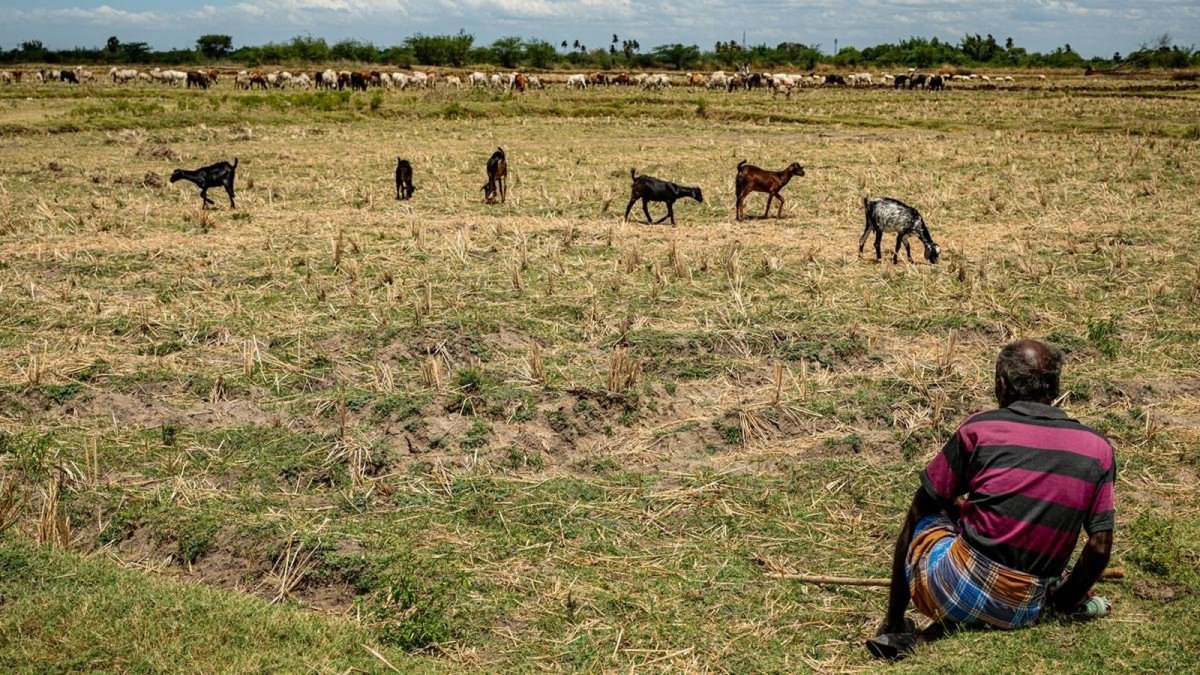
The government announced a Kuruvai Special Package of Rs 134.83 crore for both delta and non-delta districts after Mettur Dam failed to open on its customary June 12 date due to low storage levels of 35-38 tmcft against full capacity of 93.47 tmcft.
Kuruvai cultivation has already been undertaken on 8.26 lakh acres, though delta districts such as Thanjavur and Tiruvarur recorded sharp declines to 89,000 and 64,000 acres respectively. Production losses could reach 15 lakh tonnes of paddy with an estimated value of Rs 1,125 crore.
Tamil Nadu received only 2.915 tmcft of Cauvery water from Karnataka in June against the 9.19 tmcft mandated by the Cauvery Water Disputes Tribunal and Supreme Court orders, leaving Mettur inflows near 125 cusecs and the Grand Anaicut dry. Climate projections indicate the basin’s drying trend will persist until at least 2050, compelling a structural shift from surface-water dependence toward conjunctive groundwater use. This hydrological stress directly threatens the delta’s rice-based cropping system and the food-security buffer it provides to southern India.
Following last year’s record kuruvai coverage exceeding six lakh acres, authorities have now restricted the crop to approximately 3.55 lakh acres reliant on groundwater. Farmers who invested Rs 1,500 per acre in double summer ploughing ahead of the expected June 12 release have forfeited that expenditure, while agricultural labourers confront unemployment and livestock owners face fodder shortages. These cascading losses highlight the need for timely drought-declaration protocols that unlock PMFBY prevented-sowing compensation before the season collapses.
The state’s decision to limit kuruvai acreage reflects both immediate storage constraints and longer-term climate-adaptation imperatives. Delta farmer organisations have formally requested drought-hit status for affected districts, seeking to trigger insurance payouts and input subsidies. Such measures, if implemented swiftly, could preserve rural liquidity and prevent distress migration, yet they also underscore the urgency of basin-wide water-sharing agreements resilient to projected 2050 drying trends.
PMFBY Coverage Expanded Statewide
Pradhan Mantri Fasal Bima Yojana has been implemented across 14 clusters covering all 37 districts for Kuruvai, Samba and Rabi seasons with Rs 648.55 crore from state funds.
The scheme targets 36 lakh acres and 15 lakh farmers with a goal of 100 percent crop insurance coverage for every notified crop across the state.
Short-Term Credit and Loan Waiver Outlays
The budget provides Rs 17,000 crore in short-term agricultural credit and Rs 3,000 crore in working capital loans for allied activities.
Rs 5,267 crore in crop loan waivers has already been disbursed in four instalments to eligible farmers. Free power support stands at Rs 7,432 crore for agricultural pump sets.

Soil Health and Micro Irrigation Push
The Tamil Nadu Soil Conservation Mission receives Rs 122.51 crore in 2026-27 under a five-year Rs 600 crore plan to issue Soil Health Cards to one lakh farmers and promote organic inputs.
Micro irrigation schemes worth Rs 785 crore will benefit 95,000 farmers and extend coverage to another 50,000 acres. New irrigation infrastructure targets 2,600 acres of rain-fed land through borewells and tube wells.
The Soil Conservation Mission’s 2026-27 allocations earmark Rs 63.50 crore for green-manure cultivation, Rs 4.50 crore for liquid bio-fertilisers and Rs 12.38 crore for water-soluble fertilisers and growth promoters, alongside Rs 8 crore to expand organic farming across 20,000 acres and Rs 10 crore for permanent vermicompost units. These investments aim to rebuild soil organic carbon depleted by decades of intensive rice cultivation, thereby enhancing water-holding capacity in drought-prone districts and reducing reliance on chemical inputs whose prices remain volatile.
One lakh farmers will receive Soil Health Cards funded by Rs 4 crore from state resources, while nearly three lakh additional farmers obtain cards under the central scheme. Agricultural mechanisation receives Rs 227.20 crore for subsidised equipment, complemented by a drone-training programme preparing 500 operators—including 100 women—for 50 percent subsidised drone deployment. The UN’s designation of 2026 as the International Year of Women Farmers lends policy momentum to this gender-inclusive skilling effort, aligning with national goals for sustainable intensification.
A Rs 60 lakh carbon-trading pilot across 2,000 acres will reward adoption of Direct Seeded Rice, Alternate Wetting and Drying and slow-release fertilisers projected to cut greenhouse-gas emissions by roughly 50 percent. By linking soil-health interventions to verifiable emission reductions, the programme positions Tamil Nadu to access emerging carbon markets while advancing the state’s commitments under the National Mission for Sustainable Agriculture and climate-resilient food-production targets.
National Context and Food Security Stakes
Union Agriculture Minister Shivraj Singh Chouhan has activated district-level contingency plans nationwide. The 2026 Super El Nino is projected to rank among the strongest episodes on record.
Tamil Nadu’s food grain target of 125 lakh MT in 2026-27 forms part of a five-year goal of 131 lakh MT. Shortfalls here would directly affect Indian food security and increase pressure on central relief mechanisms.
A high-level review chaired by Principal Secretary to the Prime Minister P.K. Mishra has mandated continuous El Nino monitoring and coordinated assessment of weak-monsoon impacts on vulnerable districts. National kharif sowing lagged last year’s pace by about 6 percent at 531.25 lakh hectares as of mid-July, with the June deficit of 33 percent narrowing to 24 percent by July and rain-deficient districts declining from 262 to 178. These figures illustrate both the partial recovery delivered by late monsoon revival and the persistent spatial variability that threatens production in rain-shadow regions.
Complementary state missions address long-term food-security risks: the pulses and edible-oilseeds self-sufficiency programme receives Rs 203.64 crore over five years, the millet mission Rs 63.81 crore, and the cotton renaissance mission Rs 27.21 crore covering 73,360 acres for 40,000 farmers. The State Seed Development Agency will produce 43,400 MT of certified seeds at a cost of Rs 250 crore, while eight new Integrated Agricultural Extension Centres with 300-MT godowns are budgeted at Rs 27.82 crore and a Farmers Development Agency at Rs 23 crore. These outlays follow three months of TVK governance consultations spanning Salem, Thanjavur, Vellore, Tirunelveli and Chennai.
Together, the central monitoring directive and state-level investments in seed systems, extension infrastructure and climate-resilient crops form a multi-layered response to the combined threats of El Nino and structural water deficits. By anchoring budgetary allocations in district-specific consultations and aligning them with national food-security frameworks, Tamil Nadu seeks to safeguard kharif output and rural incomes even as climate variability intensifies across the peninsula.
Political Reactions in Assembly
Chief Minister C. Joseph Vijay praised Finance Minister N Marie Wilson and Vinoth for delivering revised estimates within three months of assuming office. DMK MLAs protested in black shirts while AIADMK members criticised the allocations.
Udhayanidhi Stalin demanded an all-party meeting on Cauvery issues and accused the government of rebranding old schemes while ignoring farmer distress.
— By Dr. Raj Patel, Staff WriterThis article was produced with AI-assisted research and editorial support. Reporting is based on sources cited in the article.
What's Your Reaction?
 Like
0
Like
0
 Dislike
0
Dislike
0
 Love
0
Love
0
 Funny
0
Funny
0
 Wow
0
Wow
0
 Sad
0
Sad
0
 Angry
0
Angry
0

India/South Asia Correspondent at Global1.News. Analytical voice with a background in science and health journalism. Based in New Delhi, covering Indian politics, education, healthcare, technology, and policy. Breaks down complex data into clear, actionable reporting.














Comments (0)