
Tamil Nadu Grants 365-Day Maternity Leave for Third Child
The Tamil Nadu government has dramatically expanded maternity benefits for its female employees, announcing on Tuesday that those giving birth to a third child will now receive 365 days of paid leave—more than four times the existing 12-week entitlement.
The Tamil Nadu government has dramatically expanded maternity benefits for its female employees, announcing on Tuesday that those giving birth to a third child will now receive 365 days of paid leave—more than four times the existing 12-week entitlement. The decision, announced by Human Resources Management Minister D Sarathkumar in the state Assembly, reverses a policy framework that had been in place for less than six months and places the state at the centre of India's intensifying debate over falling fertility rates and women's workforce participation.
Tamil Nadu's Bold Gamble: 365-Day Maternity Leave for Third Child Sparks Fertility, Fiscal, and Feminist Debate
Chennai, Tamil Nadu – August 19, 2026 — In a move that merges welfare policy with demographic strategy, Tamil Nadu has equalised maternity leave for a third child with the one-year benefit already available for the first two. The announcement came during the Assembly debate on the Human Resources Management department's demand for grants, with Minister Sarathkumar framing the decision as a hallmark of a "welfare-oriented administration that prioritises social welfare and women's empowerment." The policy shift applies to all women government employees and brings the state's third-child provision in line with the 365-day norm established in July 2021.

The Policy Reversal — From 12 Weeks to 365 Days
The announcement represents a complete reversal of the state's position as recently as March 2026. At that time, Tamil Nadu amended Fundamental Rule 101(A) to restrict maternity leave to 12 weeks (84 days) for employees with two or more surviving children, a move the Madras High Court upheld in June 2026. That 12-week provision had itself been introduced in line with the Supreme Court's interpretation that maternity benefits cannot be denied for a third child—but the benefit had been capped at 12 weeks.
Under the new framework, women government employees with fewer than two surviving children continue to receive 365 days, while those with two or more surviving children—previously capped at 12 weeks with full pay—now receive the full year. The trajectory of Tamil Nadu's maternity benefits shows a consistent expansion: from the original 90 days, to six months in 2011, nine months in 2016, and one year in July 2021, under governments led by both the AIADMK and the DMK. The latest change, under the new Tamilaga Vettri Kazhagam (TVK) government led by Chief Minister Vijay, who was sworn in on 10 May 2026, extends that generosity to a demographic group previously excluded.
Demographic Pressures — A State Below Replacement Level
The policy cannot be understood in isolation from Tamil Nadu's demographic trajectory, which Health Minister KG Arunraj described as a major public health challenge. At a workshop of the Obstetrics and Gynaecological Society of South India on August 16, Arunraj revealed that the state's Total Fertility Rate (TFR) has fallen below 1.4, against the replacement level of 2.1 needed to maintain population stability. Sample Registration System data confirms the trend: Tamil Nadu's TFR stood at 1.4 in 2020 and dropped to 1.3 in 2023, among India's lowest, tied with West Bengal and behind only Delhi's 1.2.
The long-term trajectory is stark. Tamil Nadu's fertility rate was 3.9 in 1971, 2.7 in 1986, and 1.6 in 2017—a steady decline that now places nearly 16% of the state's population above the age of 60. The state's population, estimated at 7.2 crore in 2011, is projected to reach around 7.8 crore by the early 2030s before beginning to decline if fertility does not rise. Arunraj signalled that the government is actively considering pronatalist measures, citing Andhra Pradesh's example: "We were told that in places like Andhra Pradesh, there are government schemes providing incentives for couples to have a third child. Therefore, in the future, there could definitely be such measures here too." Andhra Pradesh Chief Minister N Chandrababu Naidu has already announced cash incentives of Rs 30,000 for a third child and Rs 40,000 for a fourth, announced at a public meeting in Narsannapeta.
The arithmetic of a TFR of 1.3 is unforgiving. At the replacement level of 2.1, a population roughly replaces itself across generations; at 1.3, each generation is only about three-fifths the size of the one before it, which means a shrinking pool of working-age taxpayers supporting a growing elderly cohort. With nearly one in six Tamil Nadu residents now over 60, the pressure on pension outlays, public healthcare spending and elder-care infrastructure will mount in the coming decades. This is the demographic bind that makes the maternity leave announcement as much an economic intervention as a welfare measure.

Political Reactions — Support, Skepticism, and a Newborn in the House
The decision has drawn sharply divided responses. Congress MP Karti Chidambaram opposed the policy on economic grounds, stating: "While maternity leave is most welcome, paternity leave should also be considered, but the government should not be encouraging a third child in families. Do families have the resources to support a 3rd child?" His remarks highlight a central tension: the policy assumes families can afford the long-term costs of a third child, even as the state provides only the leave benefit, not direct financial support.
M Manimekalai of the Tamil Nadu Primary School Teachers' Federation welcomed the move but cautioned that the beneficiary pool will likely be small. Women account for more than 80% of the elementary education department workforce, making the policy symbolically significant but numerically limited. She urged the government to resume substitute-teacher appointments during maternity leave to prevent disruption in classrooms. C Sekar of JACTO-GEO added a structural critique: the policy's reach is constrained because the government is recruiting fewer employees, and many women join the workforce over the age of 40, reducing the window for third births.
The human dimension of the debate was on full display in the Assembly itself. First-time TVK MLA R Pallavi brought her newborn to the session, leaving the child with a caregiver near the hall. Responding to social media criticism, she said: "Please think before making a comment. It is fine even if you do not understand another person's pain, but do not troll." Her presence underscored the practical realities of balancing legislative duties with motherhood—a reality the new policy seeks to address for thousands of state employees.
Fiscal and Administrative Context — Beyond Maternity Leave
The maternity leave announcement was part of a broader package of Human Resources Management measures presented in the Assembly. The department has allocated Rs 20 lakh for the 'Vetri Paathai' app, designed to help candidates prepare for SSC, RRB, IBPS, and TNPSC examinations. Infrastructure spending includes Rs 12.5 crore for a new TNPSC headquarters building, Rs 10 lakh for CCTV installation at the Tamil Nadu Information Commission, Rs 1 crore for a computer lab at the Government Training Institute in Bhavanisagar, and Rs 2.25 crore for sports facilities at the same institute.
The fiscal implications of the maternity leave expansion could be significant, and the government did not announce a cost estimate alongside the policy. With women constituting over 80% of the elementary education workforce and a substantial share of the broader state bureaucracy, the policy could affect thousands of employees annually. However, as JACTO-GEO's Sekar noted, the actual number of third-child births among government employees is likely to be modest, given the state's low fertility norms and the age profile of new entrants.
National Implications — Southern Fertility and the Delimitation Debate
Tamil Nadu's decision arrives at a politically charged moment. Southern states' low fertility rates have become a flashpoint in the national discourse ahead of the upcoming delimitation exercise, which will reallocate Lok Sabha seats based on population. Congress's Praveen Chakravarty has warned that "delimitation will fuel north-south friction," as states that successfully reduced fertility—like Tamil Nadu—stand to lose parliamentary representation to states with higher population growth.
The policy also creates a notable contrast with the central Maternity Benefit Act 1961, which provides 26 weeks of leave for private-sector employees. Tamil Nadu's 365-day provision for government employees now far exceeds the national standard, potentially setting a benchmark for other states to follow. The state's move aligns with a broader regional trend: Andhra Pradesh's cash incentives for third and fourth children represent a different approach to the same demographic problem, combining leave benefits with direct financial transfers.
The design question for Chennai is whether paid leave alone can move a fertility curve. Pronatalist policy worldwide has typically paired family benefits with childcare infrastructure, tax relief and housing support—none of which feature in Tuesday's announcement. By choosing leave rather than cash, Tamil Nadu has adopted a lower-cost, service-based instrument that directly targets working mothers in government service, the segment of the female workforce with the strongest employment protections. Whether that is enough to nudge third-child decisions remains an open empirical question, but the political signal is unambiguous.
The Bottom Line
Tamil Nadu's decision to extend 365-day maternity leave to third-child births is a policy of dual intent: it strengthens women's workforce protections while signalling a shift toward pronatalist thinking in a state where fertility has fallen to 1.3. The policy's immediate impact will be limited by the small number of eligible employees, but its symbolic weight is considerable. It positions Tamil Nadu as a laboratory for demographic policy in southern India, testing whether welfare benefits can nudge fertility upward without direct financial incentives. The state's next move—whether to follow Andhra Pradesh's cash-incentive model—will determine whether this is a one-off welfare expansion or the beginning of a coordinated pronatalist strategy. For now, the message from Chennai is clear: the state is willing to invest in the families it has, and it wants more of them.
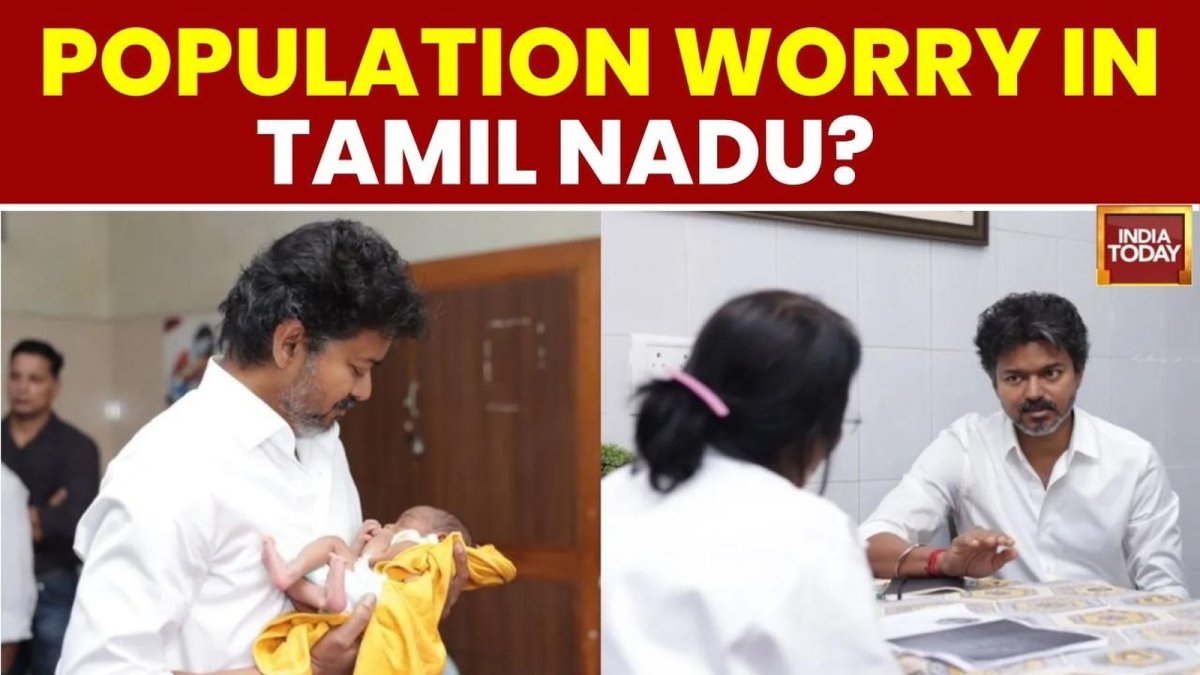
This article is based on reporting by India Today, The Economic Times, The New Indian Express and The News Minute, supplemented by the India Today video embedded above.
— By Dr. Raj Patel, Staff Writer
This article was produced with AI-assisted research and editorial support. Reporting is based on sources cited in the article.
What's Your Reaction?
 Like
0
Like
0
 Dislike
0
Dislike
0
 Love
0
Love
0
 Funny
0
Funny
0
 Wow
0
Wow
0
 Sad
0
Sad
0
 Angry
0
Angry
0

India/South Asia Correspondent at Global1.News. Analytical voice with a background in science and health journalism. Based in New Delhi, covering Indian politics, education, healthcare, technology, and policy. Breaks down complex data into clear, actionable reporting.















Comments (0)