
Lula Hails Oil Discovery Near Amazon River
President Lula hails Petrobras' oil discovery 175km off the Amazon coast, calling it a passport to Brazil's future, as environmentalists warn of spill risks to reefs and wetlands and the find reshapes October's election campaign.
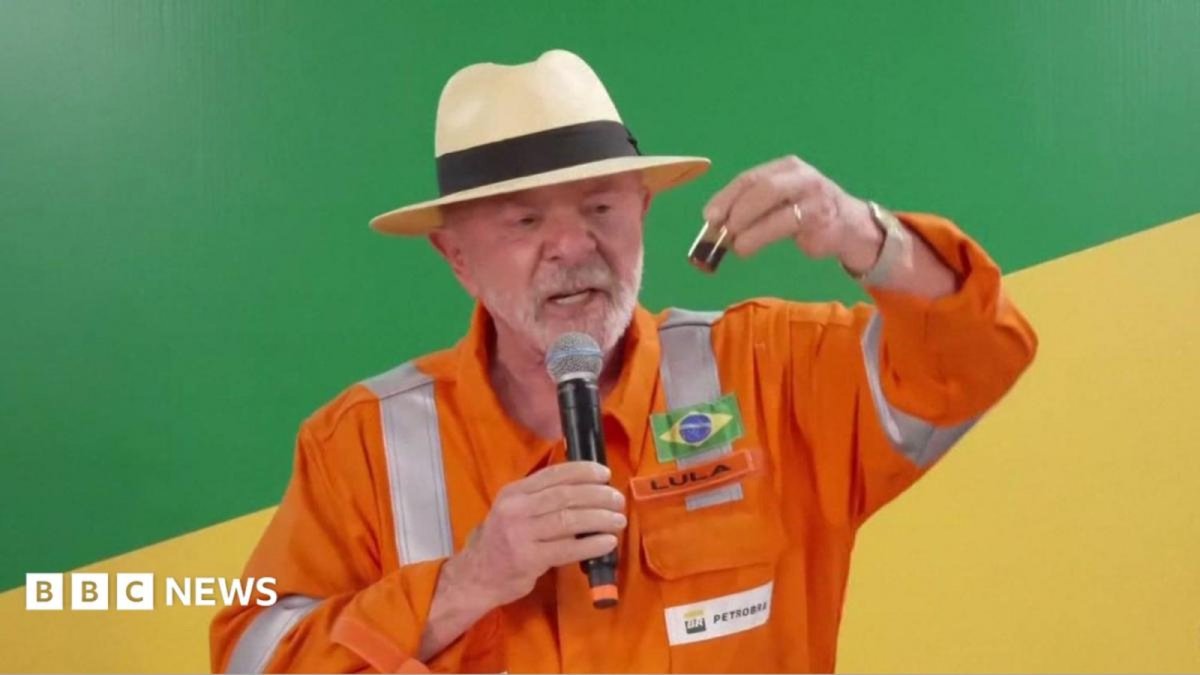
In a moment that crystallizes Brazil's great contradiction, President Luiz Inácio Lula da Silva held up a vial of dark crude oil this week and called it "a passport to the country's future." The oil, extracted from exploratory drilling 175 kilometers off the Amazon coast, represents the latest chapter in a saga that pits the nation's immediate economic ambitions against its role as a global climate leader. The discovery, announced by state-run oil giant Petrobras, comes less than a year after Brazil hosted the COP30 climate summit — and just months before Lula faces voters in October's presidential election.
Brasilia, Brazil — The president's triumphant display of the vial in Brasilia was more than a celebration of a geological find; it was a political statement aimed at both domestic voters and international critics. Lula, who has long positioned himself as a champion of the Amazon and renewable energy, now finds himself defending the very fossil fuel extraction that environmentalists warn could devastate one of the planet's most biodiverse marine regions. The tension between these two identities — the green statesman and the development-minded populist — has never been more visible.
A Discovery Wrapped in Uncertainty
The oil was found in the Brazilian Equatorial Margin, a promising offshore basin that Petrobras has pursued with increasing urgency. The find sits at a depth of 2,886 meters, roughly 9,469 feet beneath the ocean surface, in waters that are technically challenging and environmentally sensitive. But the size of the field remains unknown, and Petrobras has not yet determined whether commercial extraction would even be viable at such depths and in such conditions.
Petrobras chief executive Magda Chambriard framed the discovery as validation of the company's long-held optimism about the region. "This confirms that our optimism was warranted," she said, adding that the company remains committed to "ensuring the country's energy security." For a nation that has struggled with fuel prices and economic volatility, the promise of new oil reserves carries significant weight — even if the timeline for actual production could stretch a decade or more into the future.
The Environmental Gamble
Conservationists have been sounding alarms since Lula first granted Petrobras the green light for exploratory drilling in this area. The Equatorial Margin is not just another offshore oil field; it is a region of extraordinary ecological richness, home to coral reefs that scientists say are largely unexplored and coastal wetlands that serve as critical habitat for countless species. The fear is not merely the immediate impact of a potential spill, but the long-term consequences of ocean currents carrying oil far beyond the drilling site.
The warnings are stark: an accident could threaten the nearby reefs directly, while prevailing currents could transport spilled crude to coastal ecosystems teeming with wildlife. For environmentalists, the risk-reward calculation is simple — the potential devastation far outweighs the uncertain economic benefits. Yet Lula has repeatedly dismissed such concerns, and on Monday he went further, framing the criticism as an attack on Brazil's sovereignty.
Sovereignty or Isolation?
"This means national sovereignty. Any country which has oil of this quality won't allow anyone to butt in," Lula declared, a statement that echoes his earlier dismissal of environmentalist concerns as "meddling." The president's rhetoric taps into a deep vein of Brazilian sentiment — a historical wariness of foreign interference that dates back to colonial times and extends through decades of economic exploitation by outside powers.
Lula specifically singled out European opposition, recalling the anger that greeted his decision to announce the drilling license just weeks before COP30, which Brazil hosted in November. "Many people didn't want me to announce that Petrobras had won the licence because they said that the Europeans would be annoyed," he said. "I took the decision to announce that people wanted to do exploratory drilling there before COP because the interests of our country and our company were at stake."
It is a calculated political move, positioning Brazil's economic independence against what many here perceive as hypocritical pressure from wealthy nations that built their own prosperity on fossil fuels. The subtext is clear: Europe industrialized on oil and coal, and now lectures Brazil about conservation while Brazil's people still struggle with poverty and inequality.
The Energy Transition Paradox
Lula insists there is no contradiction in his position. "I'm not denying my commitment to the fight for a day when we no longer need fossil fuels," he said, pointing to Brazil's leadership in biofuel innovation and its substantial renewable energy sector. The argument is that oil revenues will fund the transition — that Brazil cannot afford to leap directly into a post-fossil-fuel future without first cashing in on its natural resources.
It is an argument with genuine merit, but also one that carries significant risk. The global energy transition is accelerating, and investments in new oil fields today may become stranded assets within decades. Moreover, the very act of expanding fossil fuel extraction undermines Brazil's credibility as a climate leader — a role that carries diplomatic weight and potential economic benefits through carbon markets and green investment.
The timing is particularly fraught. Lula approved the drilling just weeks before COP30, a summit that was supposed to showcase Brazil's environmental leadership to the world. Instead, it became a deeply divisive event, with the oil decision casting a shadow over the proceedings. Now, with the discovery announced, the debate has been reignited at a critical political moment.
Hope and Migration in Oiapoque
While the debate rages in Brasilia and at international climate forums, the impact is already being felt in the small town of Oiapoque, in Amapá state, the nearest community to the drilling site. According to local housing authorities, the prospect of oil wealth has triggered an influx of people hoping to find jobs and opportunities in this remote corner of Brazil.
Oiapoque sits at the northern edge of the country, a place that has long been overlooked by national development. For its residents, the oil discovery represents something tangible — a chance at economic survival in a region where options are scarce. The migration of hopeful workers is a familiar pattern in Brazil's resource-rich areas, from the gold rush towns of the Amazon to the oil cities of the northeast. But it also brings challenges: housing shortages, pressure on public services, and the social disruption that comes with rapid population growth.
The human dimension of this story is often lost in the abstract debates about climate policy and corporate strategy. For the people of Oiapoque, the oil is not a symbol of environmental betrayal or a geopolitical chess piece — it is a potential path out of poverty. That reality cannot be dismissed, even as the environmental risks remain profound.
An Election-Shaping Issue
With less than two months until the presidential election, Lula is walking a tightrope. He needs to attract voters in regions like Amapá who see oil as their ticket to development, while not alienating the urban, environmentally conscious electorate that forms a crucial part of his base. The discovery gives him a concrete achievement to tout — proof that his policies are delivering economic benefits, not just environmental promises.
But the political calculus is complicated. Environmental groups are mobilizing against the drilling, and their voices carry weight in Brazil's cities and among younger voters. The question is whether the promise of jobs and revenue in the north can outweigh concerns about ecological catastrophe in a country that has already witnessed the devastating impacts of environmental degradation in the Amazon.
Lula's reference to the Europeans being "annoyed" suggests he is betting that nationalist sentiment will trump environmental concerns. It is a gamble that reflects his political instincts — a leader who has always understood the power of framing issues in terms of Brazilian pride and self-determination. Whether that bet pays off in October remains to be seen, but the oil discovery has already reshaped the electoral landscape.
A Nation at a Crossroads
Brazil has long been defined by its contradictions — a country of immense natural wealth and profound social inequality, of environmental treasures and extractive industries, of global aspirations and domestic struggles. The oil discovery off the Amazon coast encapsulates all of these tensions in a single, dark vial of crude.
The path forward is not clear. The field's commercial viability is unproven, the environmental risks are substantial, and the political consequences are unpredictable. What is certain is that Brazil's decision will reverberate far beyond its borders, shaping the global conversation about climate, development, and the rights of nations to chart their own course.
For Lula, the oil represents both opportunity and peril — a chance to deliver economic progress to neglected regions, and a risk of cementing Brazil's reputation as a country that talks green while drilling black. The coming months will reveal which vision prevails, and whether the passport to the future leads to prosperity or to a reckoning with the environmental costs of that journey.
This article was produced with AI-assisted research and editorial support. Sources: BBC News.
By Elena Vasquez, Staff Writer
What's Your Reaction?
 Like
0
Like
0
 Dislike
0
Dislike
0
 Love
0
Love
0
 Funny
0
Funny
0
 Wow
0
Wow
0
 Sad
0
Sad
0
 Angry
0
Angry
0

Latin America Correspondent at Global1.News. Based in Mexico City, covering politics, economics, energy, and culture across the region. Brings an on-the-ground perspective to stories spanning from the Rio Grande to Patagonia.













Comments (0)