
Syria and Russia Reach Deal on Moscow's Two Coastal Bases
Syria and Russia have signed a memorandum of understanding turning the Hmeimim airbase and Tartus naval base into joint training centers, ending 18 months of talks. Damascus reclaims civilian control of both coastal sites as it asserts sovereignty after Assad's fall.
In a recent i24NEWS English report, Syria announced a landmark agreement with Moscow on the future of Russia's two remaining military bases on the Mediterranean coast, ending a year and a half of negotiations over the fate of assets that once anchored the Kremlin's power in the Middle East. The deal, announced through the official SANA news agency, transforms the Hmeimim airbase and the Tartus naval facility into joint training centers while Damascus reclaims control of the adjoining civilian installations.
Syria and Russia Reach Deal to Reshape Moscow's Military Presence on the Coast
Jerusalem, Israel – This Week — Syria said it has reached a memorandum of understanding with Moscow on the future of Russia's two military bases in the country, a significant assertion of sovereignty by the post-Assad government and a major recalibration of the Kremlin's military footprint in the eastern Mediterranean. Under the agreement, the Hmeimim airbase in Latakia province and the Tartus naval base will become "joint training and capacity-building centers," with civilian facilities at both sites handed over to Syrian civil administration.

On the Ground: What the Deal Actually Changes
The Syrian Foreign Ministry, quoted by SANA, described the memorandum as the outcome of "a year and a half of negotiations and intensive discussions led by the ministry." The transition is expected to be completed within three months, according to officials. In the meantime, Damascus takes over management of civilian facilities including Hmeimim airport and the fourth commercial pier at Tartus port, gradually folding them into the civil administration.
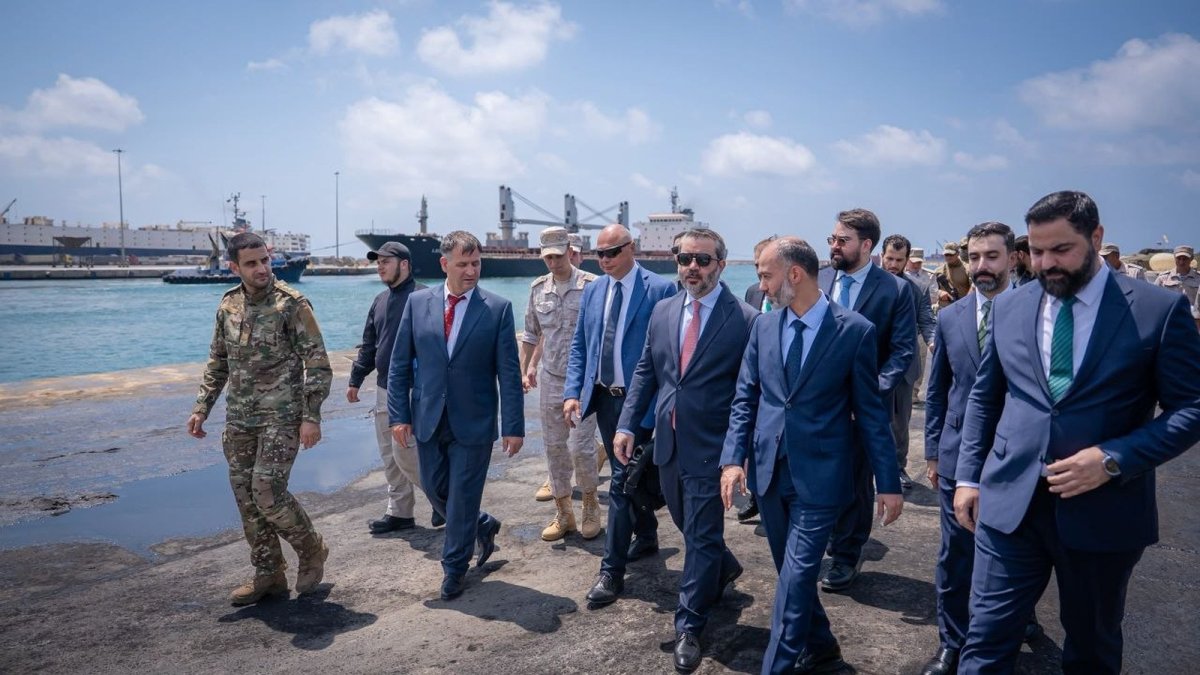
Foreign Minister Asaad al-Shaibani visited Latakia International Airport and the port of Tartus on Sunday to inspect the facilities covered by what officials described as a "historic" memorandum. The ministry framed the new arrangements as a "reorganization of the Russian presence" along Syria's coast, adding that the move "marks the most significant development since negotiations began approximately a year and a half ago, paving the way for a new phase in Syrian-Russian relations."
Regional Context: A Superpower Presence Cut Down to Size
Russia has not yet officially commented on the agreement, but the practical significance is difficult to overstate. The Tartus naval facility is Russia's only overseas naval base outside the former Soviet Union, serving as the central hub for resupplying Moscow's Mediterranean fleet and projecting power across the region. Hmeimim became the main base for Russian air operations in Syria following Moscow's 2015 military intervention, which helped turn the war decisively in favor of Bashar al-Assad.
Since Assad's overthrow in December 2024, Russia's footprint in Syria has contracted dramatically. "Russia has significantly downgraded its military presence from over 100 military bases to just these two positions on the Syrian coast," Al Jazeera's Obaida Hitto reported from Damascus. Both bases remained operational while talks were ongoing, and the new agreement means Moscow will no longer operate the sites in the same way it did under Assad — though it will not be completely excluded either.
Diplomatic and International Reactions
Damascus is using the agreement to send "a clear message that the central government in Damascus is in control of all assets that belong to Syria and are part of Syrian territory," Hitto said, adding that Syria's leadership is affirming that "its national sovereignty is not up for negotiation." The message is directed at regional and international audiences alike, as Syria's new leadership balances its relationship with Moscow against a broader reopening to the West.
Since Assad's fall, Syria has strengthened ties with the United States, Europe, and neighboring Arab countries that had cut off Damascus during the crackdown on protests. Washington has lifted most of its crippling sanctions, and French President Emmanuel Macron visited Syria in July, announcing that the two countries would appoint ambassadors for the first time in 14 years. President Ahmed al-Sharaa has visited Moscow twice since taking power, with the two bases a central point of discussion with Vladimir Putin.
Analysis and What This Means for Israel and the Region
For Israel, the recalibration of Russia's Syrian presence is a double-edged development. On one hand, a diminished Russian military footprint reduces Moscow's ability to constrain Israeli operations in Syrian airspace, where the IDF has conducted hundreds of strikes in recent years against Iranian and Hezbollah targets. On the other hand, the deal hands Damascus greater control over its own territory at a moment when Syria's new government is actively seeking a security arrangement with Israel, with several countries reportedly involved in the mediation.
Al-Sharaa said in an interview last month that Syria is seeking a security deal with Israel that could serve as a gateway to a broader resolution, while insisting such an agreement would not compromise Syria's claim to the Golan Heights. Israel has held the buffer zone in southwestern Syria since December 2024 and has carried out repeated strikes in southern Syria. The Russia deal suggests Damascus is consolidating its sovereignty and normalizing relations across the board — from Moscow to Washington to Jerusalem — as it seeks to rebuild a state shattered by 13 years of war.
The Road Ahead: A Three-Month Window
The next three months will determine how quickly the transition proceeds and how much operational latitude Russia retains at the two facilities. For Moscow, the deal preserves a foothold in the Mediterranean while accepting a diminished role — a compromise born of necessity after the loss of its most important regional ally. For Damascus, it is a demonstration that the new Syria can negotiate with a former superpower patron on terms that put Syrian sovereignty first.
Both capitals have an interest in presenting the memorandum as a success: Moscow avoids a humiliating full withdrawal from the Mediterranean, and Damascus secures formal control over assets that are central to its claim of full independence. The coming weeks, as al-Shaibani's ministry works through the technical details, will show whether the "joint training" framework is a genuine partnership or the beginning of the end of Russia's military era on the Syrian coast.
Wider Implications for the Mediterranean Balance
The agreement also carries meaning for the wider balance of power in the eastern Mediterranean. Turkey, which backed the opposition forces that toppled Assad and maintains a military presence in northern Syria, has been watching the fate of the Russian bases closely. A reduced Russian footprint alters the calculus among the various foreign powers that have operated in Syrian territory since 2011 — from the United States, which keeps forces in the northeast, to Iran, whose proxies have been repeatedly targeted by Israeli airstrikes. For Ankara, which has its own complex relationship with Moscow, the deal is another sign that the post-Assad order in Syria is being written by Damascus rather than imposed from outside.
For Moscow, the stakes extend beyond Syria itself. The Kremlin has used the Mediterranean presence as a component of its broader power projection, from supporting operations in Africa to signaling capability in a region where NATO navies routinely operate. Losing Tartus entirely would have been a strategic setback; the joint-training compromise allows Putin's government to frame the outcome as a managed drawdown rather than a defeat. Yet the deal also reflects Russia's reduced leverage: once the indispensable protector of the Assad dynasty, Moscow now negotiates the terms of its own reduced presence with a government it did not help create.
In Israel, the development is being read through the lens of the northern front. Israeli officials have long viewed Russian presence in Syria as a complicating factor in the campaign against Iranian entrenchment, requiring a delicate deconfliction mechanism between the Israeli and Russian militaries. With that presence now shrinking in scope and status, Israeli planners gain greater operational freedom — but they also face a more capable, more independent Syrian military establishment that is itself seeking formal security understandings with Jerusalem. The outcome, Israeli analysts note, will depend on whether Damascus's new assertiveness translates into stability on the ground or into new friction along the Golan frontier and in southern Syria.
The humanitarian and economic dimension is equally significant. Syria's economy remains shattered after more than a decade of conflict, with reconstruction needs estimated in the hundreds of billions of dollars and the state heavily dependent on foreign assistance and investment. Reclaiming the commercial pier at Tartus and the airport at Hmeimim gives Damascus revenue-generating civilian assets at a time when every source of income matters. Syrian officials have framed the handover not merely as a sovereignty issue but as a practical step toward rebuilding state capacity — a message aimed at international donors and investors watching whether the new government can translate political control into economic recovery.
Western capitals are watching the implementation phase closely. Washington, which has lifted most sanctions while maintaining caution, has said it supports Syria's sovereignty and territorial integrity. European governments, including France, are rebuilding diplomatic channels after years of rupture. For these stakeholders, the Russia deal offers a test of whether the al-Sharaa government can manage complex international negotiations while delivering concrete results at home — a test that will shape decisions on sanctions relief, reconstruction funding, and normalization in the months ahead. The three-month transition window is, in effect, an audition for a new Syria on the international stage.
By Hannah Berg, Staff Writer
This article was produced with AI-assisted research and editorial support. Reporting is based on sources cited in the article.
What's Your Reaction?
 Like
0
Like
0
 Dislike
0
Dislike
0
 Love
0
Love
0
 Funny
0
Funny
0
 Wow
0
Wow
0
 Sad
0
Sad
0
 Angry
0
Angry
0
Israel Correspondent at Global1.News. Based in Tel Aviv, covering Israeli politics, security, technology, and society. Provides balanced, deeply-sourced reporting on one of the most closely-watched regions in the world.










Comments (0)