
Swiss voters reject ‘perpetual and armed’ neutrality, and the arms fight moves to November
Preliminary official results show Swiss voters rejecting the Neutrality Initiative by roughly two to one, leaving the country's deliberately undefined neutrality intact and moving the next fight over arms exports to a 29 November referendum.
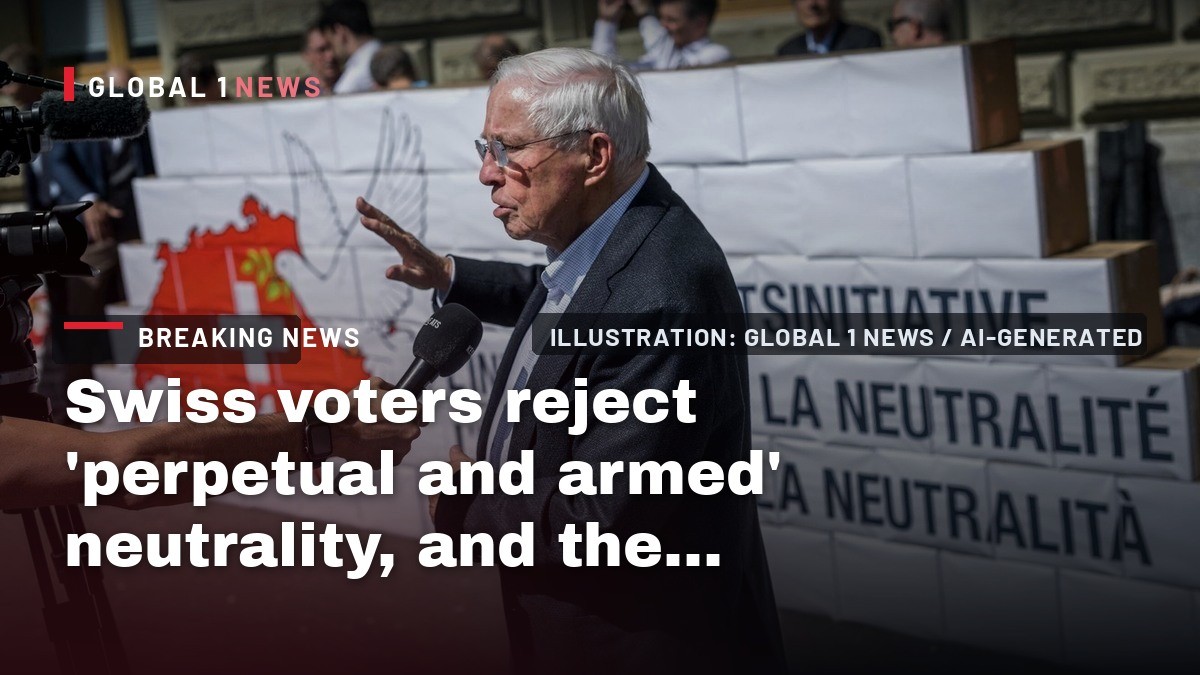
Swiss voters have rejected a proposal to write "perpetual and armed" neutrality into the constitution, with preliminary official results showing the measure losing by more than two to one. The federal vote dashboard recorded 68.27 percent against and 31.73 percent in favor as counting continued on Sunday, 27 September 2026.
Swiss voters reject ‘perpetual and armed’ neutrality, and the arms fight moves to November
Bern, Switzerland — The defeat leaves Switzerland's existing, deliberately undefined neutrality intact, and shifts the next confrontation over the country's place in Europe's security order to a November referendum on weapons exports.
The Count That Ended the Argument
The federal dashboard, published by the Federal Statistical Office and flagged "counting in progress," showed 497,035 votes for the Neutrality Initiative and 1,069,352 against as of 12:42 PM. Preliminary participation stood at 46.14 percent. Only two cantons, Aargau and Glarus, had reported at that point, and both rejected the text. The measure needed a double majority — a majority of the national popular vote and a majority of the cantons — and the margin on the popular vote was never close. Reuters, reporting from Zurich, said more than two thirds voted against it, with government projections showing opponents leading by more than two to one. Anadolu Agency put opposition at 69.12 percent and support at 30.88 percent, with turnout of 46.07 percent. Bloomberg, carried by swissinfo.ch, reported about 31 percent support and 69 percent against in early results issued while ballots were still being counted. Deutsche Welle, citing SRF television projections, had the split at 29 percent in favor and 71 percent against.
What Voters Were Actually Asked to Approve
The measure's formal name was the federal popular initiative "Safeguard Swiss neutrality (Neutrality Initiative)," known in German as "Wahrung der schweizerischen Neutralität (Neutralitätsinitiative)." It would have inserted a new Article 54a into the Federal Constitution with four effects. It would have barred Switzerland from joining or cooperating with any military or defence alliance, with an exception only in the event of a direct military attack on Switzerland or preparations for one. It would have barred the country from taking part in military conflicts between third countries and from imposing non-military sanctions on states at war, except where the United Nations Charter required it or where the measure was needed to stop other states circumventing sanctions. And it would have directed Switzerland to use its permanent neutrality to prevent and resolve conflicts and to act as a mediator. Parliament rejected the initiative: the National Council voted 128 to 60 against the text, and the Council of States rejected it by 33 votes to 9. A counter-proposal was approved by the Council of States 27-15 with one abstention but was ultimately shelved, after the House of Representatives torpedoed the Senate's version by 109 votes to 77.
A Clause Called ‘Perpetual and Armed’
The opening clause of the proposed article read: "Switzerland is neutral. Its neutrality is perpetual and armed." That language would have marked a break with the tradition it claimed to defend. Swiss neutrality has been internationally recognized since the end of the Napoleonic wars in 1815 and has been anchored in the Federal Constitution since 1848. But the constitution has never contained an explicit definition of neutrality, a deliberate omission that leaves the Federal Council room to manoeuvre. Writing one in, the measure's opponents argued, would have converted a flexible instrument into a fixed rule. Green Liberal lawmaker Corina Gredig framed the risk from the other direction: "The initiative risks turning neutrality into isolation, and isolation in this world is not a very good security strategy." The vote was the first time Swiss neutrality itself had been the direct subject of a national ballot.
Blocher’s Bet: Millions of Francs and a 40-Year-Old Idea
The initiative was launched by the Pro Schweiz (Pro Switzerland) association, successor to the AUNS (Campaign for an Independent and Neutral Switzerland), an organization founded 40 years ago by Christoph Blocher. The signature campaign began in November 2022, and the committee submitted about 129,806 valid signatures on 11 April 2024. The initiative committee was chaired by former SVP National Councillor Walter Wobmann. Blocher, the 85-year-old billionaire former SVP federal councillor and the driving force behind the campaign, put his money behind it. Bloomberg reported he spent 2 million francs, about $2.4 million, while swissinfo.ch reported a CHF 3 million, or $3.75 million, personal injection. SVP vice-president and Geneva National Councillor Céline Amaudruz made the case in her own words: "Our goal is to foster peace, diplomacy and dialogue... To achieve that, we must maintain credibility through perpetual armed neutrality." She added: "It is not our role to be following the herd, but to keep channels open for negotiation."
‘Our Neutrality Works’: The Case From the Foreign Ministry
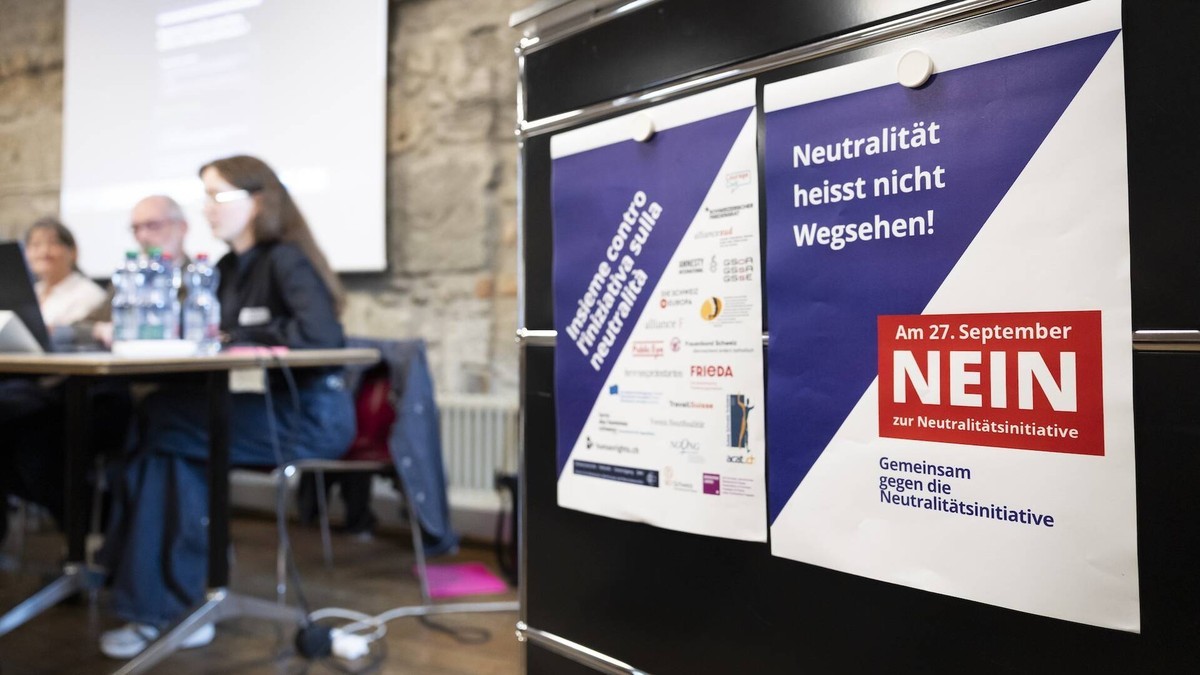
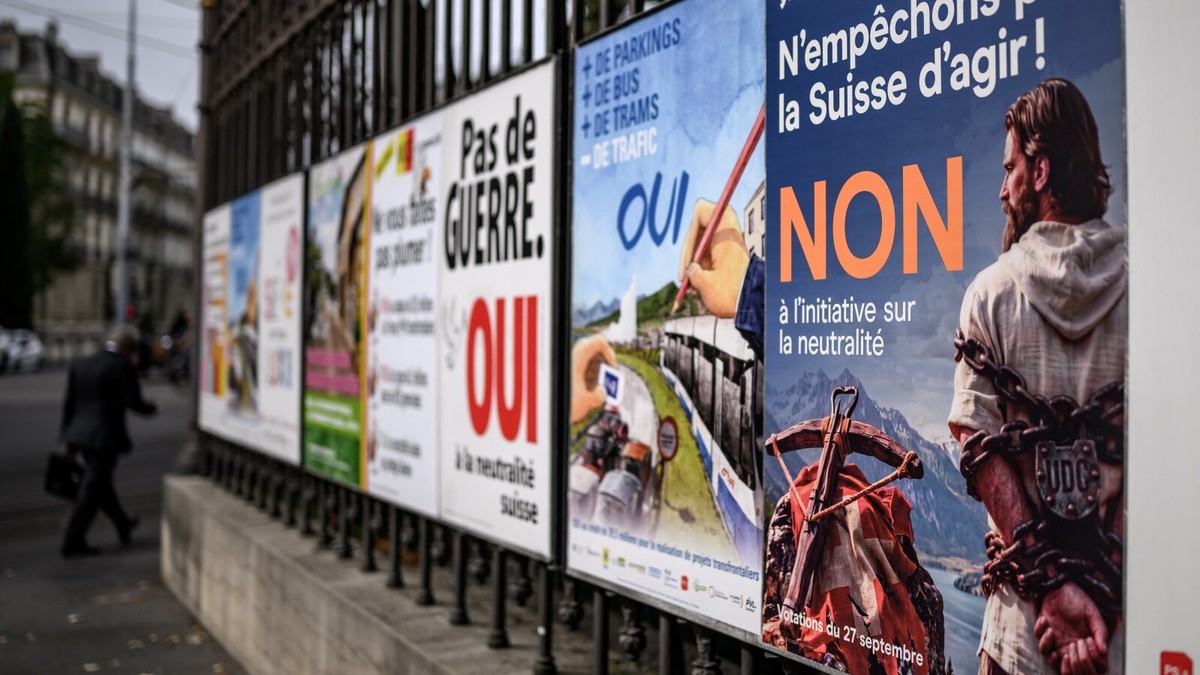
The campaign against the initiative was carried by the Federal Council and a coalition that ran from the Social Democrats to the Centre, the FDP, the Greens and the Green Liberals. Every major party except the SVP opposed it. Foreign Minister Ignazio Cassis argued the constitution should not be loaded with language "that creates more uncertainty than clarity," and said: "Our neutrality works. We don't need to change it." He has also described neutrality as "an instrument and not an end in itself," and said during the campaign that Switzerland "was neutral, is neutral, and will remain neutral." In the parliamentary debate, Social Democrat Council of States member Daniel Jositsch mocked the carve-outs in the rejected counter-proposal: "We want to be neutral, except in war." He added: "That makes about as much sense as lending someone an umbrella whenever it isn't raining." Left-wing parties called the proposal a "pro-Putin initiative," while centre-right opponents described it as a "deceptive package" whose practical effect would be to benefit Russia. Russia urged Swiss voters to back it.
Why Sanctions Were the Real Target
The trigger for the initiative was Russia's full-scale invasion of Ukraine in February 2022 and Switzerland's decision to largely mirror European Union sanctions against Russia. Switzerland also ruled out supplying weapons or protective equipment to Ukraine. Blocher said the sanctions turned Switzerland into "a party to the war" "for reasons of pure opportunism," and described economic sanctions as "a weapon of war." Under Article 54a as drafted, that sanctions policy would no longer have been a decision the government could revisit. Imposing non-military sanctions on a state at war would have been constitutionally barred, except where the UN Charter required it or where the measure was needed to prevent other states from circumventing sanctions. What the measure's opponents called a routine exercise of foreign policy would have become a question with one legal answer. That is the argument the government put to voters, and it is the argument that won by roughly two to one.
What the Numbers Say About Swiss Opinion
Pre-vote polling had pointed to a heavy defeat. A gfs.bern poll for SRG published 16 September 2026 found 63 percent opposed and 34 percent in favor, with opposition up nine points since August and support down eight points. A "20 Minuten"/Tamedia poll published the same day found 68 percent against and 31 percent in favor. Reuters noted that "one of the latest surveys showed 68 percent against with 31 percent in favor." gfs.bern also found the SVP was the only major party whose own voters backed the initiative, at 77 percent, down nine points. Italian-speaking Switzerland was evenly split. Fabio Wasserfallen, professor of European politics at the University of Bern and a partner at the LeeWas polling institute, said: "It's not a vote against neutrality — neutrality is very supported — it's about what neutrality means." Lukas Golder, co-director of the gfs.bern research institute, told Swiss television the result was "a clear vote in favor of a nuanced neutrality."
The Second Question on the Same Ballot
Voters also rejected a Food Security Initiative, by a wider margin still. The federal dashboard at the same 12:42 PM reading showed 26.24 percent in favor and 73.76 percent against. Bloomberg, carried by swissinfo.ch, said it "received just 24 percent support," while Deutsche Welle, citing SRF projections, put it at 28 percent in favor and 72 percent against. swissinfo.ch's headline on the day captured both defeats: "Swiss neutrality and food security initiatives set for hefty defeat." The two votes came three months after Swiss voters rejected a separate SVP-backed initiative to cap the country's population at 10 million, the "No to a Switzerland of 10 million" sustainability initiative. That measure failed with 45.21 percent Yes and 54.79 percent No, on participation of 58.86 percent, with 8 agreeing cantons, so the double majority was not reached either. Under Switzerland's system of direct democracy, voters can be called to the polls up to four times a year.
What Happens Next: Weapons Exports in November
A referendum is set for 29 November 2026 on a parliamentary amendment to the War Materiel Act that would relax Swiss arms export rules. The change would allow exports and re-exports of war materiel to 25 countries — 19 of them in Europe, plus Argentina, Australia, Canada, Japan, New Zealand and the United States — even if those countries are involved in an armed conflict, provided the materiel is not used in that conflict and the transfer is consistent with the law of neutrality, human rights and Switzerland's other international obligations. The government keeps a right of veto in the national interest. Parliament adopted the revised act on 19 December 2025; the upper house backed the changes by 31 votes to 12, after approval in the lower house. Opponents, including the Social Democrats, the Greens, the Protestant Party and NGOs, collected more than 75,000 signatures and forced the referendum in April 2026. Nothing changes for Ukraine. Direct export of weapons to Ukraine remains prohibited, and the new rules are not retroactive, so Swiss arms sold in the past to European countries will still not reach Kyiv. The arms-export question is the biggest item on a November ballot that includes three other proposals.
The Question Switzerland Has Not Settled
Armaments made up 0.7 percent of all Swiss exports in 2024. Swiss army expenditure is set to rise to 1 percent of GDP by 2032. Public support for neutrality is high at 87 percent, though it has dipped since the Ukraine war began. That combination — strong attachment to neutrality alongside a parliament that has voted to loosen arms-export rules — is the ground on which the November campaign will be fought. Urs Bieri of gfs.bern said the initiative found little support beyond the right-wing conservative camp, and that "it is unclear whether the public has recognized the problem." The preliminary count left the underlying argument unresolved: what the country's 1815 inheritance now requires of it, and whether an undefined neutrality can still be defended as an instrument rather than an end.
By Jessica Ali, Staff Writer
This article was produced with AI-assisted research and editorial support. Sources: SWI swissinfo.ch, Reuters, Bloomberg, Deutsche Welle, Anadolu Agency, Keystone-SDA and bluewin.ch, gfs.bern and SRG, 20 Minuten and Tamedia, the Swiss Federal Statistical Office and admin.ch.
What's Your Reaction?
 Like
0
Like
0
 Dislike
0
Dislike
0
 Love
0
Love
0
 Funny
0
Funny
0
 Wow
0
Wow
0
 Sad
0
Sad
0
 Angry
0
Angry
0

Editor-in-Chief at Global1.News. Atlanta-based journalist who cuts through the BS and tells it like it is. Lead anchor, host, and the voice you hear when the spin stops and the truth starts.









Comments (0)