
South Africa Hikes Rates to 7.25% as the Oil Shock Comes Back
The South African Reserve Bank raised its repurchase rate by 25 basis points to 7.25% on Wednesday, the first increase since May, lifting prime lending to 10.75% as an oil and fuel price shock pushes inflation back above the 3% target.
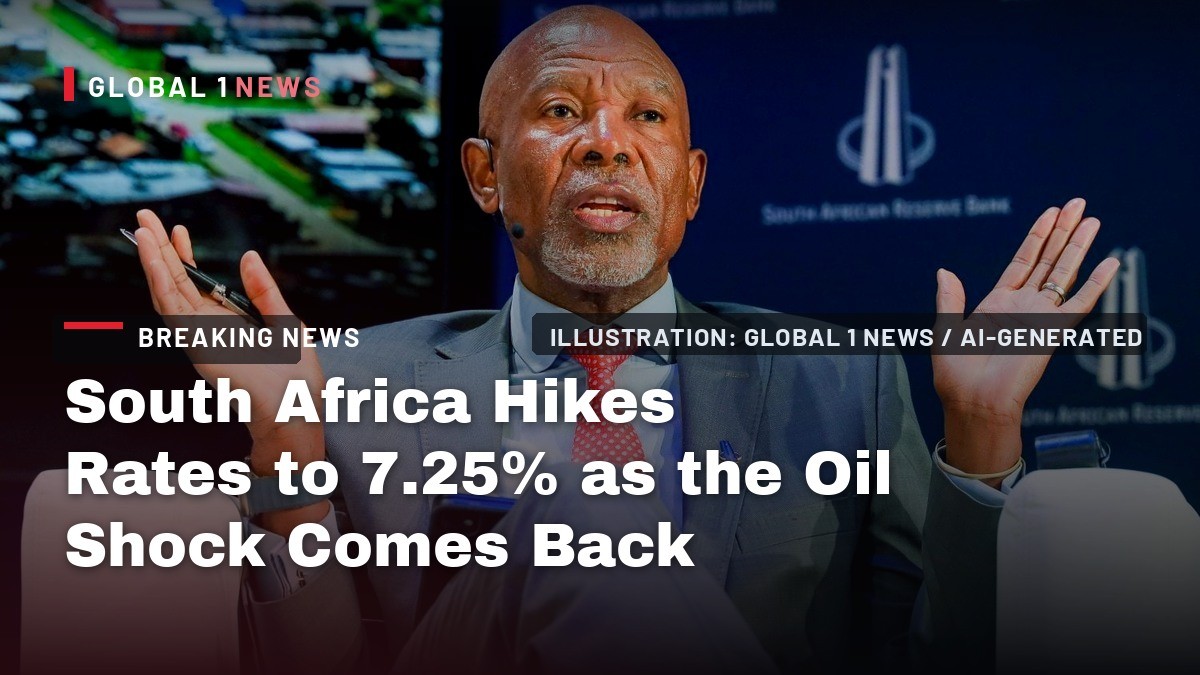
The South African Reserve Bank raised its repurchase rate by 25 basis points to 7.25% on Wednesday, its first increase since May and the highest policy rate since May 2025. The Monetary Policy Committee voted unanimously for the move, which takes effect on 25 September and lifts the prime lending rate to 10.75%. Governor Lesetja Kganyago said a fresh oil shock and a widening Middle East conflict left the Bank no room to wait.
SOUTH AFRICA HIKES RATES TO 7.25% AS THE OIL SHOCK COMES BACK
Johannesburg, South Africa — The repurchase rate now sits at 7.25%, up from 7%, after the Monetary Policy Committee delivered a unanimous 25-basis-point increase on Wednesday 23 September 2026. The prime lending rate climbs to 10.75% from 10.5%, effective 25 September. It is the first increase since May, when the MPC lifted the rate 25 basis points to 7%, and it takes the policy rate to its highest level since May 2025.
The Decision: 7.25 Percent, and Not One Dissent
There was no split this time. Every member of the Monetary Policy Committee backed the increase, a contrast with July, when four of six members favoured holding and two wanted to hike. Economists had broadly expected the move. Kganyago wrapped the decision in the Bank's mandate rather than in the week's headlines. "It is crucial that inflation reverts to 3% as the current shock fades, and we take responsibility for delivering that outcome," he said. The Bank targets 3%, with a tolerance band of one percentage point on either side. Kganyago described the approach as measured rather than aggressive. "We have taken a measured approach to rate setting, in conditions of high uncertainty, but we remain focused on our price-stability mandate," he said, adding that decisions will keep being taken meeting by meeting, with attention to the outlook, the data and the balance of risks.
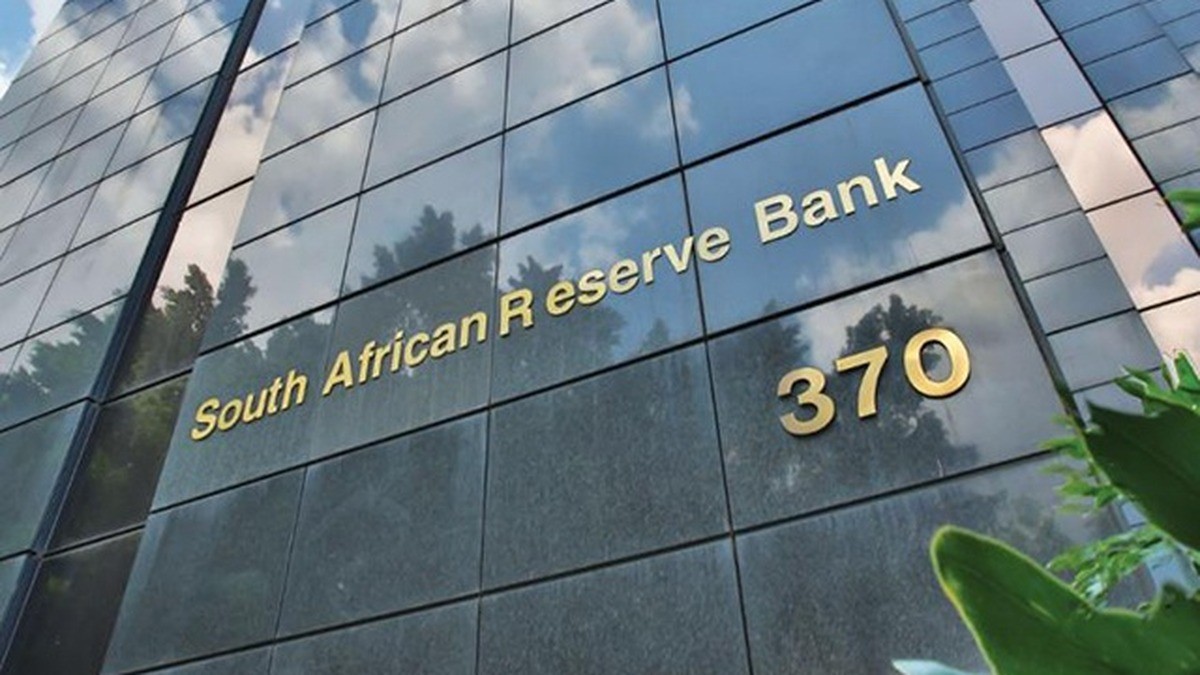
The Shock That Stopped Fading
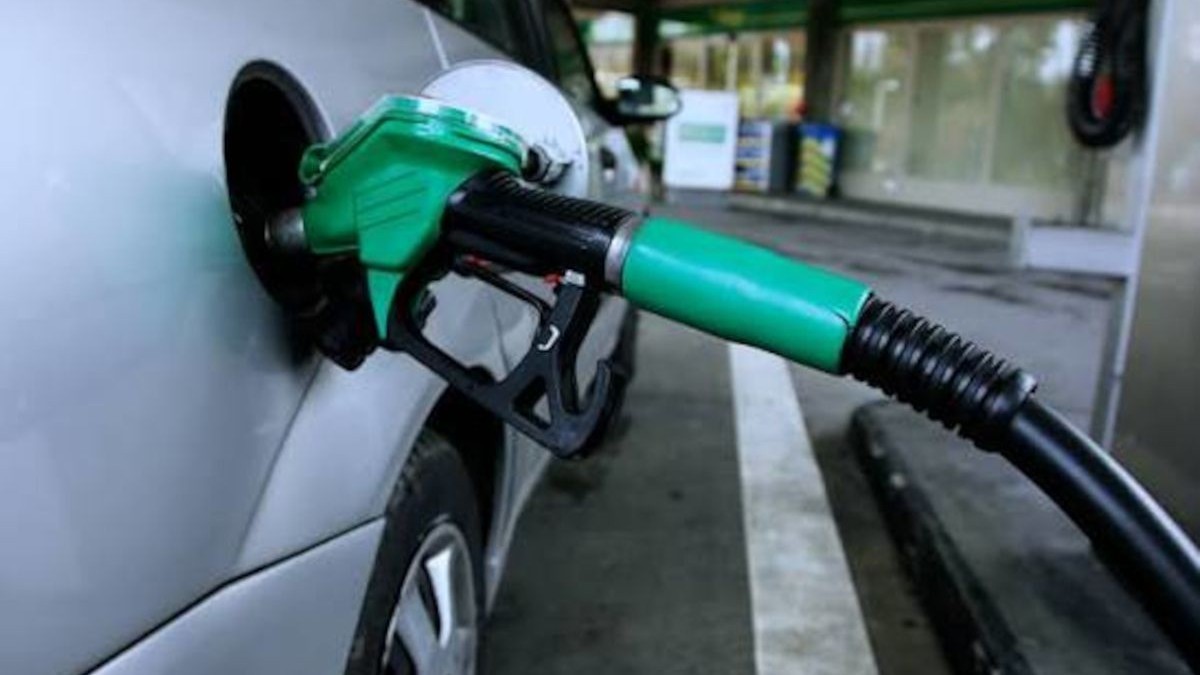
Kganyago laid out the external pressures in blunt terms. "Since our last meeting, the Middle East conflict has escalated further. Not much oil is getting through the Strait of Hormuz. Meanwhile, oil exports from Saudi Arabia are being interrupted by fighting in Yemen," he said. He added that the Russia-Ukraine war is causing ongoing destruction of refinery capacity and affecting food exports through the Black Sea. "These geopolitical events add up to a large, negative and persistent global supply shock, creating additional inflationary pressures," he said. Fuel prices rose on 2 September 2026: petrol 93 and 95 both up R1.34 a litre, the 0.05% and 0.005% grades of diesel up R2.94 and R3.15 a litre, and illuminating paraffin up R2.13 wholesale. Inland 95 unleaded reached R26.92 a litre. The average Brent crude price rose from $82.37 to $87.88 a barrel over the review period, per the Department of Mineral and Petroleum Resources. The slate levy rose 21.90 cents to 83.28 cents a litre after the cumulative slate balance hit negative R9.519 billion at the end of July 2026.
Above Five Percent, Then Back to Three
Headline consumer inflation edged up to 4.4% in August 2026 from 4.3% in July, per Statistics South Africa. June was 5.0%. The August figure came in below the roughly 4.5% economists had expected, largely because petrol prices were lower during that month. Kganyago warned the reprieve is temporary. "Headline inflation will likely be above 5% later this year and early next year, before slowing as the fuel shock recedes," he said. "We currently expect inflation to be back around 3% towards the end of 2027." The SARB projects inflation at 4.4% in 2026, up from its previous forecast of 4%, with 2027 raised to 4% and 2028 to 3.2%. Longer-run inflation expectations sit around 4% rather than the 3% target, according to the Bureau for Economic Research survey. Petrol prices are rising again after moderating between June and August, with an average under-recovery of R2.83 per litre currently.
Two Scenarios, Both Pointing Up
The MPC ran two risk scenarios, and both pointed to tighter policy. In the first, the baseline assumed major central banks raise rates by about half a percentage point between this year and next; the scenario doubled that to a full percentage point. "This causes rand depreciation, which lifts inflation. The model responds with a tighter policy stance, with rates about one hike above the baseline path and slower cuts subsequently," Kganyago said. The second scenario covered higher inflation expectations and wage increases, and also pointed to a tighter stance, with the policy rate rising by the equivalent of one to two additional hikes above the baseline peak and remaining higher for longer. Kganyago defended acting early. "Our approach is to look through the initial effects of price shocks, while ensuring that they do not entrench higher inflation," he said. He said the MPC cannot wait until second-round effects are present, because then it will be too late to act.
South Africa Is Not Doing This Alone
The hike lands in the middle of a global tightening wave. The United States Federal Reserve raised its policy rate 25 basis points to a range of 3.75-4% last week, for the first time in three years. The Bank of Japan raised its benchmark rate 25 basis points to 1.25% on Friday, in a 7-2 vote. The European Central Bank tightened policy on 10 September 2026, raising its three key interest rates by 25 basis points. Charlie Robertson, global chief economist at Renaissance Capital, wrote on X: "These unanimous decisions to hike to 25bp might be the new fashion... first the Fed, now South Africa." Kganyago pointed to longer-term interest rates that have moved higher recently, with various benchmarks reaching multi-decade highs. He gave the drivers as large fiscal deficits in major economies, inflation risks, and heavy borrowing to fund infrastructure for Artificial Intelligence.
What R168 a Month Means
The arithmetic lands on household budgets quickly. Herschel Jawitz, CEO of Jawitz Properties, said a 0.25% increase means a R1 million mortgage repayment rises by R168 a month, and this is the second rate increase this year on top of higher petrol prices. Quay 1 International Realty put the added cost at roughly R335 a month on a R2 million bond and around R500 a month on a R3 million bond. Stephan Potgieter, CEO of BetterHome Group Mortgage Origination and BetterBond, said the increase "should be viewed as a precautionary measure to absorb any potential oil price shocks amid ongoing hostilities in the Middle East." He noted that while prime is now 10.75%, it remains below the 11.75% level of the previous tightening cycle, so homeowners are still paying less on their bonds than they were three years ago — for someone with a R2 million bond, the difference is just over R1,360 less each month.
The Industry Says It Went Too Far
Samuel Seeff, chairman of the Seeff Property Group, did not hold back. "We had hoped that the Bank would look past short-term spikes and focus on protecting long-term economic stability. The current inflationary spike is driven by temporary factors such as oil prices rather than runaway domestic demand. The higher interest rate will do little to mitigate external cost shocks but will inflict real financial pain on households and businesses," he said. Seeff said the hike "unnecessarily punishes already overburdened consumers" and will dampen economic and property market activity, noting national transaction volumes are still about 16 percent below pre-pandemic levels. He cited a growth downgrade from 1.4% to around 1.1%. Antonie Goosen, principal and founder of Meridian Realty, said: "Nobody in the property sector welcomes higher borrowing costs. They increase monthly bond repayments, reduce affordability for buyers and can make it more difficult for first-time buyers in particular to enter the market." Adrian Goslett, CEO and regional director of RE/MAX Southern Africa, said the decision is understandable given global uncertainty, though it "can translate into higher living costs," reducing the disposable income available for bond repayments. Tertia Jacobs, treasury economist and fixed income specialist at Investec, offered a cooler read: "A 25-basis-point increase is a risk-management response rather than the start of an aggressive hiking cycle."
The Good News in the Same Statement
Not everything in the statement pointed upward. Food inflation is at its lowest level since 2010, reflecting strong harvests and a levelling off in meat prices following the foot-and-mouth disease outbreak. Kganyago warned drought pressures from El Niño may start to show soon, but said agricultural conditions are broadly favourable for now. Import prices remain contained, helped by the rand, which Kganyago called "notably resilient throughout the year." Services inflation, however, is elevated, with price hikes well above the 3% target in many categories. Kganyago said an important part of lowering services inflation is getting inflation expectations lower. On the currency, he was direct: "As the Monetary Policy Committee, our primary role is to protect the value of the currency, by getting inflation back to 3% over time. We will act as needed to achieve this goal."
An Economy That Was Already Contracting
The rate hike lands on an economy that was already shrinking. The economy contracted 0.2% in the second quarter of 2026. The SARB cut its 2026 growth forecast to 1.2% from 1.4%, while its 2027 and 2028 projections are unchanged at 1.7% and 1.9%. Kganyago expects a rebound in the second half of the year and projects growth of around 2% over the medium term, based on global conditions stabilising and domestic reforms delivering a better business environment. "Our assessment is that growth risks are skewed to the downside," he said. He also made the case for reform, calling domestic reforms South Africa's best growth option, including structural interventions to improve productivity in transport and energy, plus sustainable debt and permanently lower inflation. He said macro fundamentals "are becoming a differentiating factor for South Africa, lowering our country risk premium and helping to protect us from the global bond selloff."
What Comes Next
The next MPC meeting is 19 November 2026, and the Quarterly Projection Model shows the policy rate broadly stable through the remainder of 2026, with cuts later in the forecast as inflation falls to 3%. Kganyago cautioned that "this rate path remains a broad policy guide. Our decisions will continue to be taken on a meeting-by-meeting basis." Bank of America had forecast the September increase and expects another hike in November, which would take the policy rate to 7.5%. It expects inflation to average 5% in the fourth quarter and 5.3% in early 2027, with easing delayed to the second half of 2027. Morgan Stanley changed its forecast from a hold to an increase, arguing it provides "insurance" against supply shocks delaying the return of inflation to target, and expects 7.25% to hold through 2027. Neil Abernethy of Tyson Properties said the SARB was left with little choice after tensions escalated again, pushing the oil price above $100 a barrel by the beginning of September.
By Jessica Ali, Staff Writer
This article was produced with AI-assisted research and editorial support. Sources: SAnews.gov.za, The Citizen, BusinessDay NG, TechFinancials, Property24, and the South African Department of Mineral and Petroleum Resources.
What's Your Reaction?
 Like
0
Like
0
 Dislike
0
Dislike
0
 Love
0
Love
0
 Funny
0
Funny
0
 Wow
0
Wow
0
 Sad
0
Sad
0
 Angry
0
Angry
0

Editor-in-Chief at Global1.News. Atlanta-based journalist who cuts through the BS and tells it like it is. Lead anchor, host, and the voice you hear when the spin stops and the truth starts.











Comments (0)