
Sons du Mali: Amadou & Mariam's Legendary Love Story Reaches African Screens
The story of Amadou Bagayoko and Mariam Doumbia has always sounded like a love song — two blind musicians who met at Bamako's Institute for the Young Blind and carried Malian music to the world. Now a new documentary, 'Sons du Mali,' brings their legacy to African screens.
The story of Amadou Bagayoko and Mariam Doumbia has always sounded like a love song — two blind musicians who met at Bamako's Institute for the Young Blind, married in 1980, and carried Malian music to the world's biggest stages. Now, more than a year after Amadou's death, that story is reaching African audiences on the big screen. "Amadou et Mariam : Sons du Mali," a feature documentary by Canadian filmmaker Ryan Marley, has travelled from its world premiere at France's FIPADOC festival to cinemas in Dakar, Bamako and Nairobi — and Mariam Doumbia has called it exactly what it is: "une histoire d'amour," a love story.
Sons du Mali: Amadou & Mariam's Legendary Love Story Reaches African Screens
Dakar, Senegal — When Mariam Doumbia stood before the audience at the Institut français de Dakar this spring, she was not simply presenting a film. She was honouring a partnership that had defined West African music for more than fifty years — and, in her own words, telling "notre histoire," our story. The African premiere of "Amadou et Mariam : Sons du Mali" turned a documentary screening into a homecoming for a continent that had watched the blind couple from Bamako conquer the world.
The Documentary That Follows a Love Story
Ryan Marley, a Canadian filmmaker based in Toronto, spent nearly three years capturing the duo's world. The feature-length documentary, roughly 87 minutes, was shot between 2021 and 2023 across Mali, France and Spain. Marley's camera followed Amadou and Mariam through recording sessions, intimate family moments and the quiet rhythms of their daily life in Bamako — a city that pulses with music on every corner, from the bustling Marché Rose to the banks of the Niger River.
The film's journey began in January, when it received its world premiere at FIPADOC, the international documentary film festival held in Biarritz, France. From there, it moved to French cinemas on February 6 and 8, including a screening at the legendary Le Grand Rex in Paris, where the couple had performed to sold-out crowds in earlier years. The Parisian screenings drew emotional audiences of Malian and West African expatriates.
What sets this documentary apart is its structure. Marley weaves archival footage from the 1980s and 1990s with contemporary interviews and performance sequences, creating a tapestry that spans five decades. The film opens with the news of Amadou's death, so audiences watch a man already gone — in a studio, on a stage, in the streets of Bamako, laughing with his wife. It is a bold narrative choice that transforms every smile into a memory, every chord into an elegy.
A Nairobi review published during the film's run at Unseen Nairobi, which continues through the end of June, captured this quality perfectly: "a love story first, a music documentary second." The reviewer noted that even viewers unfamiliar with the duo's discography would find themselves moved by the sheer force of their partnership. The film does not simply document music; it documents a marriage that survived poverty, blindness, international fame and the ultimate test of mortality.
For African audiences, the film's arrival on the continent carries particular weight. After its Dakar premiere in April, the documentary travelled to Bamako on April 17, with Mariam attending both events. The screenings have drawn packed houses, with crowds of students, musicians and older fans who grew up with the duo's songs on the radio. The film has become more than a tribute — it is a shared act of remembrance for a continent that claims this couple as its own.

Two Blind Musicians Who Met in Bamako
Amadou Bagayoko was born on October 24, 1954, in Bamako, the son of a modest Bamako family. Mariam Doumbia arrived on April 15, 1958, in the same city. Both lost their sight in childhood — Amadou from congenital cataracts by age fifteen, Mariam at age five. Their blindness did not separate them from music; it drew them closer to it. At the Institute for the Young Blind in Bamako, they met as students, discovering a shared passion that would become their life's work.
The Institute for the Young Blind, a modest institution in Mali's capital, became the unlikely birthplace of one of Africa's most celebrated musical partnerships. Amadou and Mariam were not only students there but later returned as instructors, teaching younger generations of visually impaired children the craft of music. Their marriage in 1980 sealed a partnership that would endure forty-five years, through poverty, struggle and eventual global acclaim.
Their three children grew up surrounded by music, but only their son Sam followed in his parents' footsteps. Today, Sam is the only musician among the siblings, and he has taken on a crucial role in his mother's life. When Mariam performs now, Sam stands beside her on stage, singing some of his father's songs with her. Mariam speaks of this with visible emotion: "Il me donne la main, je ne suis pas seule. Ça me donne du courage" — he gives me his hand, I am not alone, it gives me courage.
The couple's fifty-plus years of successes and awards tell only part of the story. Their music has always carried the warmth of Malian griot tradition, the storytelling heritage that passes history through song. Amadou's guitar playing, with its distinctive blues-inflected phrasing, and Mariam's soaring vocals created a sound that felt both deeply rooted and utterly contemporary.
Their blindness was never a limitation but a defining characteristic that shaped their artistry. They navigated the world through sound, touch and memory, and their music reflects this heightened sensitivity to texture and tone. In interviews, Amadou often spoke of how blindness sharpened his hearing, allowing him to perceive nuances in music that sighted musicians might miss.
From Dimanche à Bamako to the World's Biggest Stages
The duo's signature sound — Malian blues blended with rock, funk and global rhythms — found its definitive expression in the album "Dimanche à Bamako," produced with French-Spanish artist Manu Chao. Released in the mid-2000s, the album became an international sensation, introducing the couple to audiences far beyond West Africa. The title track, with its infectious groove and Mariam's commanding vocals, became an anthem of contemporary African music.
Their fame quickly surpassed Malian and even African borders. "Welcome to Mali" (2008) brought Grammy nominations for Best Contemporary World Music Album, cementing their status as Grammy-nominated blind musicians on the global stage. They played major festivals including Glastonbury and Coachella, where their performances drew crowds that stretched to the horizon. In February 2013, they won France's Victoire de l'album de musiques du monde, a prestigious honour that recognised their impact on world music.
Since the 1980s, the duo had been major figures in contemporary West African music, but the international breakthrough transformed them into ambassadors for the entire continent. They carried Malian music to millions of listeners worldwide, from Tokyo to Toronto, from London to Lagos. Their concerts became cultural events where African diaspora communities gathered to reconnect with their roots through sound.
The couple's global success never diminished their connection to Bamako. They maintained a home in the Malian capital, returning regularly to perform for local audiences and to mentor young musicians. Their commitment to their homeland remained unwavering, even as political instability and security challenges affected Mali in recent years.
Their music videos, filmed across Mali's landscapes, showcased the country's beauty to the world. From the mud-brick architecture of Djenné to the bustling streets of Bamako, they presented an image of Mali that transcended the headlines of conflict and crisis. In doing so, they became cultural diplomats, using music to tell a different story about their homeland.
The Final Album: L'Amour à la Folie
The final album "L'Amour à la folie," released by Because Music in 2025, carries the weight of farewell. Recorded entirely while Amadou was still alive, the album's release after his death transformed it into a posthumous testament. The first posthumous single, released on June 16, 2025, honoured their forty-five-year marriage with a tenderness that moved listeners across the continent.
The album blends archival and new recordings, creating a tribute that mixes their Afro-blues signature with reflections on love and loss. Songs recorded in Bamako's studios sit alongside earlier performances, creating a dialogue between past and present. The result is an album that feels both retrospective and forward-looking, a fitting conclusion to a partnership that defined an era.
Amadou's death on April 4, 2025, at age seventy, marked the end of an era in Malian music. He had been ill for some time, and his passing was felt across the continent. Tributes poured in from musicians, politicians and fans worldwide, all acknowledging the profound impact of his work. In Bamako, thousands gathered to pay their respects, their songs filling the air in a final farewell.
Since Amadou's death, Mariam has shifted toward solo performances centred on her voice. Her concerts have taken on a more intimate quality, with Sam providing guitar accompaniment and vocal support. She has spoken openly about the difficulty of performing without her partner of forty-five years, but also about her determination to keep going.
The documentary captures the recording of this final album, showing the slow build toward a homecoming concert in Mali. The footage of Amadou in the studio, his fingers finding the strings of his guitar with practiced ease, is among the most moving in the film. It shows an artist at the height of his powers, still creating, still dreaming, still in love.
Dakar Premiere: 'Le Sénégal et le Mali Sont des Pays Frères'
The African premiere at the Institut français de Dakar in April was a moment of profound cultural significance. Mariam stood before the audience, her presence commanding, and declared: "Oui, c'est une histoire d'amour, c'est notre histoire" — yes, it is a love story, it is our story. The room erupted in applause, the emotion palpable among the Senegalese audience who had grown up with the duo's music.
Mariam expressed her joy at presenting the film in Dakar, speaking of the historical and cultural ties between Senegal and Mali. "Le Sénégal et le Mali sont des pays frères," she said — Senegal and Mali are brother countries. Her words resonated deeply in a region where borders have often divided families and communities, yet where music has always served as a unifying force.
Hearing Amadou's voice in the film remained difficult for her, she admitted. "C'est un peu difficile," she said softly, though she added that "le temps fait son oeuvre de paix" — time does its work of peace. The audience understood the weight of her words, recognising the courage it took to relive those memories on screen.
The Dakar screening was followed by an exclusive acoustic performance by Mariam, who kept the song list a surprise. "Ce sera une surprise," she told reporters before the show. When she finally took the stage, accompanied by Sam, the audience was transported. Her voice, still powerful and clear, filled the hall with songs that had become the soundtrack of West African life.
The Bamako release was scheduled for April 17, allowing Mariam to attend both events. The timing was deliberate, ensuring that the film's African premiere would be shared between the two brother countries. In Bamako, the screening drew a crowd that included government officials, musicians and ordinary Malians who had followed the duo's career from its beginnings.
The family remains central to carrying Amadou's work forward. Sam has taken on increasing responsibility, both as a performer and as a guardian of his parents' legacy. Mariam has spoken of her gratitude for her children's support, noting that their presence gives her strength to continue. The documentary, she says, is not an ending but a beginning — a way of ensuring that Amadou's music and their love story will never be forgotten.
A Message of Courage for Africa's Young Artists
Mariam's message to African youth is clear and urgent. She calls on young people to join hands, to make efforts toward understanding and peace, and to have the courage to work hard to "laisser leur trace" — leave their mark. Her words carry the authority of someone who has lived through decades of struggle and triumph, who knows firsthand the power of perseverance.
"Avec du travail et du courage, on peut porter son message sans frontières," she says — with work and courage, you can carry your message across borders. This belief in solidarity, perseverance and commitment has defined her life and career. She urges young African artists to believe in themselves, to draw on their cultural heritage, and to reach for the world without losing their roots.
Malian commentators have described the documentary as a "soft power" project for Mali, crucial for the country's image despite security and diplomatic challenges. In a region often portrayed through the lens of conflict, the film offers an alternative narrative — one of creativity, resilience and love. It reminds the world that Mali is not only a place of challenges but also a cradle of extraordinary artistic achievement.
The film's June 2026 release and continued screenings across the continent ensure that its message reaches ever wider audiences. From Dakar to Nairobi, from Bamako to Johannesburg, audiences are discovering or rediscovering the story of Amadou and Mariam. The documentary has sparked conversations about disability, creativity, love and legacy — topics that resonate across African societies.
Amadou and Mariam's journey serves as an example for artists and audiences across the continent. Their story demonstrates that blindness need not limit achievement, that poverty need not determine destiny, and that love can sustain a partnership through the most challenging circumstances. They have shown that African music can conquer the world without abandoning its roots.
What to watch for next: Mariam's concerts continue across Europe and Africa, promoting "L'Amour à la folie" and keeping the duo's music alive. Sam carries the family legacy forward, both as a performer and as a custodian of his parents' artistic vision. The documentary will continue its run in African cinemas, introducing new generations to the blind couple from Mali who conquered the world with their music.
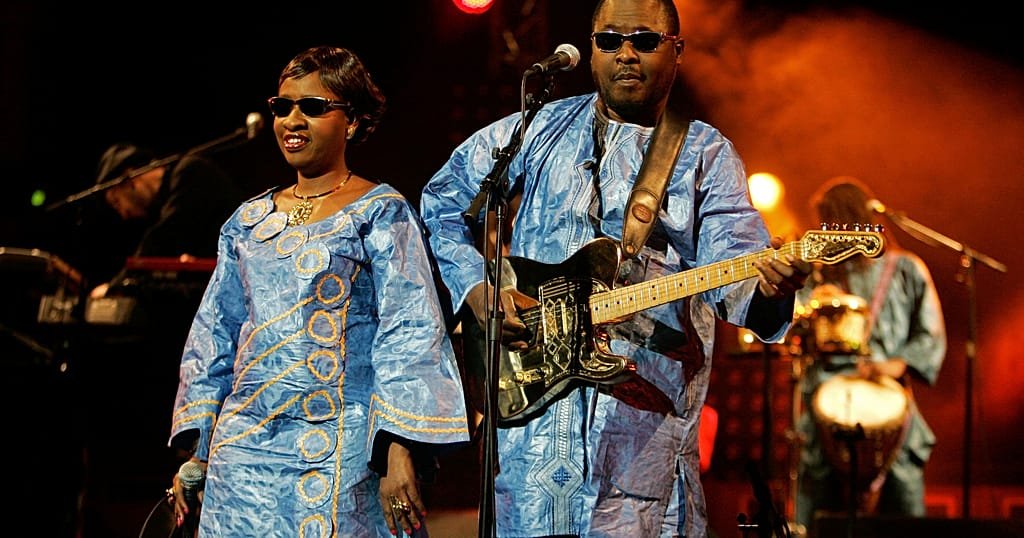
Nine months after Amadou's death, Mariam returned to the spotlight with this documentary — a return africanews highlighted when the film reached cinemas. She has not retreated into grief but has instead embraced her role as the living embodiment of their shared legacy. The photograph of the pair at a concert in Paris on December 1, 2008, shows them mid-performance — an image that now carries the weight of memory.
The story of Amadou and Mariam is not merely the story of two musicians. It is the story of Mali, of West Africa, of a continent that has produced extraordinary art against overwhelming odds. It is a story of love that transcended blindness, poverty and distance. And it is a story that will continue to inspire generations of African artists to come. As Mariam herself said, with work and courage, one can carry a message without borders — and their message, carried on the wings of song, has already travelled further than they could ever have imagined.
By Amara Diop, Staff Writer
This article was produced with AI-assisted research and editorial support. Reporting is based on sources cited in the article.
What's Your Reaction?
 Like
0
Like
0
 Dislike
0
Dislike
0
 Love
0
Love
0
 Funny
0
Funny
0
 Wow
0
Wow
0
 Sad
0
Sad
0
 Angry
0
Angry
0

West Africa/Sahel Correspondent at Global1.News. Dakar-based journalist covering politics, security, climate, and development across Francophone and Anglophone West Africa. Tells the stories of a region undergoing profound transformation.















Comments (0)