
SNU AI Cheating Scandal Tests Korea's AI Ambitions
Seoul National University (SNU), the Republic of Korea's preeminent institution of higher learning, has confirmed the largest single-course case of artificial intelligence-assisted academic misconduct at a Korean university to date: 36 of 62 students enrolled in a required computer engineering course were penalized for submitting AI-generated assignments during the first semester of the 2026 academic year.
Seoul National University (SNU), the Republic of Korea's preeminent institution of higher learning, has confirmed the largest single-course case of artificial intelligence-assisted academic misconduct at a Korean university to date: 36 of 62 students enrolled in a required computer engineering course were penalized for submitting AI-generated assignments during the first semester of the 2026 academic year. The episode, reported by the Seoul Economic Daily on July 30, 2026, arrives as the government of President Lee Jae-myung stakes national competitiveness on artificial intelligence, and it exposes a widening gap between Korea's technological ambitions and its capacity to govern generative AI in the classroom.
SNU AI Cheating Scandal Tests Korea's AI Ambitions
Seoul, South Korea – July 31, 2026 — The sanctions, imposed by the professor of "Computer Networks," a major course in the Department of Computer Science and Engineering at SNU's College of Engineering, distinguish between students who came forward and those who were identified by other means. Students who voluntarily self-reported their use of AI received a score of zero on the relevant assignment; students who were caught received a grade of D- for the entire course. The differentiated treatment reflects a deliberate attempt to encourage self-correction, but it has also generated a formal protest from the SNU student council, which contends that the criteria used to determine AI involvement were not sufficiently clear.

The Case: A Required Course, a Majority Implicated
The scale of the violation is striking. In a single major course, more than half of the enrolled students — 36 of 62 — were found to have used artificial intelligence to complete their assignments. The professor, responding in a notice to enrolled students, stated: "All the students who were penalized admitted it themselves," and asked, "What clearer basis for judgment is there than the admission of the party involved?" The notice also pressed the student council on a broader question: what position does it hold on AI cheating across Computer Science and Engineering classes, and what self-correcting efforts are being made to reduce it?
The exchange illustrates the fundamental difficulty confronting Korean universities in the generative AI era: detection tools remain imperfect, and the most reliable evidence of misconduct is often the student's own admission. That reality places enormous weight on institutional trust — and on the willingness of faculty to enforce academic standards when the technology in question is simultaneously promoted, by the same government, as an engine of national growth.
A Campus Already on Guard
This is not SNU's first encounter with AI-assisted misconduct. In October 2025, numerous students in the general education course "Statistics Experiment" were found to have used AI to write their answers, an incident that prompted campus-wide discussion of academic ethics. In response, SNU established its first comprehensive AI guidelines for education and research, which took effect on January 1, 2026. The seven-page document, which covers ethical standards in three areas — education and learning, research and development, and administration — provides that students may use AI tools only within the scope permitted by their instructors and bear ultimate responsibility for such use. Professors are required to outline their AI policies in course syllabi and are discouraged from relying on AI for student evaluation.
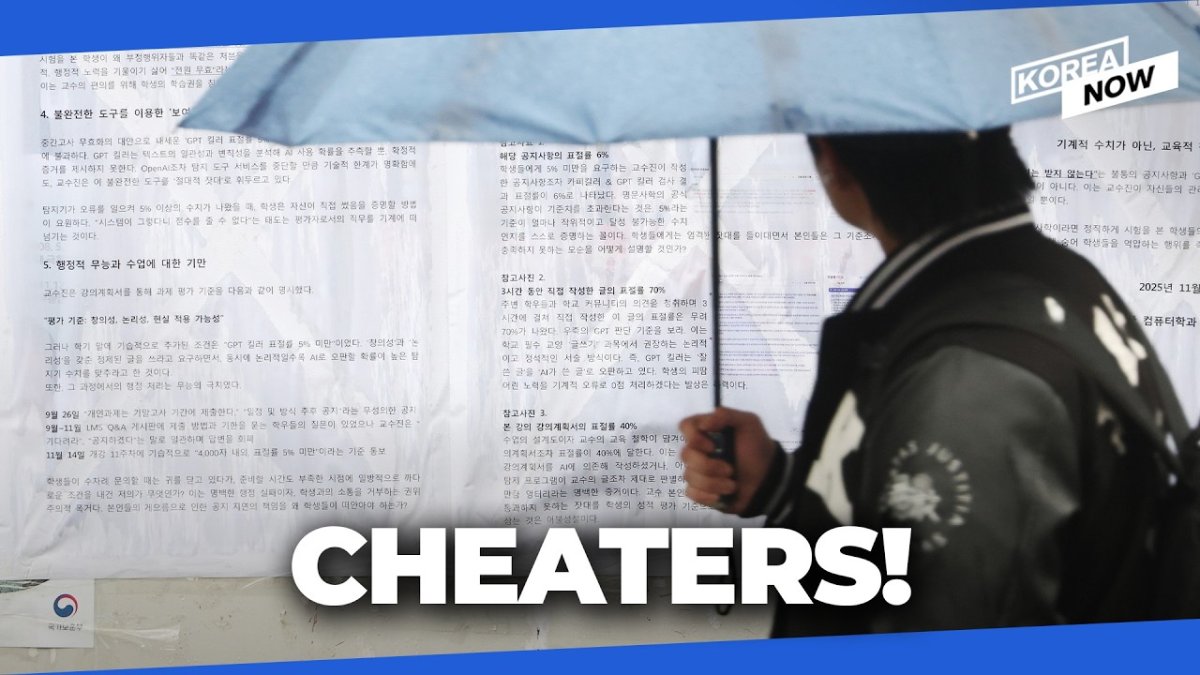
In his New Year's address on January 2, 2026, SNU President Yoo Hong-lim articulated an even more ambitious vision, declaring the university's goal of becoming an "AI-native campus" and announcing plans for campus-wide licenses for generative AI. The Computer Networks case, occurring barely six months after those guidelines came into force, suggests that codifying ethical standards is a necessary but insufficient response: the guidelines define the rules, but enforcement depends on individual faculty, and the incentives for students to cut corners in a hyper-competitive academic environment remain powerful.
National Policy in the Making
The SNU case is unfolding against a parallel policy effort at the national level. The Ministry of Education, in cooperation with the Korean Council for University Education, has been developing an "AI Ethics Guideline for University Students" — the first government guidance on the proper use of generative AI in higher education. The initiative, announced on November 27, 2025, by Rep. Kim Yong-tae of the National Assembly's Education Committee, is intended to provide broad principles that individual universities can adapt to their own circumstances. Ministry officials have been explicit that the guidelines will not carry legal force, because academic affairs are governed by each university's internal regulations.
The government has been scrutinizing AI-cheating incidents at SNU, Yonsei University, and Korea University — the three institutions that form the apex of Korean higher education. Yonsei and Korea University have each established their own AI guidelines, and the government's review is expected to draw on their experience as well as on overseas models, including Harvard University in the United States. Song Ki-chang, honorary professor of education at Sookmyung Women's University, captured the dynamic succinctly: "Universities can technically manage AI guidelines on their own, but many hesitate because they want to see what other schools are doing and how the education ministry views the issue."
Geopolitical Context: Human Capital and the AI Race
The stakes extend well beyond a single classroom on the Gwanak campus. South Korea's AI strategy — articulated most recently in the Lee administration's push to position the country among the top three global AI powers — depends on a pipeline of highly skilled engineers and researchers. The United States and China are intensifying their competition for AI talent, and Northeast Asia has become a contested arena: Chinese universities are expanding AI programs with state backing, while American institutions continue to attract Korean researchers. An academic-integrity crisis at Seoul National University, however contained, carries reputational costs that resonate in international rankings, research collaborations, and global recruitment.
There is also a historical dimension. Modern Korea's economic ascent was built on what scholars have long called "education fever" — a national conviction that education is the primary vehicle of individual and collective advancement. From the expansion of higher education in the 1980s and 1990s to the current era of fierce competition for admission to the SKY universities (Seoul National, Korea, and Yonsei), education has functioned as the country's principal social elevator. Generative AI now threatens to corrode the integrity of that system from within: if assignments can be produced by machines, the credentialing function of the university — the very signal that employers and society rely on — is weakened.
Policy Implications
The immediate question for the Ministry of Education and university administrators is how to distinguish permissible assistance — AI as a tutor or editorial aid — from impermissible substitution. The SNU guidelines defer to instructors, but the Computer Networks case demonstrates the limits of that approach when a single course produces more than three dozen violations. Universities will need more consistent detection and adjudication procedures, and appeals mechanisms for students who believe sanctions are arbitrary. There is also an equity dimension: researchers warn that generative AI could widen the digital divide, with privileged students using the technology strategically while others incur penalties.
Expert Perspectives
Academic opinion in Korea remains divided. Some faculty argue for strict enforcement and visible sanctions to preserve the value of Korean degrees; others contend that AI literacy is now a core competency and that universities should redesign assessment — in-class examinations, oral defenses, process-based evaluation — rather than fight the technological tide. The professor in the Computer Networks course has aligned with the first camp; SNU's institutional posture leans toward the second; the student council's protest letter reflects a third concern, procedural fairness. Song Ki-chang's observation points to a collective-action problem: no university wishes to be first to impose draconian penalties, and none wishes to be last to establish credible standards. Government guidelines, though lacking legal force, can resolve that coordination problem.
Looking Ahead
The 2026 academic calendar will test these arrangements. With the fall semester beginning in late August, universities are expected to finalize their AI policies in the coming weeks; the Ministry of Education's national guidelines are expected after a commissioned research project and stakeholder consultation, with separate versions for professors and students under consideration. The National Assembly's Education Committee is likely to press for faster action if additional incidents emerge.
For Seoul National University, the immediate task is institutional: to demonstrate that its AI guidelines can be enforced fairly and consistently, and that academic integrity remains compatible with technological ambition. For the nation, the deeper question is whether Korea can manage the transition to an AI-augmented educational system without devaluing the human capital that has been the foundation of its rise. The Computer Networks case is a small episode in statistical terms, but an early and revealing test of how one of Asia's most technologically advanced societies will govern generative AI — in its universities, and by extension, its workplaces and public life. How Korea answers will be watched not only in Seoul, but across a Northeast Asian region competing to define the standards of the AI age.
By Prof. David Park, Staff Writer
This article was produced with AI-assisted research and editorial support. Reporting is based on sources cited in the article.
What's Your Reaction?
 Like
0
Like
0
 Dislike
0
Dislike
0
 Love
0
Love
0
 Funny
0
Funny
0
 Wow
0
Wow
0
 Sad
0
Sad
0
 Angry
0
Angry
0

East Asia/Technology Correspondent at Global1.News. Seoul-based voice covering Korean politics, technology, business, and culture. Analyzes how technology and geopolitics intersect across East Asia.













Comments (0)