
Russia Warns It Could Strike British Military Targets Over Storm Shadow Support
Russia warned August 27 it could strike British military targets inside and outside Ukraine over Storm Shadow missile support. The threat follows Burnham's August 24 Kyiv visit releasing missile blueprints, CIA Director Ratcliffe's Moscow trip, and escalating Kremlin rhetoric.
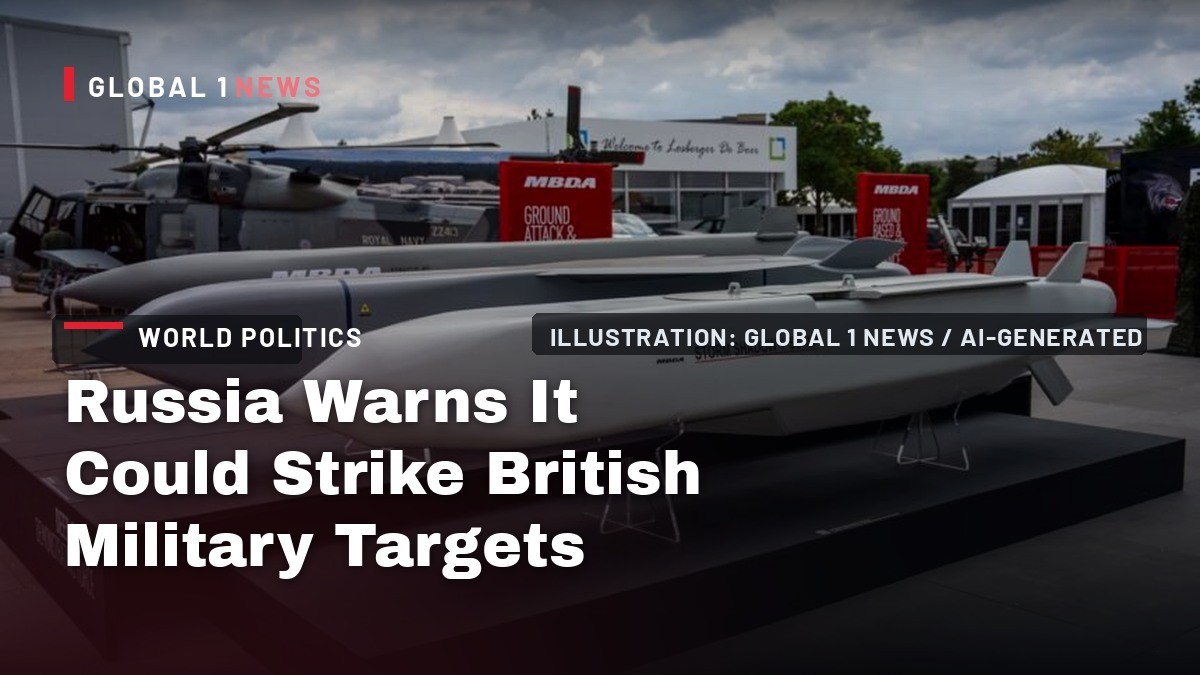
Russia issued a formal threat on Thursday, August 27, warning that it could strike British military targets both inside and outside Ukraine in response to Kyiv's use of British-supplied weapons against Russian territory. The statement, delivered by Russia's foreign ministry spokesperson, escalates a diplomatic confrontation that has been building since British Prime Minister Andy Burnham handed over missile production blueprints during a visit to Kyiv three days earlier.
The warning came just one day after Moscow accused Ukraine of firing British Storm Shadow cruise missiles at a shopping centre in the Russian-controlled city of Donetsk. That claim remains unverified and is attributed solely to Russian authorities, who have a documented pattern of making unsubstantiated allegations about Ukrainian targeting throughout the conflict. The foreign ministry spokesperson told British officials to abandon what she called London's "hostile stance" on the war, warning that continued support for Ukraine risked taking the conflict to "an entirely new level."
The threat marks a significant rhetorical escalation from Moscow, which has repeatedly drawn red lines around Western military involvement in the war but has rarely issued such a direct and specific warning against a NATO member state. British military installations in Europe and beyond now face an elevated threat assessment, though Western intelligence officials have not publicly confirmed any specific imminent action.
The Storm Shadow Blueprint Handover That Triggered Moscow's Response
The immediate trigger for Russia's threat was the announcement made on Monday, August 24, Ukraine's 35th Independence Day, when Prime Minister Burnham made his first foreign trip since taking office. During that visit, Burnham and Ukrainian President Volodymyr Zelenskyy announced that Britain would release classified technical information to allow the Storm Shadow cruise missile to be manufactured on Ukrainian soil, in partnership with France, on assembly lines positioned near the front lines.
The Storm Shadow, known as SCALP in French service, is a British-French designed long-range cruise missile that has become one of Ukraine's most effective strike weapons. The UK has authorised defence company MBDA to release classified information on British-made components of the missile system, a move that The Defense News reported represents a significant relaxation of export controls and technology-sharing restrictions.
Each Storm Shadow missile carries an estimated production cost of approximately $1 million, according to Al Jazeera's reporting. The decision to move production closer to the front lines is designed to reduce Ukraine's dependence on finite Western stockpiles and create a more sustainable supply chain for long-range strike capabilities that have proven critical to Kyiv's military strategy.
Kremlin Accuses Britain of Adding Fuel to the Fire
Kremlin spokesman Dmitry Peskov responded to the blueprint handover within hours, accusing Britain of "adding fuel to the fire" and threatening to destroy any future missile production sites that might be established on Ukrainian territory. Peskov's statement on August 24 set the tone for the escalating rhetoric that followed over the subsequent days.
By Tuesday, August 25, Kremlin adviser Andrei Fedorov, described as close to Russian President Vladimir Putin, went further by threatening possible action against British arms factories themselves. Fedorov's comments, reported by The Telegraph and Ukrainska Pravda, suggested that Moscow was considering targeting British defence industrial infrastructure as a legitimate military objective in response to what Russia frames as British participation in the conflict.
The distinction between targeting production sites inside Ukraine and striking British factories on home soil is significant. While Russia has repeatedly struck Ukrainian defence facilities, a direct attack on British territory would represent a dramatic escalation with potentially catastrophic consequences for NATO's collective defence commitments under Article 5 of the Washington Treaty.
CIA Director's Surprise Moscow Visit Adds Strategic Tension
The Russian threat against British targets unfolded against the backdrop of a highly unusual diplomatic development: CIA Director John Ratcliffe made a surprise visit to Moscow on Tuesday, August 25, meeting with Russian intelligence officials but notably not with President Putin, according to the Kremlin. The visit, first reported by Euronews, marked one of the highest-level American intelligence contacts with Moscow since the full-scale invasion began in February 2022.
Politico and The Wall Street Journal reported, citing sources familiar with the discussions, that Ratcliffe used the meeting to warn Russian officials against escalating conflict with America's NATO allies, with particular emphasis on the Baltic states of Estonia, Latvia and Lithuania. These three nations, all former Soviet republics and now NATO members, have been vocal supporters of Ukraine and have expressed deep concern about Russian revanchism.
Axios, reporting via Eurointegration on August 25, added that the United States urged Ukraine not to carry out strikes on Russian territory while Ratcliffe was in Moscow. This reported request suggests Washington was attempting to manage the escalation dynamic carefully, seeking to avoid provocation during a sensitive diplomatic window while still maintaining pressure on Moscow.
Baltic States and NATO's Eastern Flank on High Alert
The specific mention of Estonia, Latvia and Lithuania in Ratcliffe's reported warnings underscores the acute vulnerability that NATO's eastern flank feels as the war enters its fifth year. These Baltic states share borders with Russia and have watched the conflict with growing alarm, particularly as Russian rhetoric about Western involvement has become more aggressive.
For the Baltic nations, the prospect of Russian strikes against British military targets in the region is not abstract. NATO has stationed enhanced forward presence battlegroups in all three countries, including British troops leading the battlegroup in Estonia. Any Russian military action against British assets in the Baltics would immediately implicate NATO's collective defence guarantee.
The Guardian's reporting on August 27 noted that the CIA director's warning to the Kremlin formed part of the backdrop to Russia's threat against British military targets. The sequencing suggests Moscow may be attempting to test the limits of Western resolve, probing whether the United States and its allies would respond decisively to aggression against a NATO member state.
Ukraine's 100-Year Partnership and Expanding Defence Cooperation
The current escalation must be understood within the broader framework of the UK-Ukraine 100-year bilateral partnership agreement signed in 2025. That agreement, reported by Defense News, committed both nations to a century of defence, economic and political cooperation, signalling a long-term Western commitment to Ukraine's sovereignty that Moscow has consistently rejected.
Beyond the Storm Shadow production arrangement, Burnham's August 24 visit also produced a significant artificial intelligence defence partnership. Britain became the first international partner granted access to Ukraine's Avengers Labs battlefield AI data platform, which contains an annotated dataset of approximately 5 million battlefield images largely drawn from Ukraine's DELTA combat system. This arrangement, reported by LBC, Newsmax, Reuters and The Jerusalem Post, gives British defence planners unprecedented insight into modern battlefield dynamics.
The AI partnership represents a different kind of military cooperation than missile production, but it is equally significant. By sharing real-time battlefield data and machine learning capabilities, the UK and Ukraine are effectively integrating their defence ecosystems in ways that will be difficult to reverse regardless of how the current conflict concludes.
Missile Economics and the Shift to Domestic Production
The decision to move Storm Shadow production to Ukraine carries profound economic and strategic implications. At roughly $1 million per missile, the Storm Shadow is a premium weapon system, and Western stockpiles have faced significant strain after more than four years of sustained Ukrainian expenditure. Domestic production in Ukraine would alleviate this pressure while creating jobs and industrial capacity in a country whose defence sector has been severely tested by war.
Ukraine already operates Storm Shadow and SCALP missiles supplied by the UK and France, and Ukrainian crews have demonstrated considerable proficiency with the system. The new arrangement allows Kyiv and Paris to build additional missiles domestically, reducing dependence on foreign stockpiles and bringing long-range strike production closer to the front lines where it is needed most.
However, establishing missile production facilities in a war zone presents obvious vulnerabilities. Russia has already threatened to destroy any such sites, and the proximity to the front lines that makes the arrangement logistically efficient also makes it militarily exposed. The Ukrainian government will need to implement significant protective measures, including air defence coverage and possibly underground or dispersed production facilities.
What Russia's Threat Means for the Conflict's Trajectory
Russia's formal threat against British military targets represents a dangerous inflection point in the conflict. For more than four years, Moscow has sought to deter direct Western military involvement while punishing Ukraine for its Western-aligned orientation. The threat to strike British targets inside and outside Ukraine suggests Moscow now views the UK as a direct participant in the conflict rather than merely a supplier of weapons.
The timing of the threat, coming just days after Ratcliffe's Moscow visit, suggests Russia may be attempting to create maximum diplomatic pressure while also testing the credibility of Western deterrent threats. The Kremlin's calculus appears to be that by raising the spectre of direct strikes against British assets, it can force London to reconsider the depth of its commitment to Ukraine's defence industrial base.
Western officials will be watching closely to see whether Russia follows through on its rhetoric or whether this represents another instance of Moscow's pattern of issuing dire warnings without corresponding action. The coming weeks will reveal whether the threat was a bluff designed for domestic consumption or a genuine precursor to military action against British targets.
By Jessica Ali, Staff Writer
This article was produced with AI-assisted research and editorial support. Sources: CNN, Reuters, The Guardian, The Independent, Politico, The Wall Street Journal, Al Jazeera, Agence France-Presse wire reports.
What's Your Reaction?
 Like
0
Like
0
 Dislike
0
Dislike
0
 Love
0
Love
0
 Funny
0
Funny
0
 Wow
0
Wow
0
 Sad
0
Sad
0
 Angry
0
Angry
0

Editor-in-Chief at Global1.News. Atlanta-based journalist who cuts through the BS and tells it like it is. Lead anchor, host, and the voice you hear when the spin stops and the truth starts.














Comments (0)