
Russia Rolls Back Fuel Quality Standards to Quell Domestic Shortages
Russia's government has approved the sale of lower-grade Euro-2, Euro-3 and Euro-4 fuels through July 1, 2027 as Ukrainian drone strikes on refineries fuel a deepening domestic gasoline and diesel shortage that has forced rationing across more than half the country.
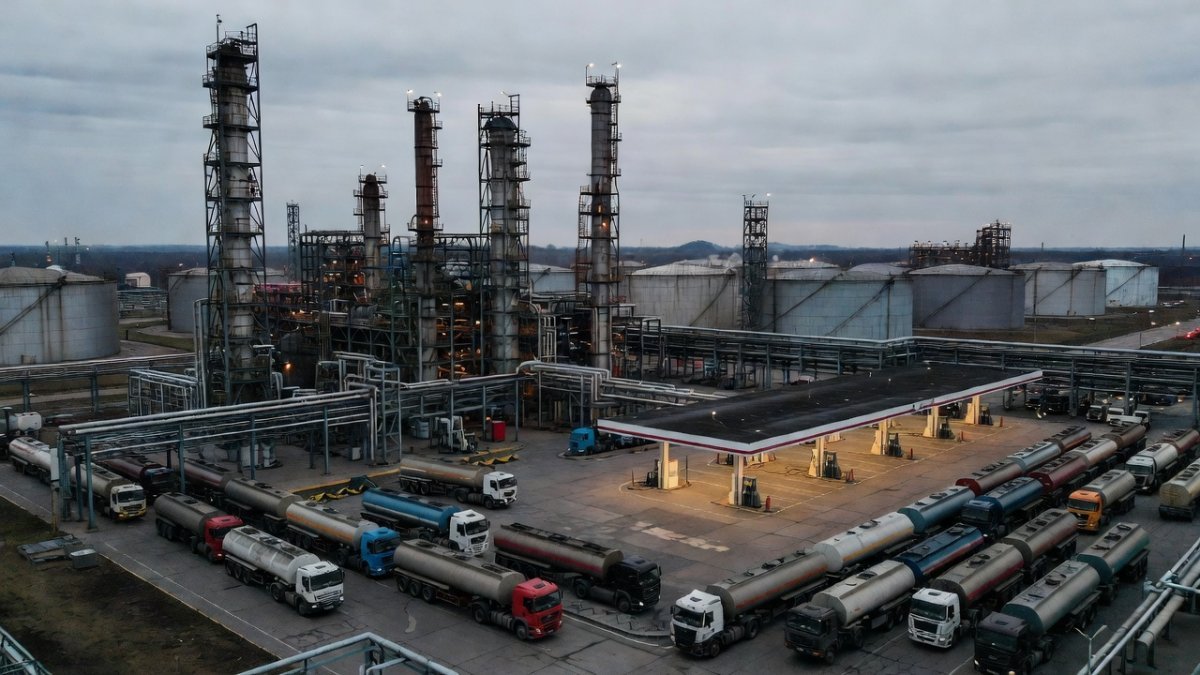
Russia's decision to permit the sale of lower-grade fuels marks a sharp reversal in environmental policy as authorities scramble to address widespread gasoline and diesel shortages triggered by intensified Ukrainian strikes on domestic refineries. The measure, approved this week, allows production and distribution of fuels long banned for their high sulfur content, underscoring how sustained pressure on refining capacity has forced the Kremlin to prioritize immediate supply over long-term standards and public health considerations.
Government Decree Lowers Fuel Standards
Russia's government has approved the sale of lower-grade fuels through July 1, 2027. Prime Minister Mikhail Mishustin signed the resolution this week, and it was published on the Official Legal Information Portal before entering into force. The Energy Ministry announced the measure on its Telegram channel, confirming that automotive gasoline of environmental classes K2, K3 and K4 may now be produced, imported and sold.
Euro-2 gasoline, banned in Russia since 2013, contains roughly 50 times more sulfur than current standards. An earlier decree in early July permitted Euro-3 sales until the end of the year. The new resolution extends allowances for these grades and marks a clear reversal of long-standing environmental policy. According to the Energy Ministry press service, the rollback addresses acute production shortfalls rather than any shift in regulatory philosophy. This adjustment comes as officials weigh the immediate need for volume against the longer-term health implications for Russian citizens exposed to higher emissions in urban areas.
Roots of the Domestic Fuel Shortage
The fuel crisis began in August 2025 after Ukrainian drone strikes intensified on Russian oil refineries. Production shortfalls escalated sharply in mid-2026. By early July, gasoline output had fallen to about 65 percent of average domestic consumption, while diesel production barely matched demand. These figures, drawn from official production data, illustrate the scale of disruption to Russia's refining sector.
Russia responded with temporary export bans on diesel, gasoline and jet fuel. Authorities also began importing gasoline from Belarus and India to offset the deficit. These steps reflect the Kremlin's priority of maintaining supply stability amid sustained pressure on refining capacity. The moves divert resources previously earmarked for foreign markets, affecting both state budgets and the operations of Russian industry and agriculture. Such reallocations highlight how energy policy decisions at the federal level now directly constrain regional economies that depend on steady fuel flows for agriculture and transport.
Drone Strikes Target Refining Infrastructure
At least 194 confirmed hits on Russian oil refineries occurred in the first half of 2026, according to Financial Times analysis of Rochan Consulting data. This rate is roughly eleven times higher than the same period in 2025. Strikes have reached facilities deep inside Russia, demonstrating Kyiv's expanding operational reach.
On the night of Wednesday, Ukrainian drones hit the Slavneft-Yanos refinery in Yaroslavl, one of Russia's five largest with annual capacity of about 15 million metric tons. Regional governor Mikhail Yevrayev and President Volodymyr Zelensky confirmed a large fire. Separate strikes that week damaged refineries in Bashkortostan and a Wildberries warehouse in the Tver region. Ukraine has conducted strikes on facilities as far as Ufa in Bashkortostan, roughly 1,600 kilometers from the border, with all three refineries near Ufa hit on the same night in early August. These operations reflect a sustained campaign against infrastructure that supports both military logistics and civilian supply chains.
Rationing Spreads Across Regions
Rationing measures have been introduced in at least 56 regions as of late June, according to open-source data analyzed by The Moscow Times. Some areas implemented odd-even gasoline sales based on license plates. Business Insider analysis found shortages affecting at least 78 of Russia's 83 regions, with purchase limits in 48 areas. In Crimea, authorities declared a state of emergency and banned fuel sales entirely, immediately disrupting the tourism industry.
These measures illustrate how the shortage has moved from industrial logistics into direct constraints on civilian mobility. The Moscow Times reported that the restrictions have spread rapidly, forcing regional administrations to improvise distribution systems under central government guidance. Local officials now coordinate with federal agencies to prevent hoarding while attempting to maintain essential services in rural districts.
The Human Cost at the Pump
The fuel crisis has become one of the most visible disruptions to everyday life for Russians since the full-scale invasion began, The Guardian reported. Motorists in several regions have compared current conditions to the Soviet era of ration coupons, according to Fortune. Queues at filling stations have lengthened in affected areas, with some regions introducing purchase limits that restrict drivers to fixed volumes per visit.
Some regions mobilized volunteers, including schoolteachers, to manage queues at filling stations. In the Pskov region, officials sought volunteers specifically to explain rationing rules, per Radio Svoboda via TVP World. These scenes highlight the Kremlin's difficulty in shielding the public from the economic consequences of the conflict, as ordinary citizens encounter visible constraints on mobility that echo earlier periods of scarcity. The involvement of everyday workers in managing distribution underscores the strain on local governance structures.
What This Means for the Kremlin
Analysts suggest the visible domestic disruption carries political risk for the Kremlin, as shortages challenge the narrative of stability that has underpinned public support during the conflict. Comparisons to Soviet-era shortages, voiced by motorists, could erode confidence in the government's ability to insulate daily life from wartime pressures. This development tests the Kremlin's long-standing approach to energy politics, where export revenues from companies such as Gazprom and Rosneft have historically taken precedence over domestic allocation.
The reallocation of refined products away from foreign markets now affects state budgets while exposing ordinary Russians to direct consequences. Independent observers note that such visible strains may complicate efforts to maintain cohesion across Russia's regions, particularly as central authorities rely on local officials to implement rationing without widespread unrest.
Energy Policy and Kremlin Calculations
The decision to roll back fuel quality standards prioritizes volume over environmental compliance. Energy Ministry statements frame the change as a temporary necessity to stabilize the market. Analysts interpret the move as evidence that refinery losses have outpaced the government's ability to restore capacity through repairs or new construction. Post-Soviet energy politics have long centered on export revenues from Gazprom and Rosneft, yet domestic shortages now force a reallocation that affects both state budgets and the daily operations of Russian industry and agriculture.
Regional and International Dimensions
Belarus and India have emerged as short-term suppliers of gasoline. The CSTO and Eurasian Economic Union frameworks have not produced coordinated regional responses. European observers note that the shortages coincide with continued Russian efforts to maintain energy leverage abroad while managing internal constraints. Ukraine's strikes on facilities deep inside Russia, including those confirmed by President Volodymyr Zelensky, underscore Kyiv's focus on Russia's fuel supply chain as a strategic target.
The Global Dimension
The crisis signals vulnerabilities in Russia's energy resilience that could influence perceptions among global buyers, as export bans on diesel, gasoline and jet fuel reduce available volumes for international markets. Imports from Belarus and India, while filling immediate gaps, highlight a shift from net exporter status toward reliance on external partners for refined products. Analysts suggest this dynamic may encourage some countries to diversify away from Russian supplies over time. Ukrainian officials have stated that targeting fuel logistics aims to weaken the broader war effort by constraining both military mobility and economic output, though Russian authorities describe these actions as attacks on civilian infrastructure.
By Irina Volkov, Staff Writer
This article was produced with AI-assisted research and editorial support. Reporting is based on sources cited in the article.
What's Your Reaction?
 Like
0
Like
0
 Dislike
0
Dislike
0
 Love
0
Love
0
 Funny
0
Funny
0
 Wow
0
Wow
0
 Sad
0
Sad
0
 Angry
0
Angry
0
Russia/Eastern Europe Correspondent at Global1.News. Covering Russian politics, energy, security, and the shifting dynamics of the post-Soviet space. Provides clear-eyed analysis on one of the world's most opaque regions.











Comments (0)