
ROK Navy Suicide Drone Test Fails at Sea: Analysis
The Republic of Korea Navy's first maritime combat trial of a domestically developed medium-sized suicide drone ended in failure on August 25, 2026, when two consecutive aircraft plunged into the sea within seconds of launch from the flight deck of the amphibious assault ship ROKS Marado . The test, conducted in waters south of Busan with the Agency for Defense Development (ADD), was meant to show a land-oriented loitering munition could adapt to the demanding environment of a naval vessel.
The Republic of Korea Navy's first maritime combat trial of a domestically developed medium-sized suicide drone ended in failure on August 25, 2026, when two consecutive aircraft plunged into the sea within seconds of launch from the flight deck of the amphibious assault ship ROKS Marado. The test, conducted in waters south of Busan with the Agency for Defense Development (ADD), was meant to show a land-oriented loitering munition could adapt to the demanding environment of a naval vessel. Instead, it exposed the gap between ground-based success and shipboard reality, raising questions about the Navy's timeline for fielding unmanned strike systems.
The failed trial comes amid heightened regional attention to drone warfare. Russia's war in Ukraine has demonstrated the battlefield utility of low-cost one-way attack drones, while North Korea's December 2022 incursion into South Korean airspace—five drones evaded a five-hour pursuit—prompted then-President Yoon Suk-yeol to order a dedicated drone unit. For the ROK Navy, the stakes are strategic, and the August 25 crash is more than a developmental setback; it tests the credibility of South Korea's defense-industrial ambitions.
ROK Navy Suicide Drone Test Fails at Sea: Analysis
Seoul, South Korea – August 27, 2026 — The operational plan for the trial was precise. A drone was to launch from a rail on the flight deck of the ROKS Marado, a 14,500-ton Dokdo-class amphibious assault ship (Yonhap lists the vessel at 14,000 tons), conduct reconnaissance, then track and strike a fast-moving unmanned surface vessel simulating an enemy target about two kilometers away.
At around 3:30 p.m., the first aircraft launched from a rocket-assisted launcher. It rose briefly, then lost altitude and fell into the sea within seconds; Korean media reported roughly four seconds of flight. After researchers inspected a suspected issue, a backup aircraft was launched about two hours later, at approximately 5:30 p.m. It crashed the same way. The core target-detection and strike phases never took place.
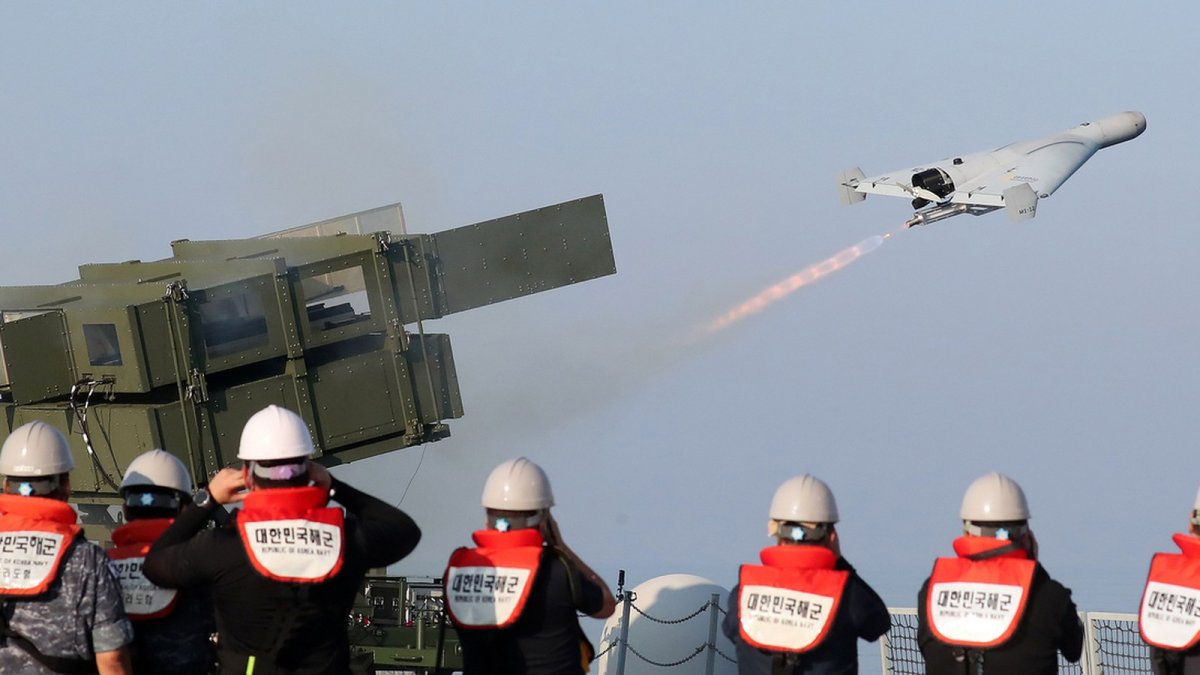
A Carefully Choreographed Trial Unravels in Seconds
The symmetry of the two failures was particularly troubling. Investigators initially suspected misalignment between the aircraft and its launch system under shipboard conditions; unlike land trials, the equipment—including explosive components—had to be disassembled for safety, brought aboard, and reassembled on deck, introducing variables absent from ground testing. Yet the similar outcome in the second launch left the ADD unable to confirm that suspicion. "The exact cause remains unknown," an ADD official told reporters, adding that flight data and the recovered aircraft would be analyzed further.
What makes the failure more puzzling is that key launch elements operated normally in both attempts. Rocket boosters separated as designed, propellers engaged, and engine RPM remained within normal parameters. The aircraft did not fail mechanically in an obvious way; it simply lost lift and fell—pointing to a more subtle aerodynamic or control-law issue, possibly tied to deck effects, launch angle, or the reassembled configuration, none confirmed.
The Program's Provenance and Promise
The failed maritime trial is part of an applied-research program launched in 2024 to secure core technologies for a domestically developed loitering munition; the project is scheduled to conclude in September 2026. The program has produced about ten prototypes and some thirty successful land sorties, including in wind stronger than recorded at sea on August 25. The maritime environment, however, introduces factors land trials cannot replicate: ship motion, salt spray, electromagnetic interference, and the confined geometry of a flight deck.
The drone is a sophisticated piece of engineering. With a wingspan of about three meters, it can stay airborne for up to ten hours on aviation fuel, cruise at around 130 kilometers per hour, and reach diving-attack speeds of several hundred kilometers per hour. It carries EO/IR sensors with automatic target recognition for day/night and severe-weather operations, relays real-time reconnaissance video via low-Earth-orbit satellite data links, incorporates anti-jamming technology, and uses a modular payload for mission-specific configurations.
The development consortium reflects the breadth of South Korea's defense industry. Korean Air built the aircraft; LIG Defense & Aerospace supplied the rocket propulsion system and launcher; Hanwha Systems developed ground control equipment. The ADD has stressed that the technologies and major components were developed domestically—a point of national pride and strategic necessity.
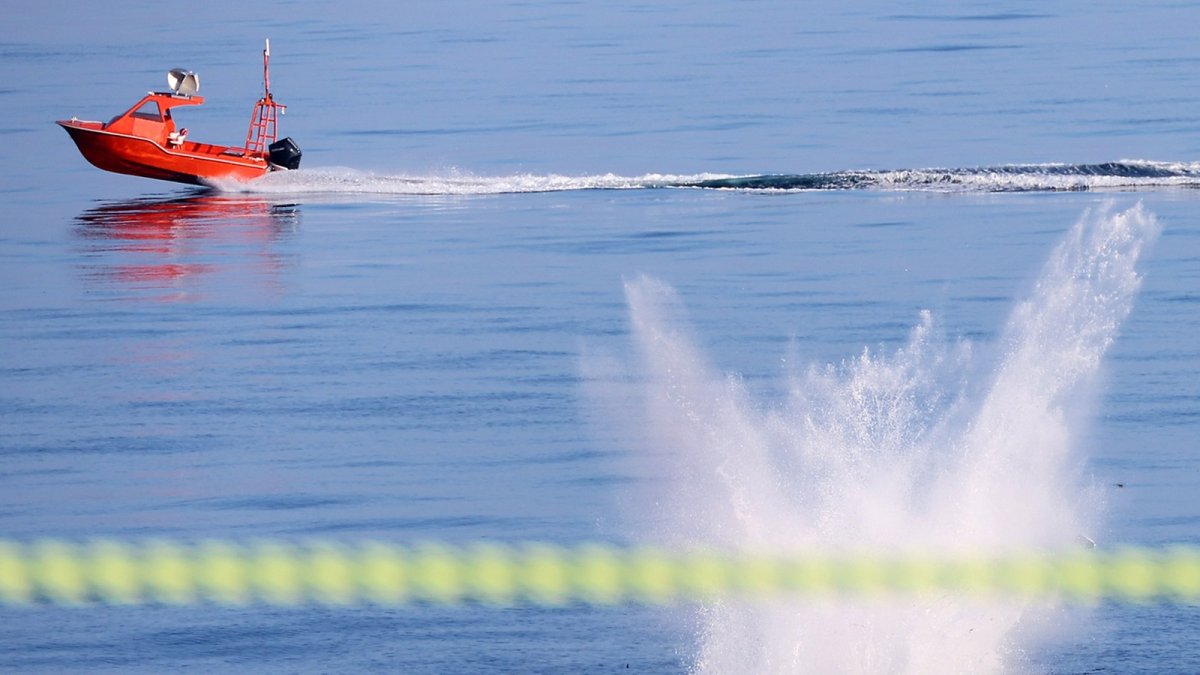
Strategic Positioning: Beyond Fire-and-Forget
ADD team leader Kim Hee-jun has been explicit about the system's place in the global drone landscape. He contrasted it with Iran's Shahed drones and Russia's Lancet loitering munitions, which he described as largely "fire-and-forget" systems. The Korean system is intended as a higher-end suicide drone capable of reconnaissance and target identification and tracking before attack—designed to loiter, observe, decide, and strike, functioning as both an intelligence asset and a weapon.
The Korean system is more expensive than simpler one-way attack drones, a fact the ADD acknowledges, but the added expense buys an expanded mission set: a persistent surveillance platform, a communications relay, and a precision strike asset in a single sortie. For a navy in the Yellow Sea and Korea Strait, that multi-functionality is strategically valuable.
The timing of the failed trial is also notable. In early August 2026, U.S. Marines conducted their first live-fire first-person-view attack drone training in Pocheon, and U.S. forces practiced turning drones into weapons with live ordnance. The ROK Navy also recently ran a first undersea mine-sweeping trial using an "AI officer" and unmanned vessels—signs of a broader shift toward unmanned systems across the U.S.-ROK alliance that the August 25 failure does not halt but does complicate.
Institutional Responses and the Path Forward
The immediate institutional response has been measured. The Defense Acquisition Program Administration (DAPA), South Korea's arms procurement agency, said Thursday, August 27, that it is investigating why the two loitering munitions crashed, while stressing the failed test does not mean the project fell short of its original goals. "The original ground-launch tests were successful," a DAPA spokesperson said at the Defense Ministry's regular briefing. "This was a challenging combat experiment conducted additionally to verify the possibility of maritime operations based on the technologies already secured." Initial cause-analysis results are expected Friday, August 28.
Vice Adm. Kwak Kwang-sup, commander of the Republic of Korea Fleet, told reporters after the test: "Today's experiment is not the end. We will try again." That determination fits the Navy's modernization trajectory: it plans phased acquisition of maritime suicide drones and expansion to next-generation landing ships and future unmanned carrier platforms, with unmanned strike systems a logical next step for the ROKS Marado's air wing.
Yet the failure also highlights a structural challenge in South Korea's defense acquisition system. The project is an applied-research program, not a full-scale development effort; its goal is to secure core technologies, including the data link to low-Earth-orbit satellites, rather than to produce a field-ready weapon. The maritime trial was an additional, self-imposed challenge—whether technologies already secured on land could transfer to sea. For now, the answer is no, at least not without further work.
Implications for the Regional Drone Arms Race
The failed trial must be understood within a regional drone arms race. North Korea has invested heavily in drone capabilities, as the 2022 incursion underscored; China's military modernization includes a substantial unmanned systems portfolio. South Korea has answered with initiatives from the drone unit ordered by Yoon to the current suicide drone program. The August 25 failure does not erase those efforts, but it gives ammunition to critics who argue the defense-industrial base is not ready for the leap to advanced unmanned systems.
There is also a strategic dimension to the U.S.-ROK alliance. The U.S. military's increasing emphasis on unmanned systems, including the live-fire FPV drone training in Pocheon, suggests a more integrated alliance approach to drone warfare is emerging. A successful maritime suicide drone would have given the ROK Navy a unique capability—a domestically produced, ship-launched loitering munition able to operate in contested environments without relying on U.S. systems. The failure delays that prospect but does not eliminate it.
For the academic observer, the trial is a case study in the gap between technological aspiration and operational reality: impressive specifications, a solid land-based record, a clear strategic rationale—but an unforgiving maritime environment.
The ROK Navy's commitment to unmanned systems is not in doubt; the question is whether the defense-industrial ecosystem can deliver in the timeline the Navy envisions. The September 2026 conclusion of the current phase looms, and phased acquisition plans depend on resolving the issues exposed August 25. Kwak's promise to try again is reassuring, but the next attempt will carry even greater weight: a second failure would raise fundamental questions about the program's viability.
For now, the ROK Navy and the ADD are left with more questions than answers, but the strategic lesson is already clear: the path to maritime unmanned warfare is longer and more difficult than planners in Seoul had hoped. The Navy will try again, and the success of that next attempt will determine the credibility of South Korea's broader ambitions in the unmanned domain.
This article was produced with AI-assisted research and editorial support. Sources: KOREA NOW (Yonhap), Korea Herald, Asia Today, Chosun Ilbo, Aju Press.
By Prof. David Park, Staff Writer
What's Your Reaction?
 Like
0
Like
0
 Dislike
0
Dislike
0
 Love
0
Love
0
 Funny
0
Funny
0
 Wow
0
Wow
0
 Sad
0
Sad
0
 Angry
0
Angry
0

East Asia/Technology Correspondent at Global1.News. Seoul-based voice covering Korean politics, technology, business, and culture. Analyzes how technology and geopolitics intersect across East Asia.















Comments (0)