
Putin Announces Reshuffling of Top Military Leadership
President Vladimir Putin announced a sweeping reshuffle of Russia's top military leadership this week, appointing new operational commanders in Ukraine, a unified logistics chief under Col. Gen. Valery Solodchuk, and Col. Gen. Denis Lyamin to head the new Unmanned Systems Forces drone branch.
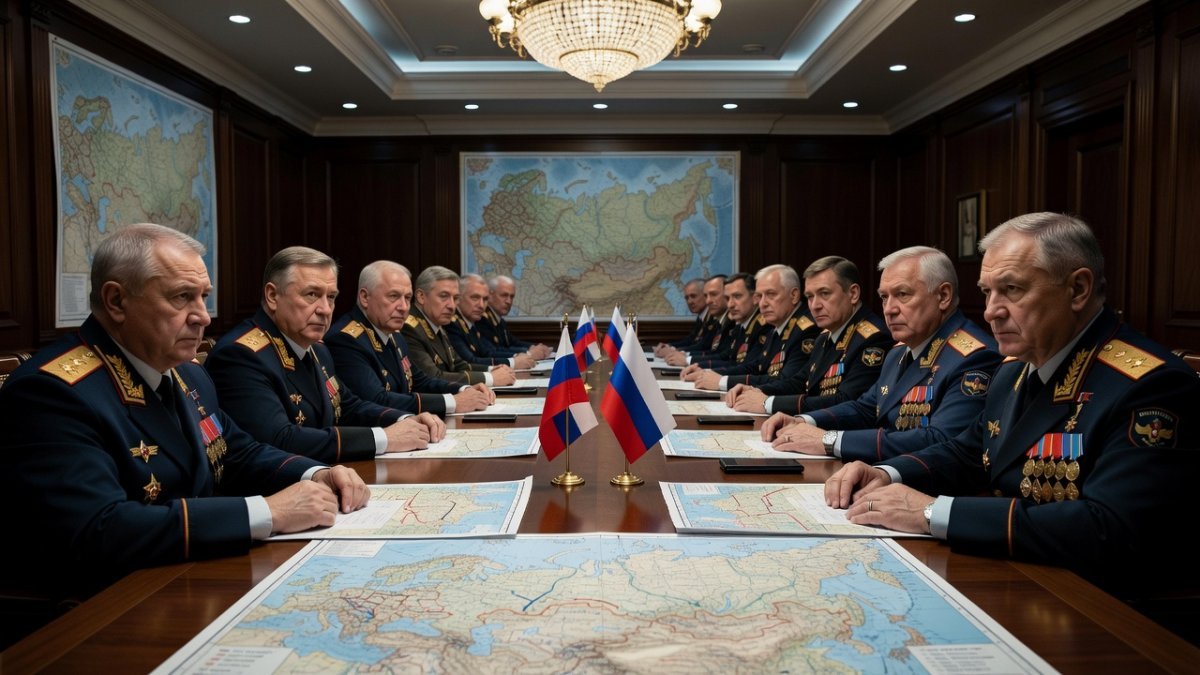
President Vladimir Putin announced a sweeping set of military leadership changes this week during a session at the Defense Ministry headquarters in Moscow. The appointments include new commanders for frontline operational groups in Ukraine, a unified logistics chief, and the first head of a newly created unmanned systems branch, in what officials described as targeted refinements to strengthen coordination and sustain long-term operations.
Putin Reshuffles Top Commanders to Strengthen Ukraine Effort
Moscow, Russia — President Vladimir Putin addressed senior officers at the Defense Ministry headquarters in Moscow. Defense Minister Andrey Belousov and Chief of the General Staff Valery Gerasimov attended alongside the newly appointed commanders. Putin described the adjustments as necessary to improve coordination in the Ukraine theater.
Details from the Defense Ministry Session
Kremlin military personnel decisions of this scope are typically finalized through consultations involving the Defense Ministry and General Staff before public announcement during ministry gatherings. The Wednesday session followed this pattern, with the broadcast serving to convey the adjustments to both domestic audiences and operational units engaged in the conflict.
Putin's framing of the changes as fine-tuning could reflect a deliberate effort to present the reshuffle as targeted refinement rather than a response to setbacks, analysts following the Russian command note. The wording, delivered directly to senior officers, positions the moves as ongoing adaptation within the existing command framework.
Shifts in Operational Command Structures
Col. Gen. Andrey Ivanaev, previously in charge of the Vostok group of forces, was named to lead the Center group operating in Ukraine. Maj. Gen. Pyotr Bolgarev, who served as chief of staff under Ivanaev in the Vostok group, received approval from Putin to take command of the East group. These moves replace earlier leadership in the key operational sectors.
Col. Gen. Valery Solodchuk, who had commanded the Center group, was reassigned away from direct combat operations. The changes reflect an effort to rotate experienced officers into new roles while maintaining continuity in frontline commands.
Under the Gerasimov-era structure, such command changes have historically been used to balance continuity with periodic adjustments. The current shifts maintain the overall group framework while inserting new leadership at key points, an approach analysts say is intended to refine execution without disrupting the broader operational architecture.
Creation of Unified Logistics Oversight
Putin directed that all rear services of the Defense Ministry be placed under unified control. Col. Gen. Valery Solodchuk was appointed to head military logistics and arms supplies across the armed forces. During the meeting, Putin told Solodchuk that leading logistics constitutes a combat mission and expressed confidence in his ability to organize the effort effectively.
Placing all rear services under a single commander addresses what military analysts have long identified as a vulnerability in Russian supply operations. By consolidating logistics and arms supplies under Col. Gen. Valery Solodchuk, the ministry is widely seen as seeking to reduce fragmentation that previously hampered timely delivery of materiel to forward units.
Ukraine has faced its own logistics strains during the same period, though Russian state reporting emphasizes the comparative impact of strikes on Ukrainian supply routes. The unified command model now adopted by Moscow aims to create a more resilient system capable of supporting extended campaigns through centralized allocation and distribution.
Establishment of the Unmanned Systems Forces
Col. Gen. Denis Lyamin, former chief of staff of the Center group, was named commander of the Russian Unmanned Systems Forces. This branch was created as a separate military service in November 2025 to centralize control of drone units and improve coordination at multiple army levels. Putin stated that the task involved selecting the officer who had proven most effective in unmanned systems work.
Drones have altered battlefield dynamics by enabling low-cost reconnaissance and precision strikes that shift the economics of engagement in favor of forces able to mass unmanned assets. Russia’s decision to establish the Unmanned Systems Forces as a separate branch in November 2025 reflects an institutional response to these changes, moving drone units from ad hoc integration to dedicated service status.
Col. Gen. Denis Lyamin’s prior role as chief of staff of the Center group provided direct exposure to drone employment at the operational level, positioning him to apply field experience to the new branch. Earlier Ukrainian reporting referenced Yuri Vaganov in connection with the formation, yet the current appointment indicates a subsequent selection based on demonstrated effectiveness in unmanned systems coordination.
The branch structure centralizes control across army levels, allowing standardized training, procurement, and deployment of drone capabilities. This step aligns with broader efforts to institutionalize technologies that have proven decisive in reconnaissance and strike missions throughout the conflict.
Russian State Media Context on the Reshuffle
Russian state media outlet RT reported that the leadership changes occur as Kyiv faces political and military turbulence. Officials cited in the coverage argued that Russian retaliatory strikes have caused greater economic damage to Ukraine than Kyiv's operations, including effects described as a de facto blockade of Ukraine's Black Sea ports.
The reporting situates the reshuffle within a 40-day period of Ukrainian pressure, using this context to portray Russian command adjustments as proactive measures rather than reactive ones. This narrative choice emphasizes continuity in Russian operations while directing attention to Ukrainian vulnerabilities.
Attributing the blockade claim directly to Moscow allows RT to convey the strategic messaging without independent verification, a common approach in state media coverage of the conflict. The overall presentation reinforces the view that Russian adaptations in command and logistics contribute to sustained pressure on Ukrainian economic and military infrastructure.
Ukrainian Reporting and Parallel Developments
Ukrainian outlets, including Mezha citing RFE/RL, noted earlier reports from November 2025 about the formation of unmanned systems forces, initially linked to Yuri Vaganov before the current appointment. Ukrainian President Volodymyr Zelensky recently conducted his own cabinet reshuffle, during which former Defense Minister Mykhailo Fedorov opposed his dismissal and criticized Gen. Aleksandr Syrsky, who was later removed as commander-in-chief of the Ukrainian armed forces.
The simultaneous reshuffles on both sides occur amid ongoing military operations, with each leadership conducting internal reviews of command effectiveness. Ukrainian coverage highlights the internal tensions surrounding Fedorov’s stance and Syrsky’s departure, presenting them as indicators of broader political and military recalibration in Kyiv.
Parallel personnel changes reflect the pressures each side faces in sustaining prolonged engagement. While Russian adjustments focus on operational groups and support branches, Ukrainian developments center on cabinet and senior military roles, illustrating how both capitals are managing leadership transitions during active conflict.
Western Analyst Assessments
The Institute for the Study of War, cited by Newsweek, assessed that the Russian reshuffle aims to address a disorganized command structure and self-reinforcing failures in the campaign in Ukraine. Analysts viewed the moves as an attempt to strengthen centralized oversight of logistics and emerging technologies such as drones.
Western think tanks more broadly note that Russian command adaptation has involved iterative adjustments to address coordination shortfalls across operational sectors. The creation of unified logistics and a dedicated unmanned branch is viewed as part of this pattern, aiming to convert battlefield experience into structural reforms.
These assessments emphasize that while the changes do not alter overall strategic objectives, they seek to mitigate inefficiencies that have compounded over time. The focus on logistics and drone integration is seen as recognition that sustained operations require reliable supply chains and technological specialization at the institutional level.
Broader Implications for Kremlin Military Posture
The appointments connect directly to ongoing efforts to adapt Russian forces for sustained operations in Ukraine. By placing logistics under a single commander and elevating unmanned systems to branch status, the Kremlin seeks improved efficiency in supply chains and technological integration. These steps occur within established power structures that link the Defense Ministry to decisions affecting the wider post-Soviet security environment.
Consolidating logistics under one commander and elevating unmanned systems to branch status together indicate a posture oriented toward protracted operations rather than short-term offensives. Unified rear services can streamline fuel and materiel distribution, while the drone branch enables more systematic integration of reconnaissance and strike capabilities across formations.
These structural steps occur within the established Defense Ministry framework that links operational decisions to wider post-Soviet security considerations. By addressing supply vulnerabilities and technological adaptation simultaneously, the Kremlin appears to be signaling intent to maintain force sustainability over an extended period.
The combined emphasis on logistics and unmanned systems suggests preparation for scenarios where energy resources and technological edges play increasing roles in determining campaign endurance. Such adaptations reinforce centralized control while seeking incremental gains in efficiency that could influence the regional balance over time.
By Irina Volkov, Staff Writer
This article was produced with AI-assisted research and editorial support. Reporting is based on sources cited in the article.
What's Your Reaction?
 Like
0
Like
0
 Dislike
0
Dislike
0
 Love
0
Love
0
 Funny
0
Funny
0
 Wow
0
Wow
0
 Sad
0
Sad
0
 Angry
0
Angry
0
Russia/Eastern Europe Correspondent at Global1.News. Covering Russian politics, energy, security, and the shifting dynamics of the post-Soviet space. Provides clear-eyed analysis on one of the world's most opaque regions.











Comments (0)