
Thai PM Anutin Stopped at Buriram Checkpoint for Gun, Drug Search
Thai PM Anutin Charnvirakul was stopped and searched at a joint police checkpoint in Buriram during a province-wide gun and drug crackdown, underscoring his hardline stance on firearm control after a series of violent incidents.
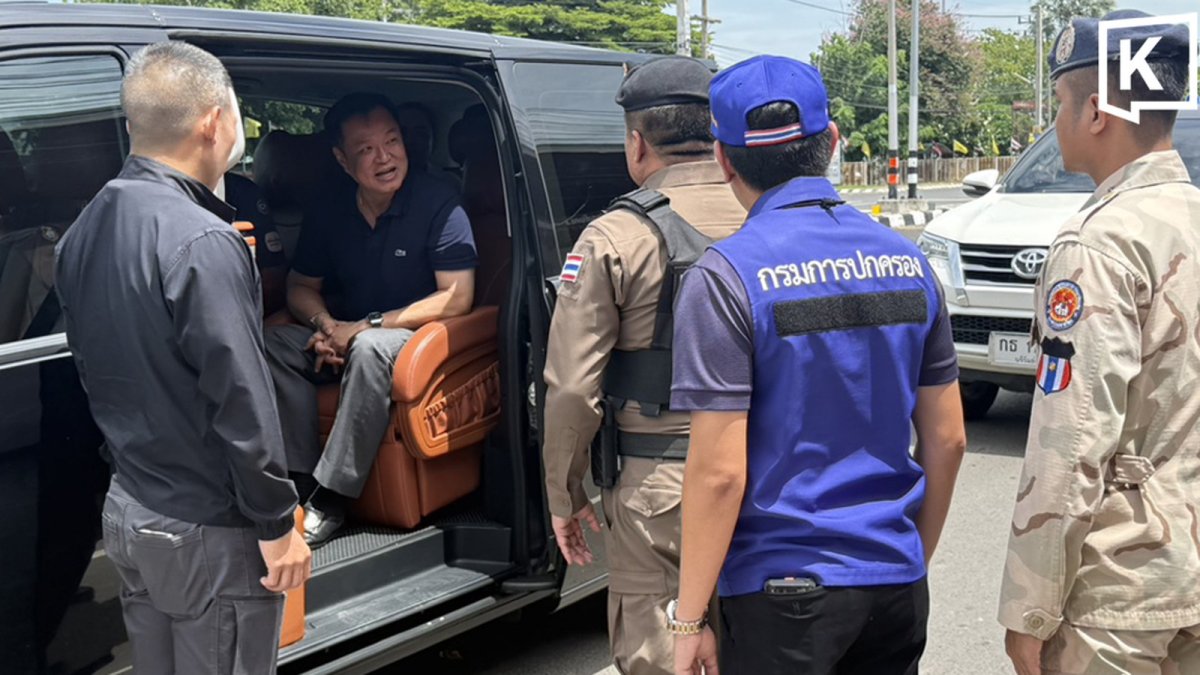
In a moment that underscored the government's new hardline stance on gun control, Prime Minister and Interior Minister Anutin Charnvirakul was himself subjected to a security checkpoint search in Buriram province on Saturday. The incident occurred as administrative officials and police conducted a province-wide operation to seize illegal firearms and drugs, a policy initiated by the prime minister himself.
PM Anutin Stopped at Buriram Checkpoint for Gun, Drug Search
Buriram, Thailand — Prime Minister Anutin Charnvirakul experienced the full force of his own anti-firearm policy on Saturday when he was stopped and searched at a joint police and administrative checkpoint in Ban Dan District. The search, which took place around 11:00 a.m., was part of a sweeping operation across Buriram province targeting the proliferation of illegal guns and narcotics.
Prime Minister Subject to Same Search as Public
While on official assignment in the lower northeastern region, the prime minister’s vehicle was flagged down at a checkpoint in Ban Dan Subdistrict. Demonstrating that the new measures apply to everyone, including the nation's leader, Mr. Anutin willingly complied with the search procedure. According to reports from Khaosod English and Thai Rath, the prime minister engaged in a brief exchange with the officers, asking, "Did you find anything?"
A police officer replied, "No, sir." The prime minister then clarified his question, asking, "I mean at the checkpoints around here?" The officer responded with a candid update: "We only found drugs, sir." The exchange highlighted the dual focus of the operation—combating both gun violence and the drug trade—which are often linked in local crime networks.
Nationwide Crackdown Following Shocking Violence
The checkpoint operation in Buriram is the most visible sign of an aggressive new policy to curb the spread of firearms. The crackdown comes after a series of violent incidents that have shaken public confidence, most significantly a school shooting in the Nonthaburi area allegedly carried out by a 14-year-old gunman that killed nine people. The tragedy sent shockwaves through the nation and prompted urgent calls for action.
The government’s response has been swift and comprehensive. In addition to the school tragedy, authorities have pointed to other high-profile cases, including an incident where the son of a prominent politician allegedly used a gun to strike a fellow student, and the shooting of Pol Col Thongchai Yenprasert, the former president of the Nonthaburi Provincial Administrative Organization. The latter case allegedly involved former politician Chalerm Riewrang, further entangling politics with the gun violence epidemic.
The timing was telling: the suspension came just days after the Nonthaburi tragedy, announced on a Tuesday following a weekend of national mourning. The swift response reflects a government aware that public patience has worn thin. For many Thais, the image of a 14-year-old wielding a firearm was a stark reminder that the problem is deeply cultural, with guns perceived as symbols of status and protection in both urban and rural settings.
Beyond the immediate moratorium, Prime Minister Anutin has also instructed Deputy Prime Minister Pakorn Nilprapunt, who oversees legal affairs, to accelerate the drafting of tougher gun-control legislation. This proposed bill, expected to be submitted soon, signals a shift from reactive measures to a more permanent legal framework. It is a recognition that while checkpoints and permit freezes are necessary, they are only as effective as the laws that underpin them. The inclusion of a review of existing licences further suggests that the government is willing to revisit past decisions, a move that could unsettle long-time gun owners who have never faced scrutiny before.
Halting Permits and Ending Reward Guns
In a decisive move to address the root of the problem, Prime Minister Anutin has ordered a halt to the issuance of new firearm purchase permits, known as Por.3, and firearm possession permits, known as Por.4. This moratorium will remain in effect until the Cabinet decides otherwise, effectively freezing the legal acquisition of new guns for private citizens. This is a significant administrative action that directly impacts the Department of Provincial Administration, which oversees these permits.
Furthermore, the prime minister has instructed the Department of Provincial Administration to end the long-standing practice of giving firearms as rewards to subdistrict headmen and village headmen. This tradition, which has been a source of prestige in local communities, is now seen as a potential vector for guns to enter the wrong hands. By cutting off this supply chain, the government aims to reduce the number of weapons circulating in rural areas like Buriram and the wider Isaan region.
The decision to review existing licences adds a layer of complexity: current holders of Por.3 and Por.4 permits may face renewed background checks or justification requirements, a process that could reveal inconsistencies in how permits were originally granted. For the Department of Provincial Administration, this is a significant administrative burden but also a chance to clean house and restore public trust. The message is clear: possessing a firearm is a privilege, not an entitlement, and that privilege can be revoked.
Ending the tradition of rewarding headmen and village headmen with firearms is perhaps the most culturally resonant change. For decades, these local leaders have received guns as tokens of their official standing, a practice that carried both practical and symbolic weight. However, in the wake of the recent violence, the government has concluded that this tradition has outlived its usefulness. By cutting off this supply chain, authorities are acknowledging that even well-intentioned distributions can become sources of leakage into the black market, especially in regions like Isaan where informal networks often bypass official channels. This move, while unpopular among some local officials, is a calculated step toward reducing the overall number of weapons in circulation.
Buriram: A Symbolic Backdrop for Enforcement
The choice of Buriram for this high-profile checkpoint operation is notable. As a major province in Thailand’s lower northeastern (Isaan) region, Buriram is a stronghold of local political power and is famous for its passionate football culture and the Chang International Circuit. The province represents the heartland of Thai provincial life, where the relationship between local officials, police, and residents is deeply intertwined. By enforcing the search protocol here, the government is signaling that its new policies are not just for Bangkok or urban centers, but are being applied rigorously in the provinces where gun ownership has historically been more common.
For residents of Isaan, the sight of the prime minister being searched at a local checkpoint sends a powerful message about equality before the law. It also serves as a practical demonstration that the crackdown is real and operational, not just a policy announcement made in the capital. The operation in Ban Dan District is one of several set up across the province, indicating a coordinated effort between the Ministry of Interior and the Royal Thai Police.
The joint nature of the checkpoint operation—combining administrative officials with the Royal Thai Police—underscores a coordinated, intelligence-led effort to intercept illegally held and black-market weapons, framed as both an emergency measure and a long-term commitment. The prime minister's visible presence also serves as a deterrent, showing rural provinces are not beyond the reach of central authority.
For the people of Buriram, seeing their prime minister submit to the same search protocol as any ordinary citizen reinforces that the law applies equally to all, regardless of rank. This is particularly resonant in Isaan, where grievances about central neglect often surface. By choosing this location for such a public demonstration, the government is telling the region that its safety matters as much as Bangkok's. The operation thus serves a dual purpose: a practical tool for seizing illegal weapons and a powerful statement about the reach and resolve of the state.
Protecting Lives and Property
The ultimate goal of these measures, according to the prime minister’s office, is to protect the lives and property of the public. The government is framing this as a necessary intervention to prevent firearms from falling into situations that could lead to further violence. The freeze on permits and the end of reward guns are designed to dry up the legal supply, while the checkpoint operations aim to intercept illegal weapons and drugs already in circulation.
This multi-pronged approach reflects a recognition that the problem is complex. It is not just about punishing criminals after the fact, but about preventing the conditions that lead to violence. For Thai society, which has been grappling with the shock of recent events, these measures offer a glimmer of hope that the government is taking the issue seriously. The prime minister’s willingness to be searched himself is a public relations victory, demonstrating that the rules apply to everyone, from the highest office in the land to the ordinary citizen traveling through Buriram.
This article was produced with AI-assisted research and editorial support. Sources: Khaosod English, Thai Rath.
By Ann Srisawat, Staff Writer
What's Your Reaction?
 Like
0
Like
0
 Dislike
0
Dislike
0
 Love
0
Love
0
 Funny
0
Funny
0
 Wow
0
Wow
0
 Sad
0
Sad
0
 Angry
0
Angry
0

Southeast Asia Correspondent at Global1.News. Based in Bangkok, covering Thai and Southeast Asian politics, economy, technology, and culture. Deep regional perspective on one of the world's most dynamic regions.













Comments (0)