
Pacific Islands Forum Stumbles on Joint Condemnation of China's Pacific Missile Test
The Pacific Islands Forum has long prided itself on consensus — the principle that 18 island nations, however small, speak with one voice. That voice fractured in Suva on Friday.
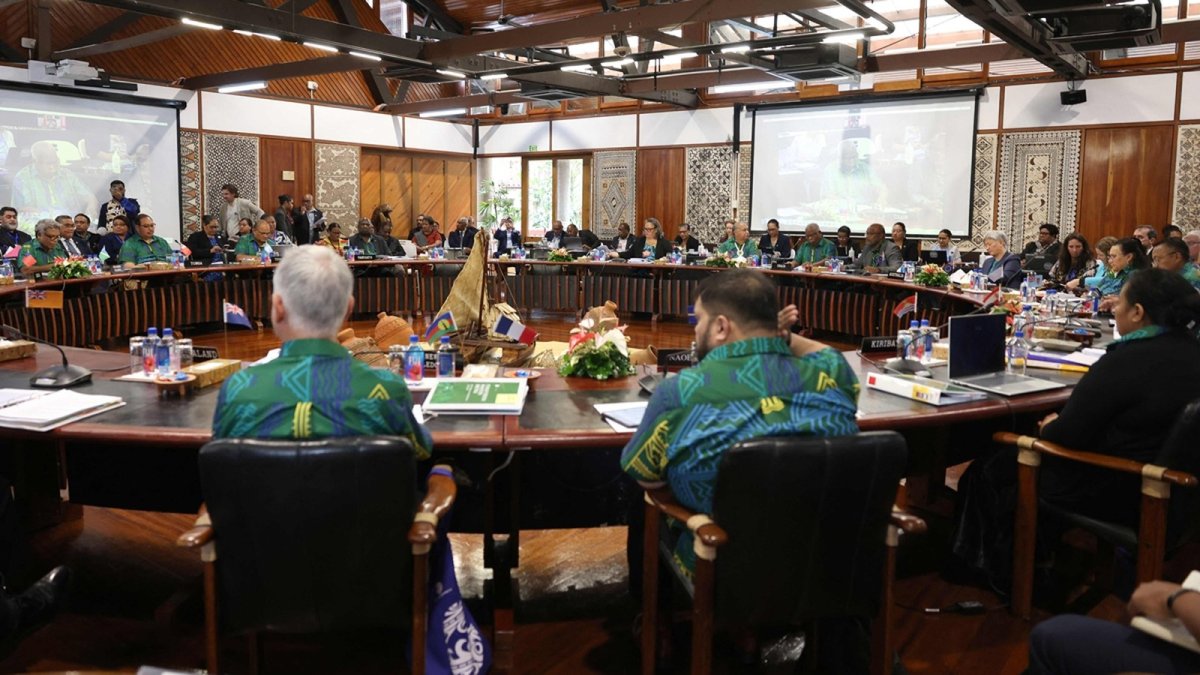
The Pacific Islands Forum has long prided itself on consensus — the principle that 18 island nations, however small, speak with one voice. That voice fractured in Suva on Friday. When foreign ministers gathered to confront China's first-ever submarine-launched ballistic missile test into the Pacific Ocean, two members — Nauru and Kiribati — used the forum's unanimity rule to block any joint condemnation, exposing the deepest strategic fault line the Pacific bloc has faced in a generation.
Pacific Forum Fractures as Nauru and Kiribati Block China Missile Condemnation
Suva, Fiji — The Pacific Islands Forum's 18 foreign ministers failed on August 7 to agree on a joint response to China's July missile test, with New Zealand accusing unnamed members of deferring to an outside power. The episode threatens to destabilise the region's premier diplomatic institution ahead of its leaders' summit in Palau next month.
The Suva Meeting and Its Immediate Outcome
Pacific Islands Forum foreign ministers gathered in Suva, Fiji, on August 7, 2026, but concluded their session without a joint statement condemning China's July missile test. The 18-member body operates under a consensus model, and that requirement prevented any unified text from emerging after hours of discussion. The final communique will remain silent on the test, with members agreeing only to continue talks ahead of the leaders' meeting in Palau in early September.
New Zealand's Direct Criticism of Internal Divisions
New Zealand Foreign Minister Winston Peters expressed clear frustration at the outcome. He identified two unnamed countries that had blocked the statement without offering substantive reasons, describing their stance as lacking logic and amounting to a veto through the consensus rule. Peters stated that the Pacific way does not permit such use of procedure and accused the positions of reflecting outside partners' wishes rather than those of Forum members who have lived in the region for thousands of years. He emphasized the need to keep the Pacific a peaceful blue continent.
Australia's Call for Collective Responsibility
Australian Foreign Minister Penny Wong urged Pacific ministers to show leadership on the issue. She highlighted the majority view among Pacific leaders regarding concerns over the ballistic missile test, including the need for respect for sovereignty, transparency, and prior notification. Wong framed the discussion as a shared duty to protect peace, stability, and security across the region, pressing for a visible collective response.
Nauru and Kiribati's Positions and Their Ties to Beijing
Officials familiar with the closed-door talks identified Nauru and Kiribati as the two countries that withheld support. Both nations have strengthened relations with Beijing in recent years. One regional official described Kiribati's emphasis on consensus as inconsistent with the prevailing sentiment in the room. The absence of a statement leaves the matter unresolved until the Palau gathering.
The diplomatic alignments of Nauru and Kiribati with Beijing are rooted in infrastructure financing and security cooperation that deliver tangible domestic returns for small-island leaderships. Nauru's 2024 recognition switch from Taipei unlocked immediate Chinese development funding for port upgrades and public works, while Kiribati's 2023 police and security cooperation agreement opened channels for training and equipment that bolster internal stability without requiring large local budgets. These arrangements provide Pacific elites with visible projects that address chronic infrastructure deficits and employment shortfalls, reinforcing political legitimacy at home where electoral margins often hinge on delivering external resources rather than abstract regional principles.
Within the Pacific Islands Forum's consensus framework, such bilateral dependencies translate into structural veto power for the smallest members. An 18-nation body operating under unanimity rules elevates the influence of states whose populations number in the tens of thousands, allowing them to withhold endorsement on security matters even when a clear majority favors collective language. This procedural reality amplifies Beijing's leverage through targeted outreach, as the absence of a single voice can stall statements that larger partners like Australia and New Zealand seek to advance, thereby preserving space for continued bilateral engagement without public regional friction.
Reactions from Nations Closest to the Impact Zone
Tuvalu Permanent Secretary Pasuna Tuaga noted that the missile landed near Tuvalu's exclusive economic zone and that his country had sought assistance from multiple powers, including the United States and China, to locate the dummy warhead. Tuvalu had received no advance notice and called for a strong collective Pacific statement to reinforce its position against intimidation. Papua New Guinea Foreign Minister Justin Tkatchenko acknowledged China's role as a major economic partner yet described the test as unhelpful and negative for the region overall.
Tuvalu's position illustrates the acute vulnerability of small states lying directly astride the test impact corridor. The dummy warhead's splashdown near its exclusive economic zone, without prior warning, prompted immediate appeals to both Washington and Beijing for recovery assistance, highlighting the practical limits of non-alignment when major powers conduct live demonstrations overhead. As one of the remaining Taiwan-recognizing Forum members, Tuvalu faces compounded pressure: its call for a unified Pacific statement against intimidation reflects not only sovereignty concerns but also the risk that future tests could further erode the diplomatic space available to states maintaining relations outside Beijing's preferred framework.
Papua New Guinea's measured response captures the wider balancing dilemma confronting larger regional actors. While acknowledging China as its principal economic partner and trade counterpart, Foreign Minister Tkatchenko characterized the unannounced launch as counterproductive to collective stability. This stance echoes earlier Solomon Islands decisions to restrict partner attendance at leaders' meetings, illustrating how bilateral economic ties can coexist with quiet reservations about military signaling that threatens to polarize the Forum and complicate efforts to maintain an inclusive regional security dialogue.
China's SLBM Launch and Deterrence Objectives
On July 6, 2026, a People's Liberation Army Navy Type 094A Jin-class submarine fired a JL-3 submarine-launched ballistic missile from the South China Sea. The missile carried a training warhead and impacted international waters between Solomon Islands, Nauru, and Tuvalu. This marked the first Chinese SLBM test into such waters and only the third overall Chinese ballistic missile test in international waters since 1980. Beijing provided limited advance notice to a handful of countries, with some receiving as little as 30 minutes' warning, falling short of the 24-hour recommendation in the Hague Code of Conduct. Chinese officials described the launch as compliant with international law and aimed at demonstrating minimum deterrence requirements.
The July 2026 JL-3 launch from a Type 094A Jin-class submarine marked a qualitative step in China's sea-based deterrent posture, extending credible reach across the central Pacific for the first time. With an estimated range of 10,000 to 12,000 kilometers, the third-generation missile enables submerged patrols to hold distant targets at risk while remaining within protected bastions closer to home waters. The launch signals an operational maturation of the submarine force that aligns with accelerated construction rates documented in successive IISS assessments, narrowing the gap between declared minimum deterrence and actual second-strike capacity.
Strategic Leverage and Second-Order Effects Across the Indo-Pacific
China's expanding infrastructure and security ties in the Pacific give it leverage over several Forum members, allowing subtle influence on consensus outcomes. This dynamic complicates efforts by Australia, New Zealand, and the United States to maintain unified regional positions. For Taiwan's remaining Pacific diplomatic partners, such as Palau and Tuvalu, the episode underscores risks of isolation if Beijing continues to press for exclusion of certain actors from future meetings. A proposed regional security treaty floated by the Solomon Islands could further fragment unity if larger powers exploit bilateral channels to divide smaller states.
Outlook Ahead of the Palau Leaders' Meeting
PIF Secretary General Baron Waqa expressed hope that shared commitments to the Ocean of Peace declaration would still produce a strong regional message. Discussions will now shift to Palau, where decisions on partner participation and any further response to the missile test will test whether internal divisions can be overcome. The episode illustrates how Beijing's deterrence signaling intersects with its diplomatic outreach, shaping the Pacific's role in wider US-China strategic competition.
The September 2026 gathering in Palau will test whether the Forum can reconcile internal divisions before they harden into lasting fractures. As one of the few remaining Taiwan-recognizing states situated roughly 800 kilometers west of the Philippines, Palau's hosting role places the missile-test issue at the center of debates over partner participation and the proposed regional security treaty advanced by the Solomon Islands. Professor Steve Ratuva's warning that such instruments risk being weaponized against individual sovereignty underscores the sensitivity surrounding any text that might constrain bilateral choices or invite external vetoes over domestic policy.
Parallel defense initiatives, including the New Zealand-Papua New Guinea agreement signed on 5 August and Wellington's exploration of deeper ties with the Fiji-Australia arrangement following the Ocean of Peace declaration, suggest that like-minded members are already hedging against Forum paralysis. Whether these tracks can generate sufficient momentum to address the missile test before leaders convene, or whether the episode remains an unresolved fault line dividing consensus-oriented small states from those favoring explicit collective positions, will determine the Forum's relevance in managing great-power competition across the Pacific.
By Prof. Marcus Chen, Staff Writer
This article was produced with AI-assisted research and editorial support. Reporting is based on sources cited in the article.
What's Your Reaction?
 Like
0
Like
0
 Dislike
0
Dislike
0
 Love
0
Love
0
 Funny
0
Funny
0
 Wow
0
Wow
0
 Sad
0
Sad
0
 Angry
0
Angry
0

World Politics Analyst at Global1.News. Based in Beijing, covering US-China relations, global trade, and geopolitical strategy. Brings deep analytical perspective to the power dynamics shaping international affairs.













Comments (0)