
Nvidia Just Guaranteed the Price of Used GPUs — and the Secondhand Market Just Became the AI Economy's Floor
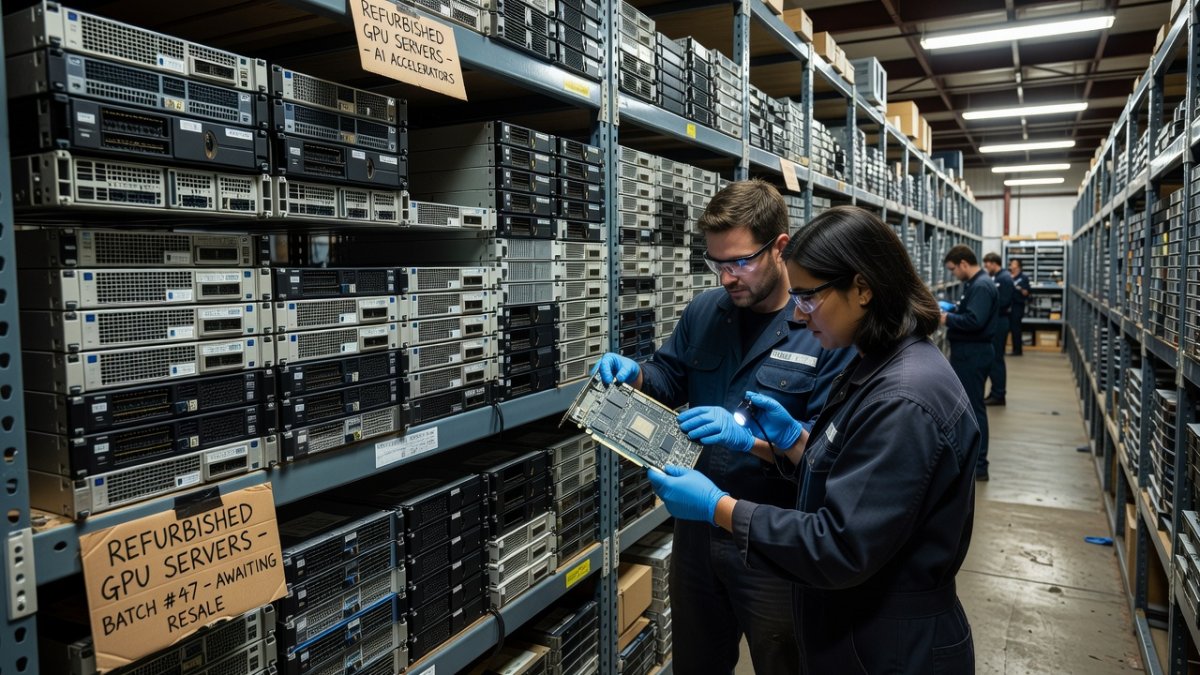
Nvidia is covering up to 25% of the value of older GPUs used as loan collateral, betting AI hardware ages like railroads, not PCs. The used GPU market — H100s down from a $50K peak, Wall Street-backed marketplaces, refurbished servers at 40-70% off — has become the AI economy's collateral floor.
Nvidia Just Guaranteed the Price of Used GPUs — and the Secondhand Market Just Became the AI Economy's Floor
Let me tell you something that's been sitting with me since Wednesday. Nvidia — the richest chip company on earth — just started guaranteeing the resale value of its OLD chips. Not the new ones. The ones already sitting in racks, the ones this industry has spent three years treating like disposable gold.
I've been buying and selling server hardware for over a decade. I remember when the secondary GPU market meant gamers fighting over used cards, then crypto miners flooding the channel with dead ones. Nobody serious bought used data center gear back then — you didn't know the history, and a fried GPU is a very expensive paperweight.
That world is over. This week, the secondhand GPU market became the collateral floor of the AI economy — and Nvidia put its own balance sheet behind it. If you run hosting infrastructure, understand what just happened, because it changes the economics of every server you'll ever buy again.
The News Peg — Nvidia Just Guaranteed Old Chips Keep Their Value
Here's what happened. Nvidia has been building a $500 billion-plus financing program with six major Wall Street firms to fund AI data centers, chip factories, and power stations. The Guardian and CNN covered the broad strokes August 11. But the detail that matters landed August 13, in TechCrunch: Nvidia agreed to guarantee, with its own money, that chips used as collateral in these deals retain their value.
Read the mechanism carefully. If a data center owner defaults on a loan and the lender has to liquidate — but the GPUs can't fetch the price the books say they should — Nvidia covers up to 25% of the difference. That's not a marketing program. That's a floor under the price of used Nvidia hardware, written by the company that makes the hardware.
Wall Street noticed. The bond market got spooked enough that Jensen Huang had to go on X and business TV to explain how Nvidia's risk is limited. His defense is the whole thesis in one line: "Is this circular financing? This initiative is designed to address that concern. We are bringing independent, long-term institutional capital into the AI infrastructure market."
Here's where it gets interesting. Huang isn't just protecting lenders. He's arguing AI servers are "AI factories" — assets that age like railroads and airlines, not like PCs. His words: "When needs change, the factory can be used by another customer, another cloud or another operator. This broad ecosystem gives NVIDIA compute a deep market of potential users and offtakers, helping protect residual value."
Read that again. The chip company is telling you its chips are investments that hold value, not depreciating electronics. No hardware vendor has ever made that claim with a straight face — and he's backing it with a guarantee.
The Secondhand Market Just Got Institutionalized
The used GPU market stopped being a discount bin years ago. It's a functioning, financed, warrantied marketplace — and it's enormous.
At the peak of H100 scarcity in mid-2024, used and refurbished units traded as high as $50,000 per GPU. Supply normalized, and by mid-2026 refurbished H100s sit between $21,000 and $34,000 — against $25,000 to $40,000 for new units. The A100, now six years old, is one of the most actively traded enterprise GPUs on the planet: 40GB units run roughly $8,000 to $12,000, with listings from about $7,800 refurbished up to $18,900 for an 80GB card.
At the server level it gets even better. A used 8-GPU H100 server trades around $150,000 to $180,000; a new B300 server runs about $500,000. Refurbished GPU servers from established vendors offer 40% to 70% savings over new OEM systems. That's the difference between a business case and no business case.
The market built real infrastructure around itself. ITAD vendors like Procurri and Bitpro specialize in buying, testing, and reselling hyperscaler surplus; resellers like Alta Technologies have been doing this for 30 years. Roughly a third of AI workloads now run on neoclouds — much of that capacity built on used hardware.
On July 17, the market took another step toward Wall Street respectability: Compute Exchange — co-founded by Don Wilson, the founder of trading firm DRW Holdings — launched a dedicated venue for used and refurbished GPUs. Buyers submit requests ranging from hundreds to tens of thousands of GPUs. CEO Carmen Li of Silicon Data put it plainly: "Not every workload requires the newest generation of GPUs."
Why the Used Market Is Exploding Right Now
Three forces are colliding in real time.
First: new hardware is brutally expensive and supply-constrained. HBM memory is short 30% to 70% of demand across the industry. DRAM costs are up about 15% versus late 2025. A new B200 runs $30,000 to $50,000 per unit; a DGX B300 cluster unit lists at $300,000 to $350,000. When the new stuff is both scarce and astronomically priced, the used market becomes the rational option, not the poor man's one.
Second: cloud rental prices have collapsed. H100 instances went from roughly $7 to $10 an hour at launch in 2023 to about $2 to $4 an hour by late 2025, with spot dipping below $2. The margin that used to justify new hardware at any cost has evaporated. When rental rates fall, the whole game becomes utilization and cost per hour — and that math favors older chips.
Third: the B200 transition is about to flood the market. Enterprises and hyperscalers that locked A100 and H100 into multi-year contracts in 2023 and 2024 are watching those contracts expire this year. As they migrate to Blackwell, their Hopper and Ampere fleets hit the secondary market through ITAD channels. Second-half 2026 is going to bring a wave of H100 inventory — supply is coming, demand is proven, and prices are going to move.
The Secondary Bottleneck Nobody's Talking About — Residual Value Risk
Here's what keeps me up at night, the part the headlines keep missing. Nvidia's guarantee doesn't eliminate risk — it converts it into what financiers call "wrong way" risk: Nvidia's obligations grow exactly when its own business weakens. If AI demand cools, chip sales slow, used prices fall, the guarantees trigger, and Nvidia writes checks at the precise moment its revenue shrinks.
The Lucent comparison hangs over all of this. Lucent lent its customers money to buy its gear, then rode the dotcom crash into the ground. Huang's answer: Lucent financed customers with its own balance sheet, while this program brings independent institutional capital in. That's true — up to a point. But the residual-value guarantee still puts Nvidia's money on the line.
And there's an uncomfortable moment hiding in plain sight. Microsoft CEO Satya Nadella — during an earnings call, mind you — recommended a book called "1873." It's about the railroad-era financial engineering that crashed the American economy. The AI factories are being financed like railroads. The question is whether they'll hold value like railroads, or end like the buggy whip business the moment something better comes along.
That's the real bet. Nvidia is betting its balance sheet that AI compute ages like infrastructure, not like electronics. Every secondhand GPU price from here on is a referendum on that bet.
What This Means for Independent Hosting Providers
Okay. Enough macro. Here's what I'd actually do tomorrow if I ran a hosting or colo business.
First — start treating the secondary market as a leading indicator, not a bargain bin. The price of used H100s and A100s is now the fastest honest signal of whether the AI buildout is overbuilt. If used prices firm up, demand is real. If they crater, the correction is coming before the headlines admit it. Check the indices weekly. This is your canary.
Second — buy certified refurbished for inference and fine-tuning workloads. You don't need a B200 to serve a 13-billion-parameter model; a used A100 80GB handles a big slice of production inference at a fraction of new hardware cost. Buy from vendors who test, warranty, and document provenance — the market has matured but still has plenty of bad actors. Insist on testing records and a real warranty, not just a good price.
Third — don't sign leases or long-term contracts priced on new-hardware economics. With H100 rental rates at $2 to $4 an hour and falling, and a flood of used supply coming in the second half of this year, the days of paying a premium for scarcity are ending. Negotiate like you know the hardware is depreciating — because, Nvidia's guarantee or not, it is.
Fourth — get ready to be the offtaker. Huang's "AI factory" thesis depends on a deep market of secondary users for aging chips. That's you. When hyperscalers rotate Blackwell into their fleets, the H100s and A100s hitting the market are your chance to build capacity at 40% to 70% below new prices. The independent hosting sector is the safety valve that makes Nvidia's residual-value story work.
The Structural Reality — This Market Is Permanent Now
Step back and look at what actually changed. Nvidia's incentive structure just flipped. For the first time, the most powerful hardware company on earth has a financial reason to make sure its old chips keep their value. The used market isn't a side effect of the AI boom anymore — it's a designed feature.
That's why the secondhand market is going to be permanent. The infrastructure — ITAD vendors, marketplaces, financing, warranties — is built, price discovery is real, and now the vendor itself is underwriting the floor. This isn't a fad that fades when the hype cools. It's the AI economy building its own aftermarket, the way every industrial economy before it did.
The Bottom Line
Nvidia just told the world its chips are collateral, not commodities. The guarantee is a bet that AI factories age like railroads — and every used GPU sold from here on tests that bet in real time.
For independent hosting providers, this is the most interesting moment in years. The hardware you thought you'd never afford is about to be available at prices that actually make sense — if you buy smart and understand what you're really buying. You're not just buying a chip. You're buying into Nvidia's bet that the AI buildout holds its value. I don't know if that bet wins. But I know the secondary market is now the place where we find out — and I'd rather be a buyer in that market than a lender betting against it.
— Allan Ali, Founder
This article was produced with AI-assisted research and editorial support. Sources: TechCrunch (Aug 13, 2026), The Guardian (Aug 11, 2026), SiliconANGLE (Jul 17, 2026), Hashrate Index (Apr 2026), TBR Trade Group GPU Market Update (Q2 2026).
What's Your Reaction?
 Like
0
Like
0
 Dislike
0
Dislike
0
 Love
0
Love
0
 Funny
0
Funny
0
 Wow
0
Wow
0
 Sad
0
Sad
0
 Angry
0
Angry
0

Publisher of Global1.News. Automation architect, systems builder, and the guy making sure the truth gets published.













Comments (0)