
Nepal-Tibet Border Flood Disaster: Death Toll Surpasses 500, Over 2,500 Missing After Glacial Lake Outburst
Catastrophic flash floods from a glacial lake outburst on the Nepal-China border have killed over 500 people, with more than 2,500 missing. Rescue efforts are hampered by a new threat of a barrier lake breach, as the region faces one of its worst disasters in years.
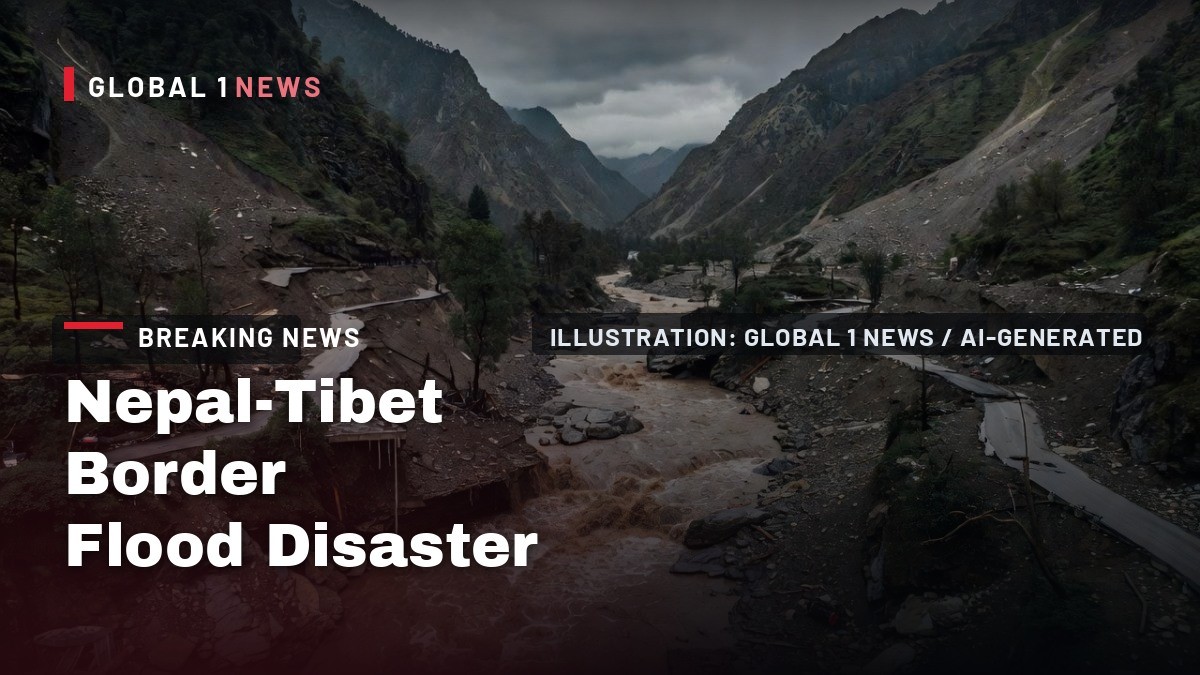
Nepal-Tibet Border Flood Disaster: Death Toll Surpasses 500, Over 2,500 Missing After Glacial Lake OutburstThe catastrophic flash floods and mudslides that obliterated mountain communities along the Nepal-China border on Wednesday, August 26, 2026, have escalated into one of the deadliest natural disasters in the Himalayas in recent memory. As of Friday, August 28, Nepal’s official death toll has climbed to 538, according to The Guardian, while AFP reports that police figures place the number at 579 dead on the Nepalese side alone. With more than 2,500 people still unaccounted for, the true scale of this tragedy is only beginning to emerge from the thick, dark mud that now covers entire villages.
A Wall of Water and Mud: The Moment of Impact
The disaster was triggered by a glacial lake outburst, a sudden and violent release of water from a high-altitude lake following a glacier collapse. The resulting surge, described by eyewitnesses as a wall of water and mud several stories high, tore through the steep river valleys with terrifying speed. Verified CCTV footage captured the sheer destructive force of the flood as it slammed into the Gyirong Port border crossing between Nepal and Tibet, sweeping away buildings, vehicles, and infrastructure in a matter of seconds.The footage, authenticated by multiple news organizations including CNN and Al Jazeera, shows the port facility being overwhelmed by a churning torrent of brown water and debris. The border crossing, a vital artery for trade and travel between the two nations, has been effectively destroyed. Contact with the port had still not been fully re-established as of Friday evening, leaving a communications black hole in the heart of the disaster zone.The flood struck with almost no warning on Wednesday morning, catching residents, trekkers, and workers completely off guard. In the Nuwakot District of Nepal, particularly around Devighat and Bidur Municipality, the confluence of the Trishuli and Tadi rivers became a killing zone. The Rasuwagadhi border area, a popular entry point for pilgrims heading to Tibet's sacred Mount Kailash, was also heavily impacted, with entire trekking parties swept away.Death Toll Climbs: A Grim Tally of Loss
The human cost of this disaster is staggering and continues to rise with each passing hour. Nepal's official death toll stood at 538 on Friday, a figure that has more than doubled since Thursday morning when the count was just over 360. AFP reports that police on the ground have put the number even higher, at 579 dead. On the Chinese side of the border, authorities have confirmed 5 deaths, and the South China Morning Post reports the combined death toll across both sides is nearly 600.The injured number at least 466 in Nepal, according to CNN, with hospitals in the region overwhelmed by the influx of trauma cases. Many of the injured were pulled from the debris covered in dark brown mud, having survived by clinging to trees, rooftops, or any other anchor they could find as the floodwaters raged around them. Rescue workers describe harrowing scenes of families torn apart, with children separated from parents and entire communities wiped out in a matter of minutes.The discrepancy in the death toll figures reflects the chaos and difficulty of the rescue operation. With entire villages buried under meters of mud and debris, and with communication lines severed, authorities are struggling to get an accurate picture of the devastation. The Nepalese government has acknowledged that the final death toll could be significantly higher, as search teams continue to dig through the wreckage.Over 2,500 Missing: The Agonizing Wait for Answers
Perhaps the most agonizing aspect of this disaster is the sheer number of people still missing. CNN reports that more than 2,500 people remain unaccounted for, a figure that has grown dramatically as the scale of the destruction has become clearer. Nepal's disaster relief agency has doubled its estimate to 1,900, a revision driven by the addition of some 900 workers from hydropower projects along the Trishuli River corridor who have not been heard from since the flood struck.The Guardian reports that Nepal's disaster authority added 933 hydropower workers to a missing list that already included trekkers and pilgrims to Mount Kailash. These workers, employed at various dam and power plant construction sites along the river, were likely in the direct path of the flood when it hit. The Trishuli River corridor, a key economic zone for Nepal's energy sector, has been heavily damaged, with multiple hydropower projects destroyed or severely compromised.On the Chinese side, the situation is equally dire. In Gyirong County, 558 people are missing, 260 of them foreign nationals. China's Foreign Ministry has also reported that 100 Chinese nationals are missing on the Nepalese side of the border. The international dimension of this tragedy is profound, with trekkers and pilgrims from around the world caught in the disaster zone. Sky News reports that around 300 foreign nationals are among the missing, including at least 33 Britons. The Star reports that 9 Singaporeans are among 517 foreigners out of contact, while Nepal's tourism ministry earlier stated that 403 tourists, including 341 foreigners, were unaccounted for.Race Against Time: Rescue Efforts Underway
Despite the overwhelming odds, rescue teams are working around the clock to find survivors. Nepal police report that 3,742 people have been rescued so far, a testament to the determination of the emergency services. A total of 4,348 police officers have been deployed to the affected areas, with 28 Nepali police officers themselves listed as missing. International rescue teams have joined the effort, bringing specialized equipment and expertise to the search operation.Helicopters have been ferrying stranded people to safety, lifting them from rooftops and hillsides where they sought refuge from the floodwaters. On the ground, rescuers are digging through the mud with their bare hands and shovels, desperately searching for signs of life. There have been moments of joy amidst the tragedy: a mother was reunited with her 8-year-old child who survived by climbing trees as the floodwaters rose. A California couple, who were in the region on a trekking holiday, recounted their harrowing survival story to reporters, describing how they clung to a hillside for hours as the water raged below.However, the rescue operation has been complicated by a new and terrifying threat. A barrier lake, formed by the mudslide damming a river, is threatening to breach. Nepal and China briefly halted rescue operations as the barrier lake overflowed, with Chinese authorities warning that the lake could breach at any moment. Rescuers were ordered to head to safety as a precaution, highlighting the volatile and dangerous conditions in the disaster zone. The Trishuli River corridor remains heavily damaged, and the risk of further flooding is a constant concern.Downstream Fears: India on High Alert
The threat from this disaster extends far beyond the immediate border region. Bloomberg reports that India has been placed on high alert for potential downstream flooding in its border states. The rivers that have been devastated by the glacial lake outburst flow south through Nepal and into India, and the sudden surge of water and sediment could cause flooding in low-lying areas further downstream.Nepal and China have a disaster risk reduction and emergency response cooperation agreement, and under this framework, China has agreed to inform Nepal as soon as water flows begin to rise on its side of the border. This early warning system is now being put to the test, as authorities on both sides monitor river levels and prepare for potential secondary disasters. The Indian government has activated its disaster management machinery in the northern border states, urging residents in vulnerable areas to be prepared for possible evacuation.The downstream concern is not just about immediate flooding. The massive amount of sediment and debris carried by the floodwaters could alter river channels and increase the risk of future flooding. The long-term environmental and economic impact on the region is likely to be significant, affecting agriculture, infrastructure, and livelihoods for years to come.Leaders Respond: Xi Jinping Pledges Full Effort
The political response to the disaster has been swift, with leaders on both sides of the border expressing their condolences and pledging support. China's President Xi Jinping has stated that "the most urgent task is doing everything possible to search for and rescue the missing people," according to state broadcaster CCTV. His comments underscore the gravity of the situation and the priority being placed on the rescue operation.Nepal's government has declared the affected areas as disaster zones and has mobilized all available resources for the relief effort. The international community has also offered assistance, with rescue teams and humanitarian aid beginning to arrive in the region. The disaster has highlighted the vulnerability of the Himalayan region to the impacts of climate change, with glacial lake outburst floods becoming an increasingly frequent and deadly phenomenon.The cooperation between Nepal and China in the rescue effort, despite the political sensitivities of the border region, has been notable. The two countries are working together to coordinate search and rescue operations, share information, and manage the complex logistics of delivering aid to remote and inaccessible areas. This spirit of cooperation will be essential in the difficult days and weeks ahead.A Pattern of Tragedy: The Growing Threat of Glacial Floods
This disaster is not an isolated event but part of a deeply troubling pattern. The Himalayas are warming at a rate faster than the global average, causing glaciers to retreat and glacial lakes to expand. These lakes, held back by fragile moraine dams, are becoming increasingly unstable. When they breach, the results are catastrophic, as witnessed this week.This is one of Nepal's worst flood disasters in years, following a series of deadly glacial lake outburst floods across the region. Scientists have long warned that these events would become more frequent and more severe as climate change accelerates. The tragedy unfolding on the Nepal-China border is a stark reminder of the human cost of a warming planet, and it raises urgent questions about preparedness, early warning systems, and the future of development in high-risk mountain valleys.The loss of life is a profound tragedy, and the search for the missing continues. But even as the rescue operation proceeds, the world must confront the uncomfortable truth that this is likely not a one-off event. The mountains are changing, and the risks are growing. The question now is whether the nations of the region, and the global community, can learn from this catastrophe and take the necessary steps to prevent the next one.By Jessica Ali, Staff WriterThis article was produced with AI-assisted research and editorial support. Sources: CNN, The Guardian, The New York Times, Bloomberg, Al Jazeera, France 24, Sky News, AFP, Kathmandu Post, SCMP, ReutersWhat's Your Reaction?
 Like
0
Like
0
 Dislike
0
Dislike
0
 Love
0
Love
0
 Funny
0
Funny
0
 Wow
0
Wow
0
 Sad
0
Sad
0
 Angry
0
Angry
0

Jessica Ali
Editor-in-Chief at Global1.News. Atlanta-based journalist who cuts through the BS and tells it like it is. Lead anchor, host, and the voice you hear when the spin stops and the truth starts.














Comments (0)