
NASA's Roman Space Telescope Soars Into Orbit, Opening a New Era of Cosmic Discovery
Seven twenty-six on a Sunday morning. A Florida sky that couldn't quite make up its mind. And 5 million pounds of thunder rolling across the Space Coast.
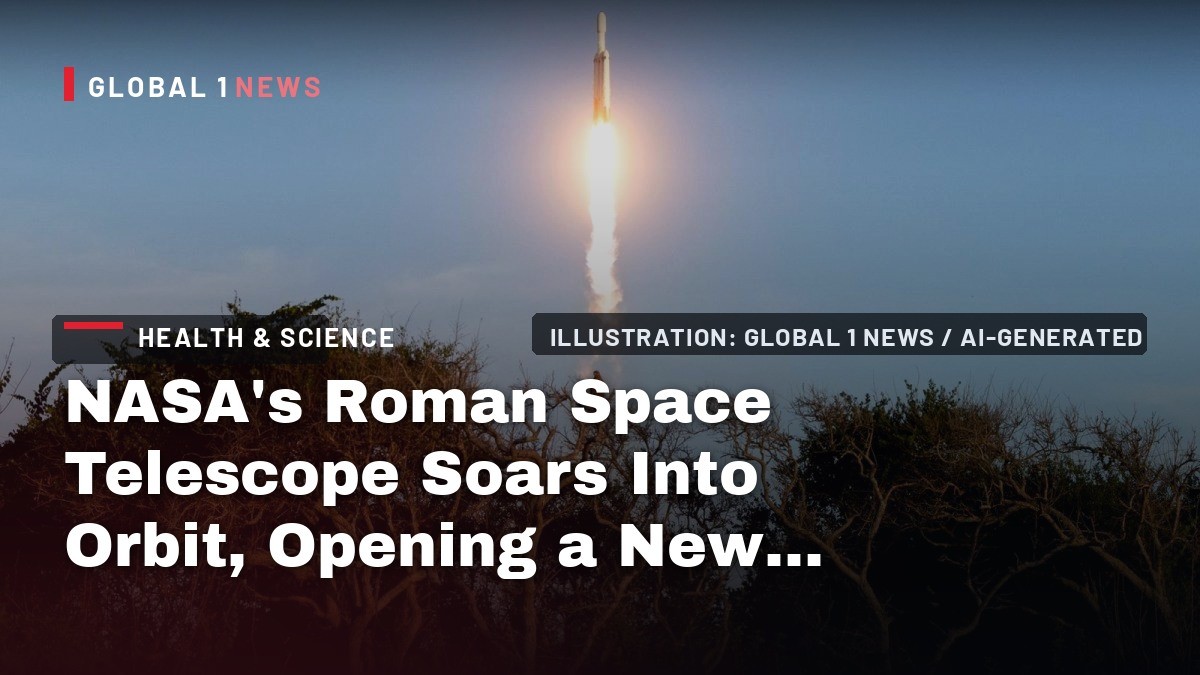
Seven twenty-six on a Sunday morning. A Florida sky that couldn't quite make up its mind. And 5 million pounds of thunder rolling across the Space Coast.
That was the scene as NASA's Nancy Grace Roman Space Telescope — the agency's next great observatory — roared off Launch Complex 39A at Kennedy Space Center, leaving Earth behind for a destination nearly a million miles away. Folks, this one was worth waking up early for.
NASA's Roman Space Telescope Soars Into Orbit, Opening a New Era of Cosmic Discovery
Cape Canaveral, Florida — The launch was picture-perfect. At 7:26 a.m. EDT Sunday, a SpaceX Falcon Heavy rocket ignited all 27 of its Merlin engines, generating more than 5 million pounds of thrust and lifting the $4.3 billion observatory off the pad and into the morning sky. The center booster, designated B1072, was making its third flight — and it returned to service just 122 days after its previous mission, a rapid turnaround that speaks to the maturity of SpaceX's reusable rocket fleet.
By about 8:00 a.m. EDT, the spacecraft had separated from the Falcon Heavy's upper stage and was flying on its own, solar arrays deployed, heading for deep space. The mood in mission control was electric. The telescope — about the size of a tour bus — is now on a roughly month-long cruise to a gravitational parking spot called Sun-Earth Lagrange Point 2, or L2, located about 1.5 million kilometers (930,000 miles) from Earth. That's more than three times the distance to the Moon.
A Flawless Liftoff
It wasn't a sure thing until the very end. The Launch Readiness Review was held Friday, Aug. 28, and the final "go/no go" poll came down to the wire. Weather forecasters gave only about a 50% chance of favorable conditions at the scheduled launch time — a coin flip, essentially. But the clouds parted, the winds cooperated, and the Falcon Heavy delivered.
The launch itself was a spectacle. The 27 Merlin engines lit up the pad in a blaze of orange and white, and the sound — a deep, rolling rumble that you feel in your chest — carried for miles across the Atlantic coastline. For a mission that has been in development for over a decade, the flawless liftoff was a moment of pure relief and exhilaration for the thousands of scientists, engineers, and space enthusiasts who have poured their careers into this project.
Roman launched ahead of its original schedule, a rare and welcome surprise in an industry where delays are the norm. The team will now spend the next month commissioning the telescope while it cruises toward L2, checking out its systems, calibrating its instruments, and preparing for the science that lies ahead.
Why Roman Matters
To understand why this mission matters, you have to look back at what came before. Hubble gave us the deep field — a tiny patch of sky packed with thousands of galaxies. James Webb gave us infrared vision into the earliest moments of the universe. Roman, named after NASA's first chief of astronomy, is designed to do something different: it will map the cosmos on a scale that makes its predecessors look like pinhole cameras.
NASA has called Roman the agency's next great observatory, following in the footsteps of Hubble and Webb. And that's not hyperbole. The telescope's primary mirror is 2.4 meters (7.9 feet) in diameter — the same size as Hubble's mirror. But that's where the similarities end. Roman's Wide Field Instrument has a field of view about 100 times larger than Hubble's infrared view. One hundred times. That means a single Roman image captures what would take Hubble hundreds of pointings to cover.
This is a survey machine. It will scan enormous swaths of the sky, creating panoramic views of the universe that scientists will use to tackle some of the biggest questions in modern astrophysics: What is dark energy, and why is the expansion of the universe accelerating? What is dark matter, and how does it shape the formation of galaxies? How did galaxies evolve over cosmic time, and what does the structure of our own Milky Way look like from the inside out?
The 'Mother of Hubble'
The telescope's name carries weight. Nancy Grace Roman was NASA's first chief of astronomy, a trailblazer who fought for decades to make the Hubble Space Telescope a reality. She was known as the "Mother of Hubble" — a title she earned through sheer persistence, scientific vision, and an unwavering belief that a space-based observatory could revolutionize our understanding of the universe.
Roman joined NASA in 1959, just a year after the agency was founded. At a time when women in science were rare and often overlooked, she rose to lead NASA's astronomy programs, championing the idea of a large space telescope when most people thought it was science fiction. She navigated the bureaucracy, secured the funding, and built the coalition of scientists and engineers that would eventually deliver Hubble to orbit in 1990.
She passed away in 2018, but her legacy lives on in this telescope. It's fitting that the observatory bearing her name is designed to look deeper and wider than anything that came before it — because that's exactly what she did throughout her career. She pushed boundaries. She broke barriers. And now, her namesake will push the boundaries of what we know about the universe.
A Field of View 100 Times Wider
Let's talk about that Wide Field Instrument, because it's the heart of this mission. Imagine taking a photograph of a crowd — Hubble gives you a tight portrait of a few faces. Roman gives you the entire stadium. The field of view is about 100 times larger than Hubble's infrared view, which means Roman can map the sky at an unprecedented pace.
This capability is critical for studying dark energy, the mysterious force that is causing the expansion of the universe to accelerate. Scientists don't know what dark energy is — they just know it exists, and it makes up roughly 68% of the universe. Roman will measure the effects of dark energy on the large-scale structure of the cosmos by surveying billions of galaxies, mapping their positions and distances with extraordinary precision.
Dark matter is another target. It doesn't emit, absorb, or reflect light, but it makes up about 27% of the universe. Roman will use gravitational lensing — the bending of light by massive objects — to map the distribution of dark matter across the cosmos. By observing how light from distant galaxies is distorted by intervening dark matter, scientists can create a three-dimensional map of where this invisible substance lurks.
And then there's the Milky Way. Roman will turn its gaze inward, surveying our own galaxy to study its structure, star formation, and the populations of stars that make up its spiral arms. It's one thing to study distant galaxies; it's another to understand the one we call home.
Hunting for Exoplanets
Roman's second instrument, the Coronagraph Instrument, is a technology demonstration with a big job: blocking starlight to directly image exoplanets. This is incredibly difficult. A planet orbiting a star is like a firefly next to a searchlight — the star's light overwhelms everything around it. The coronagraph uses a series of masks and mirrors to block that light, allowing the faint glow of orbiting planets to shine through.
Direct imaging is a key step toward studying planets in other solar systems. Most exoplanets are discovered indirectly — by the slight dimming of a star as a planet passes in front of it, or by the tiny wobble the planet induces in its star's motion. But direct imaging lets scientists actually see the planet, analyze its light, and determine what its atmosphere is made of. That's how we'll find out if a distant world has water vapor, methane, or even signs of habitability.
The Coronagraph Instrument is a pathfinder. It will demonstrate the technology needed for future missions to search for habitable worlds — planets that might harbor life. It's a stepping stone, but it's a critical one. Every exoplanet image Roman captures will be a first step toward answering one of humanity's oldest questions: Are we alone?
What Happens Next
Roman is now on its way to L2, the same region of space where the James Webb Space Telescope resides. L2 is a gravitational balance point where the Sun and Earth's gravity combine to create a stable location for a spacecraft to orbit — a prime spot for observing the universe without the interference of Earth's atmosphere or the glare of the Sun.
The cruise will take about a month. During that time, the team will commission the telescope — turning on instruments, calibrating optics, and running through a checklist of tests to ensure everything is working as designed. After reaching L2, Roman will begin a months-long commissioning phase before science operations begin. That's the careful, methodical work that turns a spacecraft into an observatory.
It won't be instant. There will be weeks of calibration, testing, and fine-tuning. But when Roman opens its eyes for the first time, the images will be worth the wait. The first light images — the first scientific observations — will be a moment of triumph for everyone who has worked on this mission.
The Bigger Picture
Roman is more than a telescope. It's a time machine. It will look back billions of years, capturing light that has been traveling across the universe since long before Earth existed. It will see galaxies in their infancy, watch them grow and merge and evolve into the structures we see today. It will map the invisible forces that shape the cosmos — dark energy and dark matter — and it will search for other worlds that might, just might, be like our own.
This is what Nancy Grace Roman fought for. This is what Hubble started and Webb continued. And now, Roman will take the next giant leap. The launch was flawless. The journey has begun. And in a few months, when the telescope starts returning data, we will see the universe in a way we have never seen it before.
Stay tuned, folks. The best is yet to come.
By Jessica Ali, Staff Writer
This article was produced with AI-assisted research and editorial support. Sources: NASA, JPL, NPR, Al Jazeera, The Planetary Society, Sky & Telescope.
What's Your Reaction?
 Like
0
Like
0
 Dislike
0
Dislike
0
 Love
0
Love
0
 Funny
0
Funny
0
 Wow
0
Wow
0
 Sad
0
Sad
0
 Angry
0
Angry
0

Editor-in-Chief at Global1.News. Atlanta-based journalist who cuts through the BS and tells it like it is. Lead anchor, host, and the voice you hear when the spin stops and the truth starts.














Comments (0)