
Turkey, Saudi Arabia and Pakistan Sign 'Mecca Pact' — A New Defense Axis Forms
Folks, a new military alliance just locked arms in Mecca this week, and it is not playing small. Turkey, Saudi Arabia, and Pakistan have signed a binding collective-defense deal that treats an attack on one as an attack on all three. The timing, right in the middle of the Iran war and Hormuz shutdown, makes this far more than symbolic.
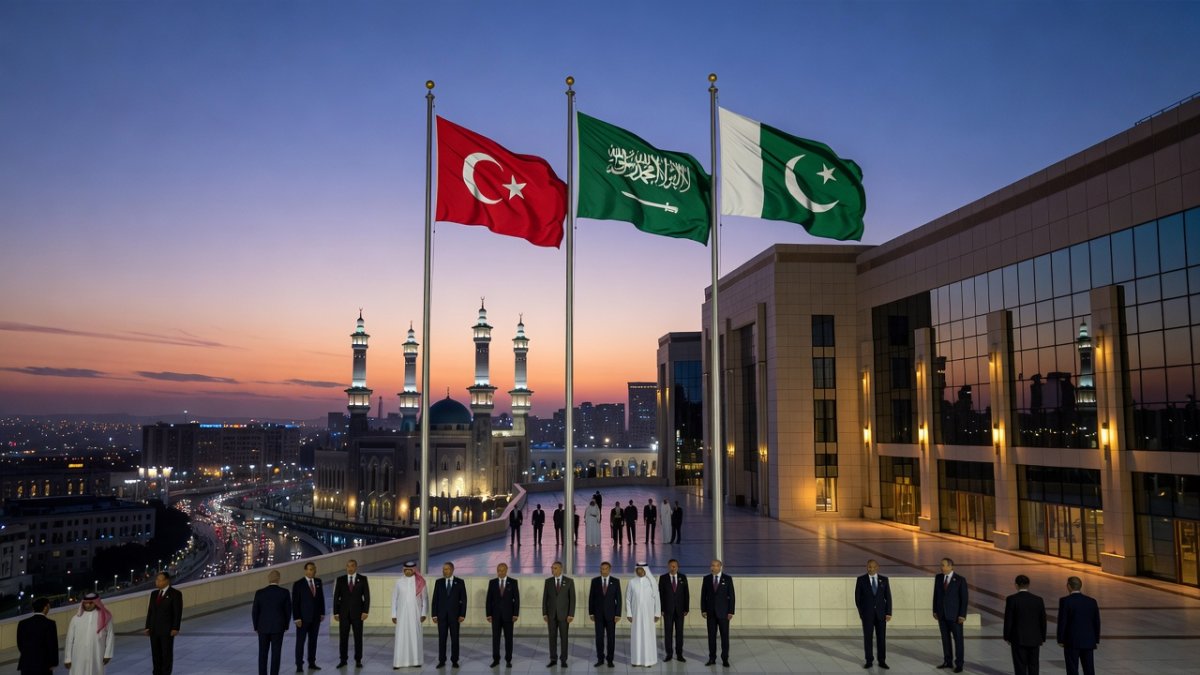
Folks, a new military alliance just locked arms in Mecca this week, and it is not playing small. Turkey, Saudi Arabia, and Pakistan have signed a binding collective-defense deal that treats an attack on one as an attack on all three. The timing, right in the middle of the Iran war and Hormuz shutdown, makes this far more than symbolic.
Mecca Pact Forms Islamic NATO Amid Iran War
Mecca, Saudi Arabia — Turkish President Recep Tayyip Erdogan, Saudi Crown Prince Mohammed bin Salman, and Pakistani Prime Minister Shehbaz Sharif signed the trilateral pact on Friday. The core clause states that any armed attack against one member shall be regarded as an attack against them all. The agreement, already nicknamed the Mecca Pact, is being described across multiple outlets as an emerging Islamic NATO.
The Pact in One Sentence
The document commits the three nations to automatic mutual defense, joint counterterrorism operations, and shared defense-industry projects while remaining open to additional friendly states.
Erdogan framed the deal around collective deterrence rather than targeting any single country, yet the timing leaves little doubt about the regional context driving the signatures.
The Economist captured the moment in its World in Brief, noting Erdogan, MBS and Shehbaz Sharif chatting after the signing with a Reuters photograph showing the three leaders in close conversation inside the holy city. That image alone signals how quickly the pact moved from concept to ink.
Analysts tracking the text say the openness clause is deliberate, allowing future members to join without renegotiating core terms. This flexibility could turn the agreement into a broader platform rather than a rigid three-way club.
Still, the automatic defense trigger remains the headline clause, and capitals across the region are already gaming out what counts as an armed attack in practice.
What Each Nation Brings
Turkey contributes NATO’s second-largest army and its expanding defense industry, including Baykar drones now moving into co-production inside Saudi Arabia. Saudi Arabia supplies capital, energy leverage, and the political weight of the holy city where the signing occurred. Pakistan adds a large standing military plus its status as the Muslim world’s only nuclear-armed state, a capability already linked to Riyadh through the 2025 bilateral pact.
These complementary strengths create a self-reinforcing bloc that analysts say reduces reliance on external powers for immediate security needs.
Pakistan’s nuclear status gives the pact a deterrence layer no other Muslim-majority grouping currently matches. Its army is one of the largest standing forces in the world, and its existing defense ties with China on platforms like the JF-17 and J-10 now sit alongside new Turkish and Saudi connections.
Saudi Arabia’s Vision 2030 target of localizing more than half its defense spending finds a ready partner in Turkey’s Baykar and SAMI. The kingdom’s oil revenues provide the cash flow to accelerate joint programs that smaller partners could not fund alone.
Turkey’s NATO-standard training pipelines and proven drone export record add operational depth. The combination lets the three capitals pool logistics, maintenance, and intelligence without waiting for Washington or European suppliers to approve every transfer.
The Iran War Backdrop
The pact arrives while the Strait of Hormuz remains effectively closed by Tehran since fighting began in late February. The United States and Israel continue operations against Iran, and President Trump has stated the conflict cannot drag on much longer while talks with Oman over new strait arrangements proceed without a full reopening.
France24 noted that Pakistan has not yet responded militarily to Iranian attacks on Saudi territory despite last year’s bilateral agreement, underscoring why the three capitals sought a stronger, trilateral framework.
ISW assessments outline Tehran’s war aims clearly: secure international recognition of control over Hormuz, degrade U.S. willingness to keep fighting, restore deterrence against Washington and its partners, and drive wedges between the United States, Israel, and Arab states. The Mecca Pact directly counters the last of those objectives.
Trump’s own comments that the strait is “sort of open” while admitting Iran still threatens vessels reveal the fragile status quo. Riyadh, Ankara, and Islamabad are positioning themselves to operate even if Hormuz stays contested for months.
The closed waterway has already spiked global energy prices and forced rerouting of tankers around Africa. That economic pressure gives the three signatories additional leverage in any future talks over maritime security.
Why Now: A New Axis Outside Washington
The New York Times reported that the idea gained traction this year as Middle East wars and instability pushed governments to explore security arrangements independent of the United States and Western powers. The joint statement emphasizes longstanding historical ties, Islamic solidarity, and shared strategic interests rather than any single external threat.
Erdogan’s public remarks that the pact targets no specific country and stays open to others signal an attempt to manage perceptions while still building concrete military and industrial cooperation.
The pact’s timing coincides with widening conflicts that have already drawn in multiple regional actors. Governments that once defaulted to U.S. security guarantees are now hedging by building parallel structures.
By signing in Mecca, the leaders wrapped the agreement in religious legitimacy that resonates across Muslim populations far beyond the three capitals. That symbolic choice amplifies the political weight of the military clauses.
Early reactions from other Gulf states show quiet interest rather than outright endorsement, suggesting the pact’s open-door policy will be tested soon.
The Drone Factor
Baykar’s deepening presence in Saudi Arabia includes the Akinci UCAV co-production deal signed with SAMI in late July, part of Riyadh’s broader push to localize defense manufacturing. These projects move beyond simple arms sales into joint development and technology transfer that could scale quickly across the three nations.
Turkey’s drone expertise, Saudi funding, and Pakistani production capacity together form an industrial triangle that existing Western suppliers cannot easily replicate or block.
The late-July Akinci agreement is already described as Turkey’s largest defense contract in history. It builds on the 2023 Baykar-SAMI deal and moves the partnership from licensed production toward genuine co-development of next-generation systems.
Pakistan’s industrial base offers lower-cost assembly and maintenance hubs that could extend the operational reach of these drones across the region. Joint training programs are expected to follow the hardware deals.
Baykar’s TB2 and Akinci platforms have already proven effective in multiple theaters. Scaling them inside this new alliance gives the three nations a rapid-reaction capability that does not depend on U.S. or European export licenses.
What It Means for the US
Washington now faces a regional security structure that can act without prior consultation or approval. The pact’s collective-defense clause and defense-industry focus reduce the leverage once provided by arms sales and security guarantees.
While the agreement does not explicitly exclude cooperation with the United States, its explicit goal of arrangements “without relying on the United States and Western powers” marks a structural shift in how these three capitals intend to manage future crises.
U.S. arms dominance in the Gulf is already narrowing as Riyadh turns to Turkish drones for capabilities once sourced exclusively from American suppliers. The Mecca Pact formalizes that diversification trend.
Even as the United States remains engaged against Iran, Gulf states are signaling they want fallback options if Washington’s commitments waver. This dual-track approach reduces U.S. veto power over regional military moves.
Analysts note that future U.S. arms packages may now face competition from Turkish-Saudi-Pakistani alternatives that come with fewer political strings attached.
How India and Israel See It
New Delhi is watching the deepening defense links between Pakistan, Turkey, and Saudi Arabia with clear concern. India’s Ministry of External Affairs issued a fake-news alert denying reports that it had sought its own defense pact with the trio, an unusual step that highlights the sensitivity.
Analysts in Foreign Policy describe the Mecca Pact as mutual defense in the face of aggressive Iranian and Israeli operations, a framing that leaves both Tel Aviv and New Delhi calculating how the new alignment alters their own risk assessments.
Indian strategists are particularly focused on implications for Kashmir, the nuclear balance, and the growing China-Pakistan-Turkey-Saudi technology linkages. Any expansion of the pact’s membership would intensify those concerns.
Israel views the agreement through the lens of its ongoing operations against Iran and the risk that coordinated responses from the three signatories could complicate targeting decisions. Tel Aviv is already adjusting contingency plans.
Both countries are quietly exploring whether quiet channels to individual pact members can still deliver influence even if the trilateral structure hardens.
Global Ripple Effects
The Mecca Pact’s ripple effects are already visible in energy markets and diplomatic backchannels. With Hormuz still contested, any coordinated move by the three capitals on maritime security or oil flows would immediately affect global prices and force new calculations in Beijing, Brussels, and Washington.
Analysts are split on whether the agreement evolves into a functional Islamic NATO or stays a high-profile umbrella with limited operational depth. The precedent of Pakistan’s restrained response to last year’s Iranian strikes on Saudi territory shows that paper commitments do not always translate into instant action.
Invitations to additional friendly states will test the pact’s real reach. How quickly those offers materialize and which capitals accept will determine whether this remains a trilateral core or expands into the wider security architecture its founders have described.
The Bottom Line
This is not a photo-op alliance. The combination of nuclear capability, NATO-standard forces, energy resources, and expanding drone production creates a bloc that can sustain operations even if external support wanes. The closed Hormuz strait and ongoing Iran conflict supply immediate urgency, yet the pact’s industrial and training provisions point to longer-term staying power.
Pay attention to which additional nations receive invitations next and how quickly the Baykar-SAMI production lines reach full output. Those two data points will reveal whether the Mecca Pact remains a trilateral arrangement or grows into the wider Islamic security architecture its founders envision.
By Jessica Ali, Staff Writer
This article was produced with AI-assisted research and editorial support. Reporting is based on sources cited in the article.
What's Your Reaction?
 Like
0
Like
0
 Dislike
0
Dislike
0
 Love
0
Love
0
 Funny
0
Funny
0
 Wow
0
Wow
0
 Sad
0
Sad
0
 Angry
0
Angry
0

Editor-in-Chief at Global1.News. Atlanta-based journalist who cuts through the BS and tells it like it is. Lead anchor, host, and the voice you hear when the spin stops and the truth starts.














Comments (0)