
Korea's PISA 2025 Reading Slide Tests Seoul's Literacy Push
South Korea's PISA 2025 reading score fell 14 points to 501, its lowest since 2000, even as Korean students stayed near the top in science and mathematics and ranked among the world's best in a new digital problem-solving assessment. The Ministry of Education is expanding reading schools, designating intensive reading years and pursuing a change in education law to rebuild literacy.
South Korea remains one of the world's strongest education systems by almost any measure, yet the OECD's PISA 2025 results, released on September 8, 2026, exposed a fault line that Seoul cannot easily dismiss. Korea scored 526 in science, 501 in reading and 522 in mathematics, all above OECD averages of 482, 461 and 463. The reading figure, however, is the country's lowest since PISA began in 2000, and it has triggered a policy response that will test whether Korea can rebuild sustained reading habits in a generation raised on short-form screens.
Korea's PISA 2025 Reading Slide Tests Seoul's Literacy Push
Seoul, South Korea - September 10, 2026 - The Ministry of Education has announced Intensive Reading Education Years, an expansion of the Reading School program from 1,000 to 3,000 schools, and a digital reading platform called Readingro, as it confronts a 14-point reading decline that OECD trend analysis identifies as statistically significant over the decade from 2015.
The Numbers: Korea's Sharpest PISA Reading Loss Since 2000
The scale of the PISA 2025 assessment was unprecedented: roughly 760,000 15-year-old students across 91 countries and economies, including all 38 OECD members, with science as the focal domain. South Korea's sample comprised 6,859 students from 196 schools. PISA scores are anchored on a scale originally set at 500 points, and because countries are sampled rather than tested exhaustively, rankings are published as ranges at a 95 percent confidence level, as the Korea Institute for Curriculum and Evaluation has explained.
Korea's reading trajectory tells the story plainly: 517 in 2015, 514 in 2018, 515 in 2022 and 501 in 2025. The OECD's trend analysis found a statistically significant 14-point downward trend in Korean reading across that decade, and Korean media report the 2025 result as the country's lowest since PISA began. Science moved in the opposite direction, with a statistically significant 12-point improvement over 2015-2025, while the estimated one-point change in mathematics was not statistically significant. Compared with PISA 2022, Korea fell 2 points in science, 14 in reading and 5 in mathematics.
The distributional picture is equally important. The share of Korean students at reading Level 5 or above fell from 13.3 percent to 10.3 percent, while the share at Level 1 or below rose from 14.7 percent to 17.8 percent. Korea's standard deviation in reading was 104 points, wider than systems with similar averages such as Ireland at 94, Estonia at 95 and Macau at 89. A Ministry of Education official said this indicates a larger gap between high- and low-performing students. Korean media further reported that the decline was more severe among male students.
A Northeast Asian Scoreboard: Science Strong, Reading Soft
Korea's position in the regional hierarchy has shifted in ways that Korean commentators find uncomfortable. Among OECD members, Korea ranked 1st-3rd in science, 1st-9th in reading and 1st-2nd in mathematics; among all 91 participants, 5th-7th in science and mathematics and 3rd-13th in reading. In PISA 2022, the OECD-member ranges were 2nd-5th in science, 1st-7th in reading and 1st-2nd in mathematics. The reading range has visibly widened.
The reading leaders in PISA 2025 were Singapore at 535, down from 543; China at 527, though only students in Beijing, Shanghai and the provinces of Jiangsu and Zhejiang took part; Taiwan at 508; Japan at 503; and then Korea at 501. Japan scored 504 in 2018, ten points below Korea's 514 that year, but has outpaced Korea since 2022. Korean commentary stresses that Korea now trails China, Taiwan and Japan in reading, a reversal that carries symbolic weight in a region where educational standing is closely watched.
East Asia was nonetheless the best-performing region. Chinese participating cities, Japan, Korea, Singapore and Taiwan had the strongest systems, with Britain and Estonia the only systems outside the region in the top 10 across reading, mathematics and science. The broader OECD picture is sobering: average reading scores fell 28 points between 2015 and 2025, equivalent to about one and a half years of learning, and mathematics fell 22 points, just over one year of learning. Among non-OECD participants, reading fell 16 points and mathematics 8 points over the same period. The OECD average reading score dropped from 476 in 2022 to 461 in 2025, with reading down about 14 points and mathematics 9 points across 35 OECD countries between 2022 and 2025, while science was broadly stable.

Screens, Short-Form Video and the Hasty Reader
At the launch press conference, OECD Secretary-General Mathias Cormann offered a diagnosis that has resonated in Seoul: "In reading, more screen time and less reading for pleasure have gone hand in hand with weaker results." He added: "We're also seeing more hasty reading, students rushing through a text and giving a quick wrong answer." The report found reading scores fell more sharply among students from better-off backgrounds, a pattern that complicates simple narratives about disadvantage.
Digital distraction was linked to lower science scores in 59 of 82 education systems studied, and more than one in four students said devices distract classmates in science lessons. Students reported spending an average of 3.4 hours per weekday on leisure screen time. Notably, the report stopped short of endorsing smartphone bans in schools, leaving systems to devise their own responses.
South Korea's Ministry of Education framed the decline as part of a broader international trend. "Reading scores have fallen not only in Korea but around the world," a ministry official said, adding that the digital media environment and this generation's motivation and attitudes toward reading may have combined to influence the results. The ministry cautioned against attributing the decline to any single cause. Park Hyun-jung, director of the Public Education Promotion Division at the Ministry of Education, said the result appeared to be driven by increased time spent on digital devices such as social media and decreased interest in reading.
Seoul's Answer: Intensive Reading Years and 3,000 Reading Schools
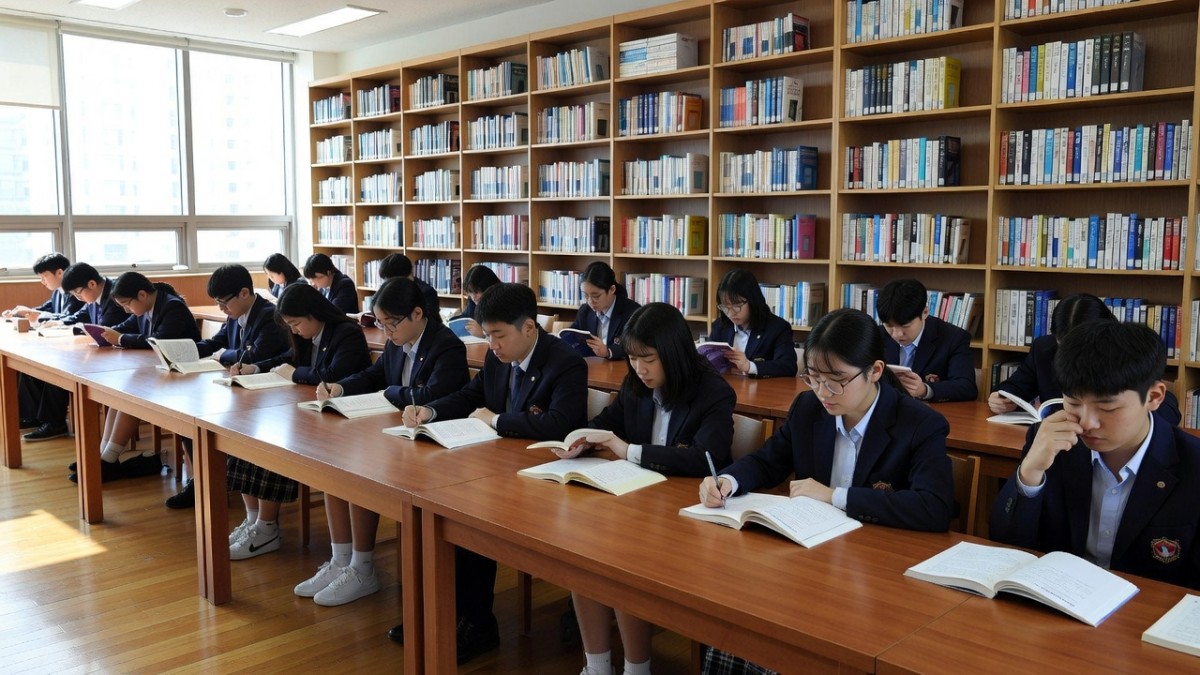
The ministry's response is structural rather than exhortatory. It plans to expand reading programs linked to classroom instruction and to promote question- and discussion-centred lessons. The Reading School program, which includes daily 10-minute group reading sessions, will expand from 1,000 schools this year to 3,000 schools next year.
Most consequential is the designation of "Intensive Reading Education Years" for third and fourth graders in elementary school, first-year middle school students and first-year high school students. The stated rationale is developmental: grades three and four mark the transition from "learning to read" to "reading to learn", first-year middle school requires reading connected to subject learning, and first-year high school demands in-depth reading spanning careers and subjects.
The ministry will select 1,000 reading-linked curriculum class models every year through 2030 and upload them by subject and achievement standard to the digital reading activity platform called Readingro for teachers to use. Reading activities recorded on Readingro are to be linked with the National Education Information System so they are automatically entered into the reading activity section of school records. From 2027, all students are to be able to borrow up to five e-books per month so reading can continue during vacations. The ministry says relevant laws and systems will be overhauled to support reading education, and it is pursuing an amendment to the Framework Act on Education that would recognise literacy improvement through reading as a responsibility of national and local governments. A reading-focused school-year program is planned for 2027.
The Equity Question: A Widening Gap at Home
Korea's reading standard deviation of 104 points is the statistical signature of a system pulling apart at the middle. The proficiency shift - fewer top performers, more low performers - suggests the decline is not concentrated at the bottom but is eating into the upper-middle band that has historically sustained Korea's reputation. A Seoul Metropolitan Office of Education survey found the share of Seoul high school students performing below the basic literacy level rose by 10 percentage points from 2025, a local signal that aligns with the national data.
The OECD's cross-national finding that advantaged students scored 85 points higher than disadvantaged students in science, with the gap narrowing between 2022 and 2025 largely because advantaged students performed less well rather than because disadvantaged students improved, offers a cautionary frame. Korea's own pattern, in which reading fell more sharply among better-off students, suggests that the mechanisms driving decline - screen saturation, diminished pleasure reading, hasty processing - cut across socioeconomic lines even as their consequences compound for weaker readers.
Cho Byeong-yeong, a professor at Hanyang University, has argued that literacy should be strengthened across subjects rather than only in Korean language classes: students should read relevant long texts, extract information and solve problems during lessons. That position aligns with the ministry's insistence that it will build reading into regular lessons rather than assigning more independent reading. Some observers nonetheless question whether simply adding reading activities can work, since many Korean students already face demanding schedules of classes, homework and private academies, or hagwons.
Why Literacy Is Now a Strategic Concern for Korea
Korea's economy depends on knowledge-intensive industries such as semiconductors and AI, and its school-age population is shrinking. Weaker literacy therefore has direct implications for human capital and productivity: a smaller cohort must carry a larger share of the innovation burden, and reading comprehension underpins the absorption of technical documentation, research literature and complex specifications. PISA measures readiness for adult life rather than syllabus coverage, which makes the reading decline a signal about the pipeline rather than a verdict on the curriculum alone.
The paradox at the heart of Korea's PISA 2025 profile sharpens the concern. In the new PISA domain, "Learning in the Digital World", which measured computational problem-solving, Korea scored 538 against an OECD average of 500, ranking 2nd-5th among OECD members and 6th-10th among all participants. Some 41.5 percent of Korean students reached Levels 5 or 6, against an OECD average of 26.1 percent, while 13.4 percent performed below Level 2. Korea is thus strong at computational problem-solving yet weak at sustained reading - a combination that is difficult to sustain in research, law, medicine or advanced engineering, where extracting meaning from long texts remains indispensable.
The policy backdrop adds texture. The previous conservative government announced an AI digital textbook plan in June 2023, with rollout from 2025 in mathematics, English, informatics and Korean for special education. Parliament later amended the Elementary and Secondary Education Act, revoking the status of "textbook" from the AI books and reclassifying them as supplementary materials, leaving the decision - and the funding - to individual school principals. As of March 2025, fewer than 30 percent of the country's 6,339 elementary schools were using the AI textbooks, concentrated in English and mathematics. The rollout was subsequently scaled back, with some subjects moved to 2027 rather than 2026, and Korean language and technology and home economics textbooks dropped from the conversion list. Educators and parents had raised concerns about student over-reliance on devices and declining literacy, while the ministry argued AI features would personalise learning and help close achievement gaps. In April 2026, falling literacy revived a public debate about reintroducing Chinese characters, or hanja, in Korean classrooms, with reports that Seoul would consider the idea - an ongoing debate, not a decided policy.
Looking Ahead: From PISA 2025 to the Implementation Test
The ministry's reading agenda is ambitious in scope but still in the design and early rollout stage. The Reading School expansion to 3,000 schools, the Intensive Reading Education Years, the 1,000 curriculum models per year through 2030, the Readingro platform and its link to the National Education Information System, and the 2027 e-book borrowing scheme together constitute a coherent architecture. Whether that architecture changes classroom practice at scale is a separate question, and one that will not be answered by the next PISA cycle alone.
Three tests loom. The first is curricular integration: whether reading activities embedded in mathematics, science and social studies lessons can survive the pressure of examination preparation. The second is equity: whether the widening spread in reading scores narrows, or whether the top-performer decline continues even as low-performer shares grow. The third is legislative: whether the Framework Act on Education amendment and the planned reading-focused school-year program of 2027 secure durable funding and cross-government commitment rather than remaining ministry-level initiatives.
Korea's history suggests that when the system identifies a measurable problem, it can mobilise. The AI textbook episode also suggests that technological remedies adopted quickly can be revised just as quickly when parents and educators object. The reading agenda is different in kind: it asks schools to protect time for a slow, cumulative activity in a media environment optimised for speed. The OECD's finding that one in five 15-year-olds across its members is now a low performer in science, mathematics and reading, up from 16 percent in 2022, indicates Korea is not alone. But Korea's ambition - and its demographic and economic stakes - mean its response will be watched closely across Northeast Asia and beyond. The next several years will reveal whether Intensive Reading Education Years become a genuine inflection point or another well-drafted plan overtaken by the screens they seek to counterbalance.
By Prof. David Park, Staff Writer
This article was produced with AI-assisted research and editorial support. Sources: KOREA NOW (Yonhap News Agency); OECD PISA 2025 Results (Volume I), September 8, 2026; South Korean Ministry of Education; Korea Herald; Chosun Ilbo; Seoul Economic Daily; Korea JoongAng Daily; UPI.
What's Your Reaction?
 Like
0
Like
0
 Dislike
0
Dislike
0
 Love
0
Love
0
 Funny
0
Funny
0
 Wow
0
Wow
0
 Sad
0
Sad
0
 Angry
0
Angry
0

East Asia/Technology Correspondent at Global1.News. Seoul-based voice covering Korean politics, technology, business, and culture. Analyzes how technology and geopolitics intersect across East Asia.















Comments (0)