
DeepSeek Just Released V4.1-Flash-1017, Scores 77.0 on DeepSWE, Opens Search API
DeepSeek just dropped its latest checkpoint, DeepSeek‑V4.1‑Flash‑1017, and the hype train is already chugging at full speed. The company touts a “Pareto improvement” – better scores, faster task completion and shorter outputs – and opens a Search and Fetch API for every developer.
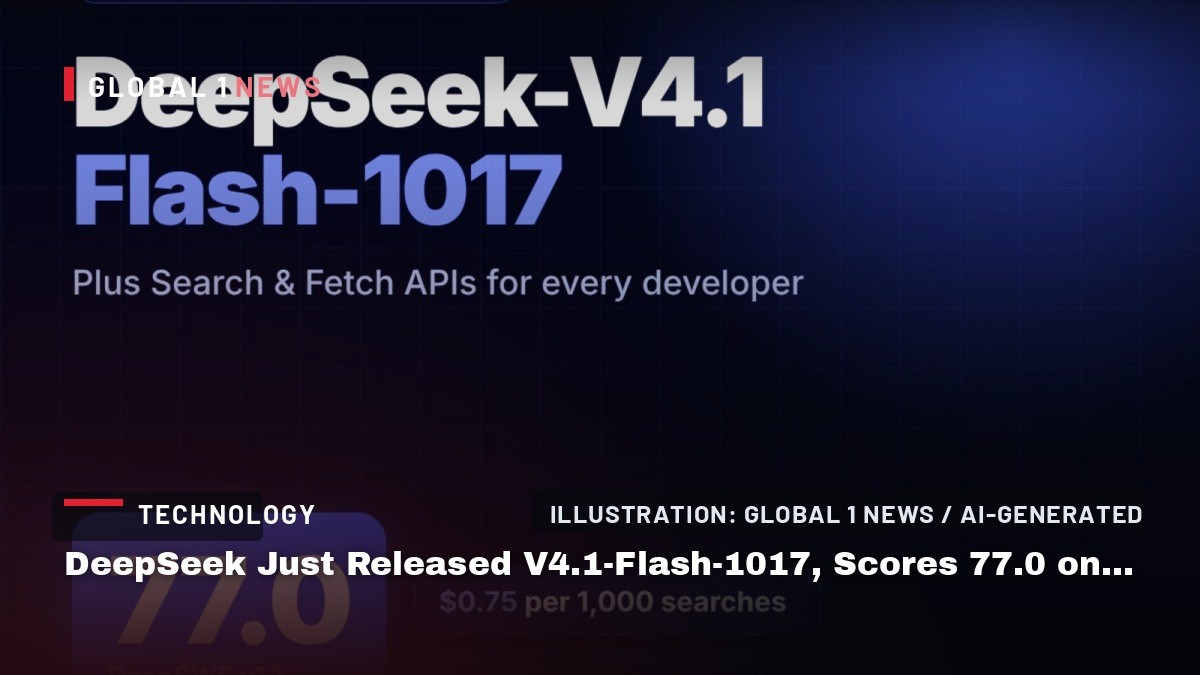
DeepSeek just dropped its latest checkpoint, DeepSeek‑V4.1‑Flash‑1017, and the hype train is already chugging at full speed. As someone who has been wiring up real‑world hosting gear for a decade, I’m less interested in press releases and more in what this actually means for the cost‑and‑performance calculus of running AI agents in production. The company touts a “Pareto improvement” – better scores, faster task completion and shorter outputs – and opens a Search and Fetch API for every developer. On paper it looks slick, but the devil is in the details that matter to independent hosting providers and founders trying to keep the lights on while building next‑gen services.
What the 1017 checkpoint actually delivers
DeepSeek‑V4.1‑Flash‑1017 is an updated post‑training checkpoint of the V4.1‑Flash model, served under the same “deepseek‑flash” name. The architecture is a multimodal Mixture‑of‑Experts with 40 Transformer layers, split evenly between a causal encoder and a decoder. The model activates 8 billion parameters per token during prefill and 16 billion during decode, with a 1 million token context window and up to 384 k output tokens. In terms of raw size, the backbone sits at 552 billion parameters plus an additional 196 billion Engram parameters – a massive scale that pushes the envelope for any on‑prem deployment.
Performance-wise, DeepSeek reports that the 1017 checkpoint beats its September V4.1‑Flash release across all eleven internal benchmarks, improving scores by 2.0 to 11.1 points. The headline number is a 77.0 on the DeepSWE v1.1 benchmark, nudging up from the previous 74.2. It also leads on Automation‑Bench (60.5), Agents’ Last Exam (35.4) and Apex Bench (72.1). Claude Opus 5 still outperforms on Terminal‑Bench 4.0, ProgramBench, NL2Repo and the HLE (no‑tools) test, where DeepSeek scores 42.6 versus Claude’s 56.3. Those gaps matter when you’re building agents that need reliable reasoning under tool constraints.
Pricing signals and the cost‑of‑ownership
DeepSeek’s pricing sheet is simple on the surface: $0.30 per 1 million cache‑miss input tokens and $1.20 per 1 million output tokens at peak rates, with off‑peak rates at half that. The Search and Fetch APIs each cost $0.75 per 1,000 successful calls, with empty or failed calls free. Rate limits sit at 5 QPS per account for each endpoint. For developers, the “free window” for server‑side calls via DeepSeek Harness, Claude Code or Codex runs until November 1, 2026 – a short‑term incentive that disappears once the calendar flips.
From a hosting perspective, those token prices translate directly into bandwidth and compute budgets. Multiply that by thousands of daily calls and you’re looking at a few hundred dollars a month – manageable for a startup, but the real expense lies in the underlying hardware to serve a 1 million token context window and the 16 billion‑parameter decode path. DeepSeek does not disclose hardware requirements for the 1017 weights, so you’re left guessing whether a single A100 can handle the load or if you need a cluster of GPUs just to keep latency in the sub‑second range.
The Search and Fetch layer – a double‑edged sword
Opening the Search and Fetch APIs to every developer is a strategic move. The Search endpoint returns ranked web results with optional page content, supporting operators like site:, lang:, after: and before:. Each result carries a rerank score (0‑3) and an authority tier (0‑4). The Fetch endpoint returns a single page as Markdown. Both are priced at $0.75 per 1,000 calls, with a 5 QPS limit.
For independent hosting providers, this creates a new revenue stream but also a new dependency. If you build a SaaS product that leans on DeepSeek’s web layer, you inherit their latency, availability and cost model. A spike in user queries can hit the 5 QPS cap per account, forcing you to shard keys or pay for higher tiers – a classic vendor lock‑in scenario. Moreover, the “hundreds of millions of requests daily” that DeepSeek claims to handle internally is impressive, but it also hints at a massive backend that could become a choke point if you rely on it for critical workflows.
Benchmark reality vs. production grind
The internal benchmark suite paints a rosy picture, but the numbers tell a nuanced story. DeepSeek’s DeepSWE lead (77.0) is a solid win over Claude Opus 5 (74.0), yet the margin is modest. More concerning is the HLE (no‑tools) score of 42.6, where Claude still dominates at 56.3. HLE reflects real‑world reasoning without external aids – the kind of scenario where many agents stumble. If your product depends on tool‑free reasoning, DeepSeek’s advantage evaporates.
Automation‑Bench (60.5) and Apex Bench (72.1) are higher‑level tasks that involve multi‑step planning and execution. DeepSeek’s lead there suggests the model’s reinforcement‑learning with self‑feedback loop is paying off for complex pipelines like game creation or 3D modeling demos. However, those same benchmarks are run on proprietary test sets; they don’t capture the variability of noisy user inputs, network jitter, or the cost of loading the 1 million token context in a live API call. In my own experience, the “shorter outputs” claim can backfire – truncated responses may miss critical steps, forcing extra round‑trips and inflating token usage.
Strategic implications for indie hosting firms
For a boutique hosting outfit, the key question is whether the performance uplift justifies the integration effort. DeepSeek’s model is MIT‑licensed on Hugging Face for the September weights, but the 1017 checkpoint’s license and weight distribution are not disclosed. That means you can’t simply pull the weights and run them on your own hardware without a separate agreement. You’re effectively forced into a SaaS consumption model, paying per‑token fees and abiding by rate limits.
The alternative is to stick with open‑weight rivals like Kimi K3 or GLM‑5.3, which have disclosed parameter counts (2.8 T and 753 B respectively) and are available under more permissive terms. Their DeepSWE scores sit in the high 60s, well below DeepSeek’s 77.0, but they might be cheaper to run on your own GPU farm if you have the expertise. The trade‑off is clear: higher raw performance for a pay‑as‑you‑go API versus lower performance but full control and potentially lower marginal cost.
Actionable steps for founders and engineers
First, benchmark the 1017 model against your current stack on a representative workload. Use DeepSeek’s public API to run a few dozen real queries and measure latency, token consumption and cost. Compare that to an in‑house run of a comparable open‑weight model on your existing GPU pool. Second, factor in the Search and Fetch API limits – if you anticipate more than 5 QPS per endpoint, plan for multiple API keys or negotiate a higher tier early. Third, watch the free‑window deadline of November 1, 2026; after that, any “free” calls will start incurring fees, so budget for the transition now.
Finally, consider a hybrid approach: keep the heavy‑lifting reasoning on DeepSeek for the high‑value, low‑frequency tasks where its 77.0 DeepSWE score matters, and fall back to an open‑weight model for bulk, low‑stakes processing. That way you capture the performance edge without surrendering total control or blowing up your cost base. In the end, the hype around Flash‑1017 is real, but the business risk lies in how you stitch it into your stack.
Bottom line – hype meets hard‑nosed hosting reality
DeepSeek’s V4.1‑Flash‑1017 is a technically impressive checkpoint that nudges the state‑of‑the‑art forward, especially on benchmarks that reward multi‑step planning. The added Search and Fetch APIs broaden the appeal for agent builders, but they also deepen the dependency on a single vendor’s pricing and rate‑limit regime. For independent hosting providers and founders, the decision boils down to three questions: Do you need the marginal performance gain on your core workloads? Can you absorb the per‑token cost and rate‑limit constraints? And do you have the bandwidth to integrate a proprietary model versus an open‑weight alternative?
If the answer is “yes” to the first two, the 1017 checkpoint could be a worthwhile addition – just be ready to monitor usage closely and have a fallback plan when the free window closes. If not, stick with the open‑weight options and keep your infrastructure under your own roof. That’s the pragmatic path in a market awash with VC‑fueled hype and hyperscaler pricing tricks.
— Allan Ali, Founder
This article was produced with AI-assisted research and editorial support. Reporting is based on the source material cited below. Sources: MarkTechPost; marktechpost.com; Global1.News (18 October 2026).
By Allan Ali, Global1.News
What's Your Reaction?
 Like
0
Like
0
 Dislike
0
Dislike
0
 Love
0
Love
0
 Funny
0
Funny
0
 Wow
0
Wow
0
 Sad
0
Sad
0
 Angry
0
Angry
0

Publisher of Global1.News. Automation architect, systems builder, and the guy making sure the truth gets published.














Comments (0)