
Japan Confirms Dispatch to India to Explore Anti-Ship Missile Drills
On 27 October 2026, GSDF Chief of Staff General Arai Masayoshi confirmed that Japan has dispatched personnel to India to explore the feasibility of live‑fire drills involving both surface‑to‑ship missiles and small attack drones.
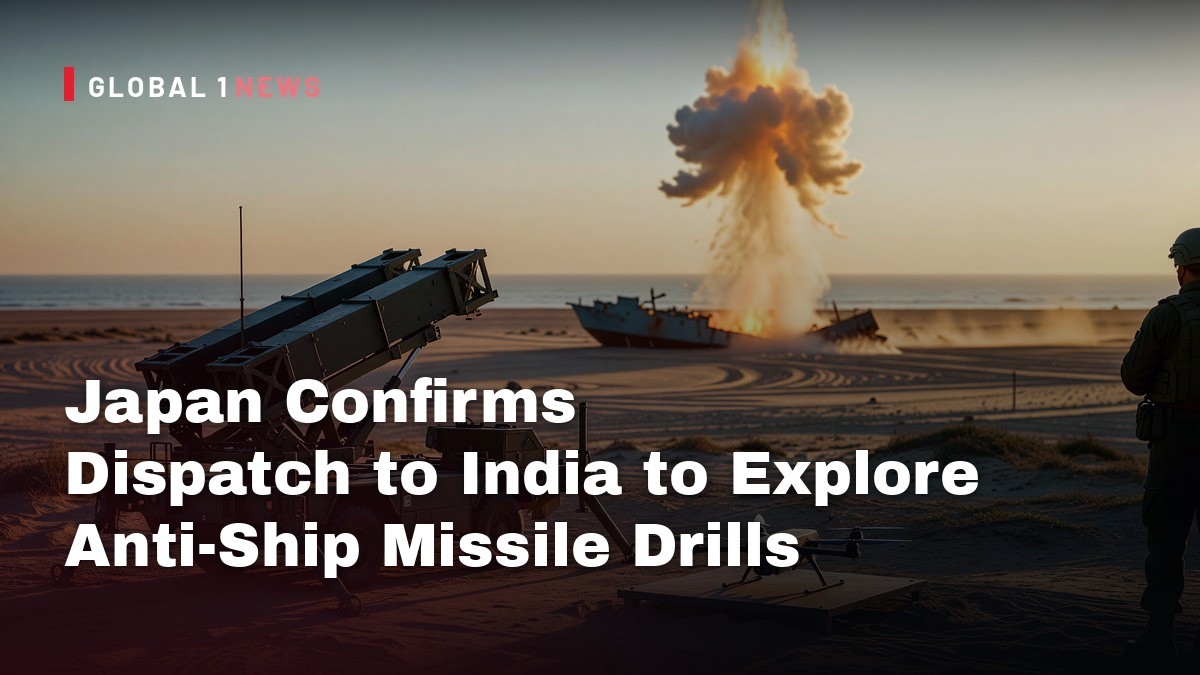
In the wake of Japan’s accelerated acquisition of long‑range surface‑to‑ship missiles, senior officials of the Ground Self‑Defense Force (GSDF) have turned to diplomatic channels to resolve a pressing operational dilemma: how to train crews for weapons whose reach extends far beyond Japan’s territorial waters. On 27 October 2026, GSDF Chief of Staff General Arai Masayoshi confirmed that Japan has dispatched personnel to India to explore the feasibility of live‑fire drills involving both surface‑to‑ship missiles and small attack drones. This development underscores a broader trend in Japanese defense policy, wherein the logistics of training have become inseparable from the geopolitics of the Indo‑Pacific.
Strategic Context of Japan’s Stand‑Off Capabilities
Japan’s recent fielding of the Type 25 surface‑to‑ship guided missile marks a decisive shift in its maritime deterrence posture. Deployed to Camp Kengun in Kumamoto Prefecture in March 2026, the Type 25 boasts an estimated range of roughly 1,000 kilometres—far exceeding the circa 200 kilometres reach of its predecessor, the Type 12. This leap in capability reflects a strategic calculus that seeks to deter potential adversaries across the broader Pacific theatre.
General Arai articulated the core training challenge: “When operating relatively long‑range missiles…how to conduct training that makes use of their range is a major challenge.” The necessity of realistic, long‑distance drills is compounded by the need to integrate emerging platforms such as small attack drones, whose operational parameters—radio frequencies, safety protocols, and suitable terrain—remain under active consideration.
Domestic Training Constraints and the Search for Overseas Sites
Japan’s domestic geography imposes strict limits on live‑fire exercises for weapons with a 1,000‑kilometre envelope. Conducting such drills would require coordination with multiple local governments, maritime authorities, and air‑space regulators to ensure safety across vast sea lanes and air corridors. The GSDF’s recent demonstration of the Type 25 during Keen Sword 27—a joint Japan‑U.S. exercise held from 19 to 29 October 2026 across Nagasaki and Saga prefectures—illustrated procedural proficiency but did not involve an actual missile launch, highlighting the gap between tabletop rehearsals and full‑scale firing.
Consequently, the GSDF is evaluating both domestic venues and overseas alternatives. Earlier in October 2026, Defense Ministry officials visited India for roughly a week, inspecting test facilities and firing ranges. This exploratory mission aligns with Japan’s broader pattern of leveraging allied territories for training, as seen in prior exercises in the United States, Australia, and the Philippines.
India as a Prospective Training Partner
India’s emergence as a potential host for Japanese missile drills reflects a convergence of strategic interests. General Arai emphasized India’s importance in the Indo‑Pacific, noting the “increasingly severe and complex security environment.” While the discussions remain exploratory, they signal a willingness to deepen bilateral defense cooperation beyond the existing Quad framework that also includes the United States and Australia.
The timing of the Indian visit coincides with Japan’s broader outreach to secure overseas training sites. During the Philippine‑U.S. Balikatan exercise in April‑May 2026, the GSDF conducted its first surface‑to‑ship missile firing in the Philippines, deploying the Type 88. That experience demonstrated Japan’s capacity to coordinate live‑fire events in allied territories, setting a precedent for potential future engagements with New Delhi.
Operational Considerations for Missile and Drone Training
General Arai outlined several technical and safety issues that must be addressed before any live‑fire exercise can proceed. For missile drills, the GSDF must secure ranges that can accommodate flight paths extending up to 1,000 kilometres, ensuring clear airspace and maritime corridors. For small attack drones, challenges include managing radio‑frequency interference, defining appropriate training content, and establishing robust safety management protocols.
The GSDF is contemplating whether overseas training should precede domestic exercises or occur concurrently. The decision will hinge on the availability of suitable ranges, the capacity of host nations to meet safety standards, and the diplomatic implications of conducting high‑profile drills in foreign jurisdictions.
Implications for Japan‑India Defense Relations
Should Japan and India agree on a joint training framework, the arrangement would add a practical layer to an already robust bilateral relationship. Both nations have a history of joint military exercises and share concerns over China’s maritime assertiveness. By hosting Japanese missile drills, India could enhance its own defense credibility and signal deeper alignment with Japan’s security objectives.
Moreover, the prospect of integrating small attack drones into bilateral training could foster technological exchange and doctrinal harmonization. Such cooperation would complement existing Quad activities, providing a bilateral conduit for capability development that does not require a multilateral consensus.
Diplomatic Dimensions of Training Site Selection
The selection of overseas training sites has become a diplomatic exercise as much as a logistical one. Conducting live‑fire drills in a foreign nation necessitates coordination with that nation’s ministries of defence, interior, and possibly foreign affairs, as well as with local civilian authorities. In Japan’s case, the Ministry of Defence (MoD) must align its training calendar with the host nation’s operational constraints, while also managing domestic political sensitivities about overseas deployments.
India’s willingness to entertain such discussions reflects its own strategic calculus. By offering training facilities, New Delhi can deepen its security partnership with Japan, diversify its own training options, and reinforce its role as a central actor in the Indo‑Pacific security architecture.
Future Outlook for Japanese Long‑Range Missile Training
As Japan continues to field stand‑off weapons like the Type 25, the imperative to develop realistic training regimes will intensify. The current exploratory talks with India represent an early step in a broader search for viable overseas ranges that can accommodate the operational envelope of next‑generation missiles.
In the medium term, the GSDF is likely to pursue a phased approach: initial domestic drills to master system handling, followed by limited overseas live‑fire events to validate long‑range performance. The outcome of the Indian negotiations will therefore shape not only bilateral defense ties but also the overall trajectory of Japan’s missile training doctrine, influencing how the nation balances domestic safety considerations with the strategic necessity of credible deterrence.
This article was produced with AI-assisted research and editorial support. Reporting is based on the source material cited below. Sources: The Diplomat; thediplomat.com; Global1.News (30 October 2026).
By Prof. David Park, Staff Writer
What's Your Reaction?
 Like
0
 Dislike
0
 Love
0
 Funny
0
 Wow
0
 Sad
0
 Angry
0

East Asia/Technology Correspondent at Global1.News. Seoul-based voice covering Korean politics, technology, business, and culture. Analyzes how technology and geopolitics intersect across East Asia.












Comments (0)